


Wydawcy
Katalog tematyczny
- Archeologia (109)
- Ekonomia, finanse, business (13704)
- Filozofia (1445)
- Historia (3040)
- Języki i językoznawstwo (2356)
- Lifestyle, hobby i rozrywka (475)
- Medycyna (9704)
- Nauki humanistyczne (4)
- Nauki o Ziemi i środowisku (2638)
- Nauki ścisłe (20412)
- Astronomia (294)
- Biologia (5119)
- Chemia (6540)
- Chemia analityczna (361)
- Chemia fizyczna (346)
- Chemia nieorganiczna (137)
- Chemia organiczna (535)
- Krystalografia (27)
- Minerologia (46)
- Fizyka (3309)
- Matematyka (4574)
- Nauki ścisłe, ogólnie (503)
- Nauki społeczne (8486)
- Nauki techniczne (13450)
- Prawo (1696)
- Publikacje informacyjne i interdyscyplinarne (1288)
- Religia i wierzenia (917)
- Technika komputerowa (4067)
- Zdrowie, relacje międzyludzkie i rozwój osobisty (657)





Informacje szczegółowe o książce
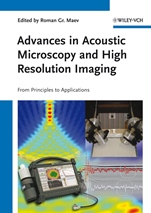
Advances in Acoustic Microscopy and High Resolution Imaging: From Principles to Applications
ISBN 9783527410569
Autor: Roman Gr. Maev
Wydawca: Wiley
Dostępność: 3-6 tygodni
Cena: 827,40 zł
Przed złożeniem zamówienia prosimy o kontakt mailowy celem potwierdzenia ceny.
ISBN13: |
9783527410569 |
ISBN10: |
3527410562 |
Autor: |
Roman Gr. Maev |
Oprawa: |
Hardback |
Rok Wydania: |
2013-03-20 |
Ilość stron: |
400 |
Wymiary: |
243x180 |
Tematy: |
PN |
Novel physical solutions, including new results in the field of adaptive methods and inventive approaches to inverse problems, original concepts based on high harmonic imaging algorithms, intriguing vibro-acoustic imaging and vibro-modulation technique, etc. were successfully introduced and verified in numerous studies of industrial materials and biomaterials in the last few years. Together with the above mentioned traditional academic and practical avenues in ultrasonic imaging research, intriguing scientific discussions have recently surfaced and will hopefully continue to bear fruits in the future. The goal of this book is to provide an overview of the recent advances in high-resolution ultrasonic imaging techniques and their applications to biomaterials evaluation and industrial materials. The result is a unique collection of papers presenting novel results and techniques that were developed by leading research groups worldwide.
This book offers a number of new results from well-known authors who are engaged in aspects of the development of novel physical principles, new methods, or implementation of modern technological solutions into current imaging devices and new applications of high-resolution imaging systems. The ultimate purpose of this book is to encourage more research and development in the field to realize the great potential of high resolution acoustic imaging and its various industrial and biomedical applications.
List of Contributors XIII
Introduction XVII
Author Biographies XIX
Part One Fundamentals 1
1 From Multiwave Imaging to Elasticity Imaging 3
Mathias Fink and Mickael Tanter
1.1 Introduction 3
1.2 Regimes of Spatial Resolution 3
1.3 The Multiwave Approach 4
1.4 Wave to Wave Generation 5
1.5 Wave to Wave Tagging 7
1.6 Wave to Wave Imaging: Mapping Elasticity 8
1.7 Super-resolution in Supersonic Shear Wave Imaging 14
1.8 Clinical Applications 16
1.9 Conclusion 19
References 21
2 Imaging via Speckle Interferometry and Nonlinear Methods 23
Jeffrey Sadler and Roman Gr. Maev
2.1 General Introduction 23
2.2 Part I: Speckle Interferometry 24
2.2.1 Introduction 24
2.2.2 Labeyrie’s Method 25
2.2.3 Knox–Thompson Method 29
2.2.4 Importance of Phase Difference Calculation 32
2.2.5 Labeyrie and Knox–Thompson in Two Dimensions 33
2.2.6 Other Improvements to Speckle Interferometry 34
2.3 Part II: Nonlinear Imaging 34
2.3.1 Introduction 34
2.3.2 Deviation (Difference Squared), or Absolute Difference 36
2.3.3 Fourier Transform-Based Methodology 36
2.3.4 Fourier Methodology: How to Create an Image 38
2.3.5 Fourier Transform: Problems with Using 39
2.3.6 Hilbert Transform-Based Methodology 39
2.3.7 Hilbert Methodology: How to Create an Image, and 3D Image 42
2.4 Summary and Closing 44
Selected References (By Subject) 45
Speckle: Base Methods 45
Speckle: More Advanced Methods 45
Nonlinear Imaging 45
Part Two Novel Developments in Advanced Imaging Techniques and Methods 47
3 Fundamentals and Applications of a Quantitative Ultrasonic Microscope for Soft Biological Tissues 49
Kazuto Kobayashi and Naohiro Hozumi
3.1 General Introduction: Basic Idea of an Ultrasonic Microscope for Biological Tissues 49
3.2 Sound Speed Profi le 50
3.2.1 Fundamentals 50
3.2.2 Specimen to be Observed 50
3.2.3 Experimental Setup and Acquired Signal 51
3.2.4 Calculation of Sound Speed 52
3.2.4.1 Frequency Domain Analysis 52
3.2.4.2 Time–Frequency Domain Analysis 54
3.2.5 Two-Dimensional Sound Speed Profi les 56
3.2.6 Attempts at Better Spatial Resolution 58
3.3 Acoustic Impedance Profi le 60
3.3.1 Fundamentals 60
3.3.2 Experimental Setup 61
3.3.3 Specimen to be Observed 62
3.3.4 Acquired Signal 63
3.3.5 Calibration for Characteristic Acoustic Impedance 63
3.3.6 Observation of Cerebellar Cortex of a Rat 65
3.3.7 Cell Size Observation 67
3.3.8 Commercialized Equipment 69
3.4 Summary 70
References 70
4 Portable Ultrasonic Imaging Devices 71
Sergey A. Titov, Roman Gr. Maev, and Fedar M. Severin
References 91
5 High-Frequency Ultrasonic Systems for High-Resolution Ranging and Imaging 93
Michael Vogt and Helmut Ermert
5.1 General Introduction 93
5.2 High-Frequency Ultrasonic System Components 94
5.2.1 Ultrasound Echo Systems 94
5.2.2 Transmitter and Receiver Components for High-Frequency Ultrasonic Echo Systems 95
5.2.3 Spectral and Range Resolution Properties 97
5.2.4 Measurement and Optimization of the Pulse Transfer Properties 99
5.2.5 Range Resolution Optimization: Inverse Echo Signal Filtering 101
5.2.6 Measurement of Acoustic Scattering Parameters in Plane Wave Propagation 102
5.3 Engineering Concepts for High-Frequency Ultrasonic Imaging 104
5.3.1 Single-Element Transducer B-Scan Techniques 104
5.3.2 Lateral Resolution Optimization 105
5.3.2.1 B/D-Scan Technique 106
5.3.2.2 Synthetic Aperture Focusing Techniques (SAFT) 106
5.3.3 Limited Angle Spatial Compounding (LASC) 110
5.3.4 Multidirectional Tissue Characterization 112
5.4 High-Frequency Ultrasound Imaging in Biomedical Applications 115
5.4.1 Skin Imaging 115
5.4.2 Imaging of Small Animals 117
5.5 Summary 118
References 119
6 Quantitative Acoustic Microscopy Based on the Array Approach 125
Sergey Titov and Roman Gr. Maev
6.1 General Introduction 125
6.2 Measurement of Velocity and Attenuation of Leaky Waves 126
6.3 Measurement of Bulk Wave Velocities and Thickness of Specimen 141
6.4 Conclusions 150
References 150
Part Three Advanced Biomedical Applications 153
7 Study of the Contrast Mechanism in an Acoustic Image for Thickly Sectioned Melanoma Skin Tissues with Acoustic Microscopy 155
Bernhard R. Tittmann, Chiaki Miyasaka, Elena Maeva, and David Shum
7.1 Introduction 155
7.1.1 What Is Melanoma? 155
7.1.2 How Is Melanoma Diagnosed? 156
7.1.3 Present Problems for Biopsy 157
7.1.4 Objective of Present Study 157
7.2 Physical and Mathematical Modeling for Five Layer Wave Propagation in an Acoustic Microscope 158
7.3 Sample Preparation 162
7.4 Digital Imaging – Optical and Ultrasonic 163
7.4.1 Optical Image 163
7.4.2 Acoustic Imaging Principle (Pulse-Wave Mode) 164
7.4.3 Resolution 168
7.4.4 Acoustic Images 169
7.4.5 Waveform Analysis 171
7.5 High Frequency Acoustic Microscopy 174
7.5.1 Normal Control Skin Tissue 174
7.5.2 Abnormal Skin Tissue 175
7.5.3 Acoustic Velocity 175
7.5.4 Computer Simulation 177
7.5.4.1 Experimental V(z) Curve 177
7.5.4.2 Theoretical V(z) Curve (Simulation of V(z) Curve) 178
7.6 Conclusions 181
Acknowledgment 183
References 183
8 New Concept of Pathology – Mechanical Properties Provided by Acoustic Microscopy 187
Yoshifumi Saijo
8.1 Introduction 187
8.2 Principle of Acoustic Microscopy 188
8.3 Application to Cellular Imaging 189
8.4 Application to Hard Tissues 191
8.5 Application to Soft Tissues 193
8.5.1 Gastric Cancer 193
8.5.2 Myocardial Infarction 195
8.5.3 Kidney 197
8.5.4 Atherosclerosis 197
8.6 Ultrasound Speed Microscopy (USM) 200
8.7 Articular Tissues 202
8.8 Summary 202
References 204
9 Quantitative Scanning Acoustic Microscopy of Bone 207
Pascal Laugier, Amena Saïed, Mathilde Granke, and Kay Raum
9.1 Introduction 207
9.1.1 Hierarchical Structure of Bone and Properties 207
9.1.2 Relevance of Multiscale Elastic Properties 209
9.1.3 History of Measurement Principles 210
9.2 Quantitative SAM-Based Impedance of Bone 213
9.2.1 Theory 213
9.2.2 Time-Resolved Measurements 216
9.2.3 Measurements with Time-Gated Amplitude Detection 217
9.2.3.1 Calibration 218
9.3 Tissue Mineralization, Acoustic Impedance, and Stiffness 219
9.4 Elastic Anisotropy at the Nanoscale (Lamellar) Level 222
9.5 Elastic Anisotropy at the Microscale (Tissue) Level 223
9.6 Applications in Musculoskeletal Research 225
9.7 Conclusions 226
References 228
Part Four Advanced Materials Applications 231
10 Array Imaging and Defect Characterization Using Post-processing Approaches 233
Alexander Velichko, Paul D. Wilcox, and Bruce W. Drinkwater
10.1 Introduction 233
10.2 Modeling Array Data 237
10.2.1 Introduction 237
10.2.2 Ray-Based Description of Ultrasonic Array Data 238
10.2.2.1 Determining the Ray-Paths 238
10.2.2.2 Predicting the Signal Associated with a Ray-Path 240
10.2.2.3 Simple Example 240
10.2.3 Mathematical Model of Ultrasonic Array Data 242
10.3 Imaging with 1D Arrays 245
10.3.1 Classical Beam-Forming Imaging Methods in Post-processing 245
10.3.2 Total Focusing Method 246
10.3.3 Wavenumber Method 247
10.3.4 Back-Propagation Method 249
10.3.5 Theoretical Comparison of Imaging Methods 250
10.3.6 Computational Burden 251
10.3.7 Focusing Performance 252
10.3.8 Experimental Example 253
10.4 Imaging with 2D Arrays 255
10.4.1 Optimization of 2D Array Layout 255
10.4.1.1 Optimization Criterion 255
10.4.1.2 Regular Sampling 256
10.4.1.3 Non-uniform Sampling 257
10.4.2 Experimental Comparison of 2D Array Layouts 258
10.4.2.1 Spherical Inclusion 259
10.4.2.2 Aluminum Block with Flat Bottom Holes 260
10.4.2.3 Surface-Breaking Fatigue Crack 260
10.5 Scattering Matrices and Their Experimental Extraction 260
10.5.1 Feature Extraction from Array Data 262
10.5.1.1 Concept 262
10.5.1.2 Inverse Imaging 263
10.5.1.3 Extraction of Scattering Matrix 266
10.6 Defect Characterization and Sizing 267
10.6.1 Crack Sizing 267
10.6.1.1 1D Array 267
10.6.1.2 2D Array 268
10.6.2 Experimental Results 269
10.6.2.1 1D Array 269
10.6.2.2 2D Array 271
10.7 Conclusions 272
References 273
11 Ultrasonic Force and Related Microscopies 277
Andrew Briggs and Oleg V. Kolosov
11.1 Introduction 277
11.2 Mechanical Diode Detection 279
11.3 Experimental UFM Implementation 280
11.4 UFM Contrast Theory 283
11.5 Quantitative Measurements of Contact Stiffness 287
11.6 UFM Picture Gallery 289
11.7 Image Interpretation – Effects of Adhesion and Topography 293
11.8 Superlubricity 295
11.9 Defects Below the Surface 297
11.10 Time-Resolved Nanoscale Phenomena 299
Acknowledgments 303
References 304
12 Ultrasonic Atomic Force Microscopy 307
Kazushi Yamanaka and Toshihiro Tsuji
12.1 Introduction 307
12.2 Principle 307
12.2.1 Forced Vibration of Cantilever from the Base 307
12.2.2 Quantitative Information, Directional Control, and Resonance Frequency Tracking 308
12.2.3 Effective Enhancement of Cantilever Stiffness 309
12.2.4 Criterion to Avoid Plastic Deformation 309
12.3 Theory 311
12.3.1 Overview 311
12.3.2 Linear Analysis of Stiffness and the Q Factor 312
12.3.3 Linear Theory of Subsurface Imaging 314
12.3.4 Advantage of Appropriate Load 316
12.3.5 Nonlinear Analysis of Spectra 316
12.3.6 Duffing Model 318
12.3.7 Numerical Model with Double Nodes 319
12.4 Instrumentation 320
12.5 Experiments 322
12.5.1 Effort to Avoid Nonlinearity at Tip–Sample Contact 322
12.5.2 Relation between UAFM and UFM 323
12.5.3 Quantitative Evaluation of Elasticity 324
12.6 Observation of Defects in Layered Materials 325
12.6.1 Defects in Graphene Sheets 325
12.6.2 Dislocation in Molybdenum Disulfide 328
12.6.3 Observation of Dislocation Behavior under Different Loads 329
12.6.4 Analysis of Dislocation Motion under Varying Applied Load 331
12.6.5 Model for the Reversible Long-Range Motion of Dislocation 333
12.6.6 Delamination in Microelectronic and Mechanical Devices 334
12.7 Conclusion 335
References 336
13 Acoustical Near-Field Imaging 339
Walter Arnold
13.1 Principle of Near-Field Imaging 339
13.1.1 Early Systems of Acoustical Near-Field Imaging 339
13.2 Near-Field Acoustical Imaging and Atomic Force Microscopy 342
13.2.1 Force Modulation 343
13.2.2 Local Acceleration Microscopy 344
13.2.3 Pulsed-Force Microscopy 345
13.2.4 Atomic Force Acoustic Microscopy or AFM Contact-Resonance Imaging 345
13.2.4.1 Principle of Operation 345
13.2.4.2 Flexural Cantilever Resonances 346
13.2.4.3 Relationship of Contact Stiffness to Indentation Modulus 350
13.2.4.4 Torsional Resonances 356
13.2.4.5 Piezo-mode Imaging 357
13.2.4.6 Nonlinear Contact Resonances and Related Phenomena 358
13.2.4.7 Subsurface Imaging Using Contact Resonances 359
Acknowledgment 362
References 362
Index 371
Koszyk
Książek w koszyku: 0 szt.
Wartość zakupów: 0,00 zł
Informacje


Kontakt
Gambit
Centrum Oprogramowania
i Szkoleń Sp. z o.o.
Al. Pokoju 29b/22-24
31-564 Kraków
Siedziba Księgarni
ul. Kordylewskiego 1
31-542 Kraków
+48 12 410 5991
+48 12 410 5987
+48 12 410 5989
Subskrypcje
Administratorem danych osobowych jest firma Gambit COiS Sp. z o.o. Na podany adres będzie wysyłany wyłącznie biuletyn informacyjny.
Autoryzacja płatności

Informacje na temat autoryzacji płatności poprzez PayU.

© Copyright 2012: GAMBIT COiS Sp. z o.o. Wszelkie prawa zastrzeżone.
Projekt i wykonanie: Alchemia Studio Reklamy