


Wydawcy
Katalog tematyczny
- Archeologia (109)
- Ekonomia, finanse, business (13704)
- Filozofia (1445)
- Historia (3040)
- Języki i językoznawstwo (2356)
- Lifestyle, hobby i rozrywka (475)
- Medycyna (9704)
- Nauki humanistyczne (4)
- Nauki o Ziemi i środowisku (2638)
- Nauki ścisłe (20412)
- Astronomia (294)
- Biologia (5119)
- Chemia (6540)
- Fizyka (3309)
- Elektryczność i magnetyzm (90)
- Fizyka atomowa i molekularna (110)
- Fizyka cząstek elementarnych (36)
- Fizyka jądra atomowego (36)
- Fizyka kwantowa (210)
- Fizyka matematyczna (121)
- Fizyka relatywistyczna (36)
- Fizyka statystyczna (51)
- Fizyka stosowana (498)
- Mechanika klasyczna (186)
- Optyka i światło (133)
- Stany materii (202)
- Matematyka (4574)
- Nauki ścisłe, ogólnie (503)
- Nauki społeczne (8486)
- Nauki techniczne (13450)
- Prawo (1696)
- Publikacje informacyjne i interdyscyplinarne (1288)
- Religia i wierzenia (917)
- Technika komputerowa (4067)
- Zdrowie, relacje międzyludzkie i rozwój osobisty (657)





Informacje szczegółowe o książce
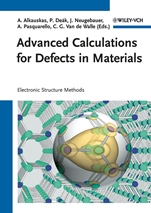
Advanced Calculations for Defects in Materials: Electronic Structure Methods
ISBN 9783527410248
Autor: Audrius Alkauskas, Peter Deák, Jörg Neugebauer, Alfredo Pasquarello, Chris G. Van de Walle
Wydawca: Wiley
Dostępność: 3-6 tygodni
Cena: 729,75 zł
Przed złożeniem zamówienia prosimy o kontakt mailowy celem potwierdzenia ceny.
ISBN13: |
9783527410248 |
ISBN10: |
3527410244 |
Autor: |
Audrius Alkauskas, Peter Deák, Jörg Neugebauer, Alfredo Pasquarello, Chris G. Van de Walle |
Oprawa: |
Hardback |
Rok Wydania: |
2011-04-20 |
Ilość stron: |
402 |
Wymiary: |
247x178 |
Tematy: |
PH |
Defects and impurities are critically influencing the properties of materials. Increase in computing power and the development of efficient algorithms indicate a promising future for computational defect science. This book surveys recent advances in electronic structure methods. The application of hybrid functionals, the LDA+U method, time–dependent DFT, quantum Monte Carlo, and many–body perturbation theory are described and assessed. Methods to treat large systems and temperature effects, as well as finite size effects in modeling are also reviewed. The book provides an introduction for novices and a guidance for practitioners in theoretical and computational defect physics.
The editor, all authorities in this field, have selected respected scientists as chapter authors to provide and expert view of the latest advances. The result is a clear overview of the connections and boundaries between methods, as well as the broad criteria determining the choice between them for a given problem.
From the contents:Advances in Electronic Structure Methods for Defects and Impurities in SolidsAccuracy of Quantum Monte Carlo Methods for Point Defects in SolidsElectronic Properties of Interfaces and Defects from Many–Body Perturbation Theory: Recent Developments and ApplicationsAccelerating GW Calculations with Optimal Polarizability BasisCalculation of Semiconductor Band Structures and Defects by the Screened Exchange Density FunctionalAccurate Treatment of Solids with the HSE Screened HybridDefect Levels Through Hybrid Density Functionals: Insights and ApplicationsAccurate Gap Levels and their Role in the Reliability of Other Calculated Defect PropertiesLDA+U and Hybrid Functional Calculations for Defects in ZnO, SnO2 and TiO2Critical Evaluation of the LDA+U Approach for Band Gap Corrections in Point Defect Calculations: The Oxygen Vacancy in ZnO – a Case StudyPredicting Polaronic Defect State
s by Means of Generalized Koopmans Density Functional CalculationsSiO2 in Density Functional Theory and BeyondOvercoming Bipolar Doping Difficulty in Wide Gap SemiconductorsElectrostatic Interactions between Charged Defects in SupercellsFormation Energies of Point Defects at Finite TemperaturesAccuracy Kohn–Sham DFT with the Speed of Tight Binding: Current Techniques and Future Directions in Materials ModellingAb Initio Green’s Function Calculation of Hyperfine Interactions for Shallow Defects in SemiconductorsTime–Dependent Density Functional Study of the Excitation Spectrum of Point–Defects in SemiconductorsWhich Electronic Structure Method for the Study of Defects: A Commentary
Spis treści:
List of Contributors.
1 Advances in Electronic Structure Methods for Defects and Impurities in Solids (Chris G. Van de Walle and Anderson Janotti).
1.1 Introduction.
1.2 Formalism and Computational Approach.
1.3 The DFT–LDA/GGA Band–Gap Problem and Possible Approaches to Overcome It.
1.4 Summary.
2 Accuracy of Quantum Monte Carlo Methods for Point Defects in Solids (William D. Parker, John W. Wilkins, and Richard G. Hennig).
2.1 Introduction.
2.2 Quantum Monte Carlo Method.
2.3 Review of Previous DMC Defect Calculations.
2.4 Results.
2.5 Conclusion.
3 Electronic Properties of Interfaces and Defects from Many–body Perturbation Theory: Recent Developments and Applications (Matteo Giantomassi, Martin Stankovski, Riad Shaltaf, Myrta Grüning, Fabien Bruneval, Patrick Rinke, and Gian–Marco Rignanese).
3.1 Introduction.
3.2 Many–Body Perturbation Theory.
3.3 Practical Implementation of GW and Recent Developments Beyond.
3.4 QP Corrections to the BOs at Interfaces.
3.5 QP Corrections for Defects.
3.6 Conclusions and Prospects.
4 Accelerating GW Calcu
lations with Optimal Polarizability Basis (Paolo Umari, Xiaofeng Qian, Nicola Marzari, Geoffrey Stenuit, Luigi Giacomazzi, and Stefano Baroni).
4.1 Introduction.
4.2 The GW Approximation.
4.3 The Method: Optimal Polarizability Basis.
4.4 Implementation and Validation.
4.5 Example: Point Defects in a–Si3N4.
4.6 Conclusions.
5 Calculation of Semiconductor Band Structures and Defects by the Screened Exchange Density Functional (S. J. Clark and John Robertson).
5.1 Introduction.
5.2 Screened Exchange Functional.
5.3 Bulk Band Structures and Defects.
5.4 Summary.
6 Accurate Treatment of Solids with the HSE Screened Hybrid (Thomas M. Henderson, Joachim Paier, and Gustavo E. Scuseria).
6.1 Introduction and Basics of Density Functional Theory.
6.2 Band Gaps.
6.3 Screened Exchange.
6.4 Applications.
6.5 Conclusions.
7 Defect Levels Through Hybrid Density Functionals: Insights and Applications (Audrius Alkauskas, Peter Broqvist, and Alfredo Pasquarello).
7.1 Introduction.
7.2 Computational Toolbox.
7.3 General Results from Hybrid Functional Calculations.
7.4 Hybrid Functionals with Empirically Adjusted Parameters.
7.5 Representative Case Studies.
7.6 Conclusion.
8 Accurate Gap Levels and Their Role in the Reliability of Other Calculated Defect Properties (Peter Deák, Adam Gali, Bálint Aradi, and Thomas Frauenheim).
8.1 Introduction.
8.2 Empirical Correction Schemes for the KS Levels.
8.3 The Role of the Gap Level Positions in the Relative Energies of Various Defect Configurations.
8.4 Correction of the Total Energy Based on the Corrected Gap Level Positions.
8.5 Accurate Gap Levels and Total Energy Differences by Screened Hybrid Functionals.
8.6 Summary.
9 LDA + U and Hybrid Functional Calculations for Defects in ZnO, SnO2, and TiO2 (Anderson Janotti and C
hris G. Van de Walle).
9.1 Introduction.
9.2 Methods.
9.3 Summary.
10 Critical Evaluation of the LDA + U Approach for Band Gap Corrections in Point Defect Calculations: The Oxygen Vacancy in ZnO Case Study (Adisak Boonchun and Walter R. L. Lambrecht).
10.1 Introduction.
10.2 LDA + U Basics.
10.3 LDA + U Band Structures Compared to GW.
10.4 Improved LDA + U Model.
10.5 Finite Size Corrections.
10.6 The Alignment Issue.
10.7 Results for New LDA + U.
10.8 Comparison with Other Results.
10.9 Discussion of Experimental Results.
10.10 Conclusions.
11 Predicting Polaronic Defect States by Means of Generalized Koopmans Density Functional Calculations (Stephan Lany).
11.1 Introduction.
11.2 The Generalized Koopmans Condition.
11.3 Adjusting the Koopmans Condition using Parameterized On–Site Functionals.
11.4 Koopmans Behavior in Hybrid–functionals: The Nitrogen Acceptor in ZnO.
11.5 The Balance Between Localization and Delocalization.
11.6 Conclusions.
12 SiO2 in Density Functional Theory and Beyond (L. Martin–Samos, G. Bussi, A. Ruini, E. Molinari, and M.J. Caldas).
12.1 Introduction.
12.2 The Band Gap Problem.
12.3 Which Gap?
12.4 Deep Defect States.
12.5 Conclusions.
13 Overcoming Bipolar Doping Difficulty in Wide Gap Semiconductors (Su–Huai Wei and Yanfa Yan).
13.1 Introduction.
13.2 Method of Calculation.
13.3 Symmetry and Occupation of Defect Levels.
13.4 Origins of Doping Difficulty and the Doping Limit Rule.
13.5 Approaches to Overcome the Doping Limit.
13.6 Summary.
14 Electrostatic Interactions between Charged Defects in Supercells (Christoph Freysoldt, Jörg Neugebauer, and Chris G. Van de Walle).
14.1 Introduction.
14.2 Electrostatics in Real Materials.
14.3 Practical Examples.
14.4 Conclusions.
15 Formation Ene
rgies of Point Defects at Finite Temperatures (Blazej Grabowski, Tilmann Hickel, and Jörg Neugebauer).
15.1 Introduction.
15.2 Methodology.
15.3 Results: Electronic, Quasiharmonic, and Anharmonic Excitations in Vacancy Properties.
15.4 Conclusions.
16 Accurate Kohn–Sham DFT With the Speed of Tight Binding: Current Techniques and Future Directions in Materials Modelling (Patrick R. Briddon and Mark J. Rayson).
16.1 Introduction.
16.2 The AIMPRO Kohn–Sham Kernel: Methods and Implementation.
16.3 Functionality.
16.4 Filter Diagonalisation with Localisation Constraints.
16.5 Future Research Directions and Perspectives.
16.6 Conclusions.
17 Ab Initio Green.s Function Calculation of Hyperfine Interactions for Shallow Defects in Semiconductors (Uwe Gerstmann).
17.1 Introduction.
17.2 From DFT to Hyperfine Interactions.
17.3 Modeling Defect Structures.
17.4 Shallow Defects: Effective Mass Approximation (EMA) and Beyond.
17.5 Phosphorus Donors in Highly Strained Silicon.
17.6 n–Type Doping of SiC with Phosphorus.
17.7 Conclusions.
18 Time–Dependent Density Functional Study on the Excitation Spectrum of Point Defects in Semiconductors (Adam Gali).
18.1 Introduction.
18.2 Method.
18.3 Results and Discussion.
18.4 Summary.
19 Which Electronic Structure Method for The Study of Defects: A Commentary (Walter R. L. Lambrecht).
19.1 Introduction: A Historic Perspective.
19.2 Themes of the Workshop.
19.3 Conclusions.
References.
Index.
Nota biograficzna:
Chris G. Van de Walle is Professor at the Materials Department of the University of California in Santa Barbara. Before that he worked at IBM Yorktown Heights, at the Philips Laboratories in New York, as Adjunct Professor at Columbia University, and at the Xerox Palo Alto Research Center. Dr. Van de Walle has published
over 200 articles and holds 18 U.S. patents. In 2002, he was awarded the David Adler Award by the APS. Dr. Van de Walle′s research focuses on computational physics, defects and impurities in solids, novel electronic materials and device simulations.
Jorg Neugebauer is the Director of the Computational Materials Design Department at the Max–Planck–Institute for Iron Research in Dusseldorf, Germany. Since 2003 he has been the Chair of Theoretical Physics at the University of Paderborn.Before that, he held positions as Honorary Professor and Director of the advanced study group ′Modeling′ at the Interdisciplinary Center for Advanced Materials Simulation (ICAMS) at the Ruhr University in Bochum, Germany. His research interests cover surface and defect physics, ab initio scale–bridging computer simulations, ab initio based thermodynamics and kinetics, and the theoretical study of epitaxy, solidification, and microstructures.
Alfredo Pasquarello is Professor of Theoretical Condensed Matter Physics and Chair of Atomic Scale Simulation at EPFL, Switzerland. His research activities focus on the study of atomic–scale phenomena with the aim to provide a realistic description of the mechanisms occurring on the atomic and nanometer scale. Specific research projects concern the study of disordered materials and oxide–semiconductor interfaces, which currently find applications in glass manufacturing and in the microelectronic technology, respectively.
Peter Deak was Professor and Head of the Surface Physics Laboratory at the Budapest University of Technology & Economics and is currently Group Leader at the Center for Computational Materials Science in Bremen, Germany. His research interests cover materials science and the technology of electronic and electric devices, functional coatings and plasma discharges, and atomic scale simulation of electronic materials. Peter Deak has published over 150
papers, eight book chapters, and six textbooks.
Audrius Alkauskas holds a position at the Electron Spectrometry and Microscopy Laboratory of the EPFL, Switzerland. His scientific interests cover computational material science, theoretical solid state spectroscopy and surface and interface science with respect to applications in renewable energy, photovoltaics, energy conversion, and molecular nanotechnology.
Okładka tylna:
Defects and impurities are critically influencing the properties of materials. Increase in computing power and the development of efficient algorithms indicate a promising future for computational defect science. This book surveys recent advances in electronic structure methods. The application of hybrid functionals, the LDA+U method, time–dependent DFT, quantum Monte Carlo, and many–body perturbation theory are described and assessed. Methods to treat large systems and temperature effects, as well as finite size effects in modeling are also reviewed. The book provides an introduction for novices and a guidance for practitioners in theoretical and computational defect physics.
The editor, all authorities in this field, have selected respected scientists as chapter authors to provide and expert view of the latest advances. The result is a clear overview of the connections and boundaries between methods, as well as the broad criteria determining the choice between them for a given problem.
From the contents:Advances in Electronic Structure Methods for Defects and Impurities in SolidsAccuracy of Quantum Monte Carlo Methods for Point Defects in SolidsElectronic Properties of Interfaces and Defects from Many–Body Perturbation Theory: Recent Developments and ApplicationsAccelerating GW Calculations with Optimal Polarizability BasisCalculation of Semiconductor Band Structures and Defects by the Screened Exchange Density FunctionalAccurate Treatment of Solids with
the HSE Screened HybridDefect Levels Through Hybrid Density Functionals: Insights and ApplicationsAccurate Gap Levels and their Role in the Reliability of Other Calculated Defect PropertiesLDA+U and Hybrid Functional Calculations for Defects in ZnO, SnO2 and TiO2Critical Evaluation of the LDA+U Approach for Band Gap Corrections in Point Defect Calculations: The Oxygen Vacancy in ZnO – a Case StudyPredicting Polaronic Defect States by Means of Generalized Koopmans Density Functional CalculationsSiO2 in Density Functional Theory and BeyondOvercoming Bipolar Doping Difficulty in Wide Gap SemiconductorsElectrostatic Interactions between Charged Defects in SupercellsFormation Energies of Point Defects at Finite TemperaturesAccuracy Kohn–Sham DFT with the Speed of Tight Binding: Current Techniques and Future Directions in Materials ModellingAb Initio Green’s Function Calculation of Hyperfine Interactions for Shallow Defects in SemiconductorsTime–Dependent Density Functional Study of the Excitation Spectrum of Point–Defects in SemiconductorsWhich Electronic Structure Method for the Study of Defects: A Commentary
Koszyk
Książek w koszyku: 0 szt.
Wartość zakupów: 0,00 zł
Informacje


Kontakt
Gambit
Centrum Oprogramowania
i Szkoleń Sp. z o.o.
Al. Pokoju 29b/22-24
31-564 Kraków
Siedziba Księgarni
ul. Kordylewskiego 1
31-542 Kraków
+48 12 410 5991
+48 12 410 5987
+48 12 410 5989
Subskrypcje
Administratorem danych osobowych jest firma Gambit COiS Sp. z o.o. Na podany adres będzie wysyłany wyłącznie biuletyn informacyjny.
Autoryzacja płatności

Informacje na temat autoryzacji płatności poprzez PayU.

© Copyright 2012: GAMBIT COiS Sp. z o.o. Wszelkie prawa zastrzeżone.
Projekt i wykonanie: Alchemia Studio Reklamy