


Wydawcy
Katalog tematyczny
- Archeologia (109)
- Ekonomia, finanse, business (13704)
- Filozofia (1445)
- Historia (3040)
- Języki i językoznawstwo (2356)
- Lifestyle, hobby i rozrywka (475)
- Medycyna (9704)
- Nauki humanistyczne (4)
- Nauki o Ziemi i środowisku (2638)
- Nauki ścisłe (20412)
- Astronomia (294)
- Biologia (5119)
- Chemia (6540)
- Fizyka (3309)
- Elektryczność i magnetyzm (90)
- Fizyka atomowa i molekularna (110)
- Fizyka cząstek elementarnych (36)
- Fizyka jądra atomowego (36)
- Fizyka kwantowa (210)
- Fizyka matematyczna (121)
- Fizyka relatywistyczna (36)
- Fizyka statystyczna (51)
- Fizyka stosowana (498)
- Mechanika klasyczna (186)
- Optyka i światło (133)
- Stany materii (202)
- Matematyka (4574)
- Nauki ścisłe, ogólnie (503)
- Nauki społeczne (8486)
- Nauki techniczne (13450)
- Prawo (1696)
- Publikacje informacyjne i interdyscyplinarne (1288)
- Religia i wierzenia (917)
- Technika komputerowa (4067)
- Zdrowie, relacje międzyludzkie i rozwój osobisty (657)







Informacje szczegółowe o książce
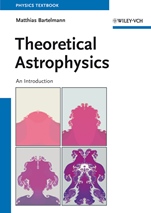
Theoretical Astrophysics: An Introduction
ISBN 9783527410040
Autor: Matthias Bartelmann
Wydawca: Wiley
Dostępność: 3-6 tygodni
Cena: 511,35 zł
Przed złożeniem zamówienia prosimy o kontakt mailowy celem potwierdzenia ceny.
ISBN13: |
9783527410040 |
ISBN10: |
352741004X |
Autor: |
Matthias Bartelmann |
Oprawa: |
Paperback |
Rok Wydania: |
2012-12-19 |
Ilość stron: |
340 |
Wymiary: |
241x170 |
Tematy: |
PH |
Beginning from first principles and adopting a modular structure, this book develops the fundamental physical methods needed to describe and understand a wide range of seemingly very diverse astrophysical phenomena and processes. For example, the discussion of radiation processes including their spectra is based on Larmor′s equation and extended by the photon picture and the internal dynamics of radiating quantum systems, leading to the shapes of spectral lines and the ideas of radiation transport. Hydrodynamics begins with the concept of phase–space distribution functions and Boltzmann′s equation and develops ideal, viscous and magneto–hydrodynamics all from the vanishing divergence of an energy–momentum tensor, opening a natural extension towards relativistic hydrodynamics. Linear stability analysis is introduced and used as a common and versatile tool throughout the book. Aimed at students at graduate level, lecturers teaching courses in theoretical astrophysics or advanced topics in modern astronomy, this book with its abundant examples and exercises also serves as a reference and an entry point for more advanced researchers wanting to update their knowledge of the physical processes that govern the behavior and evolution of astronomical objects.
Preface XI Acknowledgements XV Colour Plates XVII 1 Theoretical Foundations 1 1.1 Units 1 1.1.1 Lengths, Masses, Times, and Temperatures 1 1.1.2 Charges and Electromagnetic Fields 1 1.1.3 Natural Constants 2 1.2 Lorentz Invariance 2 1.2.1 The Special Lorentz Transform 4 1.2.2 Minkowski Space 6 1.2.3 Some Properties of the Minkowski World 9 1.2.4 Relativistic Dynamics 12 1.3 Electromagnetism 16 1.3.1 Field Tensor and Sources 16 1.3.2 Lorentz Transform of the Electromagnetic Field 18 1.3.3 Maxwell’s Equations 19 1.3.4 Energy–Momentum Conservation 21 1.3.5 Liénard–Wiechert Potentials and the Larmor Formula 22 1.3.6 The Lorentz Force 26 1.4 Elementary Kinetic Theory 28 1.4.1 The BBGKY Hierarchy and the Boltzmann Equation 28 1.4.2 Collision Terms 31 1.4.3 Diffusion in Phase–Space: The Fokker–Planck Approximation 31 1.4.4 Diffusion in Absolute Momentum 34 1.4.5 Calculation of the Diffusion Coefficient D2 35 Further Reading 37 2 Radiation Processes 39 2.1 Thomson Scattering 39 2.2 Spectra 45 2.3 Synchrotron Radiation 50 2.3.1 Larmor Frequency and Relativistic Focussing 51 2.3.2 Synchrotron Power 53 2.3.3 Synchrotron Spectrum 53 2.4 Bremsstrahlung 58 2.4.1 Orbit of an Electron Scattering off an Ion 58 2.4.2 Fourier Transform of the Orbit 61 2.4.3 Integration over Impact Parameters 62 2.4.4 Average over Electron Velocities, Thermal Bremsstrahlung 63 2.5 Radiation Damping 65 2.5.1 Damping Force 65 2.5.2 Transfer of Energy from a Moving Charge to a Radiation Field 69 2.6 Compton Scattering 72 2.6.1 Energy Change in the Scattering Process 72 2.6.2 Net Energy Transfer 74 2.6.3 The Kompaneets Equation 77 2.7 Radiative Quantum Transitions 83 2.7.1 Transition Probability 83 2.7.2 Perturbing Hamiltonian 84 2.7.3 Decomposition of the Electromagnetic Field 87 2.7.4 Dipole Approximation 88 2.7.5 Cross Sections 90 2.7.6 Photoionisation Cross Section 92 2.8 Shapes of Spectral Lines 94 2.8.1 Natural Line Width 95 2.8.2 Collisional Broadening 97 2.8.3 Doppler Broadening of Spectral Lines 98 2.8.4 The Voigt Profile 99 2.8.5 EquivalentWidths and Curves–of–Growth 100 2.9 Radiation Quantities 103 2.9.1 Specific Intensity 104 2.9.2 Moments of the Intensity 105 2.9.3 Relativistic Invariance of Iω/ω3 107 2.10 The Planck Spectrum and Einstein Coefficients 109 2.10.1 The Planck Spectrum 110 2.10.2 Transition Balance and the Einstein Coefficients 115 2.11 Absorption and Emission 117 2.11.1 Absorption Coefficients and Emissivity 117 2.11.2 Radiation Transport in a Simple Case 119 2.11.3 Emission and Absorption in the Continuum Case 121 2.11.4 Energy Transport Through Absorbing Media 124 Further Reading 126 3 Hydrodynamics 127 3.1 The Equations of Ideal Hydrodynamics 127 3.1.1 Particle–Current Density and Energy–Momentum Tensor 127 3.1.2 Collisional Invariants and the Fluid Approximation 130 3.1.3 The Equations of Ideal Hydrodynamics 134 3.2 Relativistic Hydrodynamics 139 3.2.1 Hydrodynamic Equations 139 3.2.2 Hydrodynamics in a Weak Gravitational Field 142 3.2.3 Gravitational Field Equation 143 3.2.4 The Combined Set of Equations 144 3.2.5 Perturbative Analysis 145 3.3 Viscous Hydrodynamics 148 3.3.1 Diffusion of Particles, Momentum and Internal Energy 148 3.3.2 The Equations of Viscous Hydrodynamics 152 3.3.3 Entropy 154 3.3.4 Fluids in a Gravitational Field 155 3.3.5 The Tensor Virial Theorem 157 3.3.6 Transformation to Cylindrical or Spherical Coordinates 160 3.4 Flows under Specific Circumstances 162 3.4.1 Sound Waves 163 3.4.2 Polytropic Equation of State 164 3.4.3 Hydrostatic Equilibrium 167 3.4.4 Vorticity and Kelvin’s Circulation Theorem 170 3.4.5 Bernoulli’s Constant 172 3.4.6 Bondi Accretion 175 3.4.7 Bernoulli’s Law for Irrotational, Non–Stationary Flows 178 3.4.8 Diffusion of Vorticity 179 3.4.9 The Reynolds Number 179 3.4.10 Hagen–Poiseulle Flow 180 3.5 Shock Waves 183 3.5.1 The Method of Characteristics 183 3.5.2 Steepening of Sound Waves 186 3.5.3 The Rankine–Hugoniot Shock Jump Conditions 187 3.5.4 Shock Velocity 191 3.5.5 The Sedov Solution 192 3.6 Instabilities 195 3.6.1 Gravity Waves 197 3.6.2 The Rayleigh–Taylor Instability 198 3.6.3 The Kelvin–Helmholtz Instability 199 3.6.4 Thermal Instability 202 3.6.5 Heat Conduction 206 3.6.6 Convection 209 3.6.7 Turbulence 210 Further Reading 213 4 Fundamentals of Plasma Physics and Magneto–Hydrodynamics 215 4.1 Collision–Less Plasmas 215 4.1.1 Shielding and the Debye Length 215 4.1.2 The Plasma Frequency 219 4.2 ElectromagneticWaves in Media 219 4.2.1 Polarisation and Dielectric Displacement 220 4.2.2 Structure of the Dielectric Tensor 222 4.3 Dispersion Relations 225 4.3.1 General Form of the Dispersion Relations 225 4.3.2 Transversal and LongitudinalWaves 227 4.3.3 Longitudinal and Transversal Dielectricities 227 4.3.4 Landau Damping 230 4.4 ElectromagneticWaves in Thermal Plasmas 232 4.4.1 Longitudinal and Transversal Dielectricities 233 4.4.2 Dispersion Measure and Damping 236 4.5 The Magneto–Hydrodynamic Equations 238 4.5.1 Assumptions 238 4.5.2 The Induction Equation 240 4.5.3 Euler’s Equation 241 4.5.4 Energy and Entropy 243 4.5.5 Incompressible Flows 245 4.5.6 Magnetic Advection and Diffusion 245 4.6 Generation of Magnetic Fields 246 4.7 Ambipolar Diffusion 249 4.7.1 Velocity–Averaged Scattering Cross Section 250 4.7.2 Friction Force and Diffusion Coefficient 252 4.8 Waves in Magnetised Cold Plasmas 254 4.8.1 The Dielectric Tensor 254 4.8.2 Contribution by Ions 257 4.8.3 Dispersion Relations in a Cold, Magnetised Plasma 259 4.8.4 Longitudinal and Transverse Waves 261 4.8.5 Faraday Rotation 263 4.9 HydromagneticWaves 266 4.9.1 Linearised Perturbation Equations 266 4.9.2 Alfvén Waves 269 4.9.3 Slow and Fast Hydro–Magnetic Waves 270 Further Reading 272 5 Stellar Dynamics 273 5.1 The Jeans Equations and Jeans’ Theorem 273 5.1.1 Collision–Less Motion in a Gravitational Field 273 5.1.2 The Relaxation Time Scale 275 5.1.3 The Jeans Equations 277 5.1.4 Jeans Equations in Cylindrical and Spherical Coordinates 280 5.1.5 Application to Spherical Systems 281 5.1.6 The Tensor Virial Theorem in Stellar Dynamics 286 5.1.7 Jeans’ Theorem 288 5.2 Equilibrium and Stability 290 5.2.1 The Isothermal Sphere 290 5.2.2 Equilibrium and Relaxation 294 5.2.3 Linear Analysis and the Jeans Swindle 295 5.2.4 Jeans Length and Jeans Mass 297 5.2.5 Disk Potentials 298 5.2.6 Fluid Equations for Two–Dimensional Systems 301 5.2.7 Dispersion Relation 302 5.2.8 Toomre’s Criterion 304 5.3 Dynamical Friction 305 5.3.1 Deflection of Point Masses 306 5.3.2 Velocity Changes 308 5.3.3 Chandrasekhar’s Formula 308 Further Reading 312 6 Brief Summary and Concluding Remarks 313 Index 315
Matthias Bartelmann is professor of theoretical astrophysics at the University of Heidelberg, Germany. He studied physics and astronomy at the University of Munich and obtained his Ph.D. in 1992, for which he received the Otto Hahn Medal of the Max Planck Society. He was a post–doc at the Max Planck Institute for Astrophysics in Garching and at the Harvard–Smithsonian Center for Astrophysics. He received the Ludwig Biermann Prize of the German Astronomical Society in 1996 and became a lecturer in astronomy at the University of Munich in 1998. Between 1998 and 2003, he built up and led the German scientific contribution to the Planck satellite mission. Dr. Bartelmann′s research interests are centered on structure formation in the Universe, in particular the study of dark–matter distributions by means of gravitational lensing and probes of non–linear evolution, the problem of dark energy and the physics of the cosmic microwave background.
Koszyk
Książek w koszyku: 0 szt.
Wartość zakupów: 0,00 zł
Informacje


Kontakt
Gambit
Centrum Oprogramowania
i Szkoleń Sp. z o.o.
Al. Pokoju 29b/22-24
31-564 Kraków
Siedziba Księgarni
ul. Kordylewskiego 1
31-542 Kraków
+48 12 410 5991
+48 12 410 5987
+48 12 410 5989
Subskrypcje
Administratorem danych osobowych jest firma Gambit COiS Sp. z o.o. Na podany adres będzie wysyłany wyłącznie biuletyn informacyjny.
Autoryzacja płatności

Informacje na temat autoryzacji płatności poprzez PayU.

© Copyright 2012: GAMBIT COiS Sp. z o.o. Wszelkie prawa zastrzeżone.
Projekt i wykonanie: Alchemia Studio Reklamy