


Wydawcy
Katalog tematyczny
- Archeologia (109)
- Ekonomia, finanse, business (13704)
- Filozofia (1445)
- Historia (3040)
- Języki i językoznawstwo (2356)
- Lifestyle, hobby i rozrywka (475)
- Medycyna (9704)
- Nauki humanistyczne (4)
- Nauki o Ziemi i środowisku (2638)
- Nauki ścisłe (20412)
- Astronomia (294)
- Biologia (5119)
- Chemia (6540)
- Fizyka (3309)
- Elektryczność i magnetyzm (90)
- Fizyka atomowa i molekularna (110)
- Fizyka cząstek elementarnych (36)
- Fizyka jądra atomowego (36)
- Fizyka kwantowa (210)
- Fizyka matematyczna (121)
- Fizyka relatywistyczna (36)
- Fizyka statystyczna (51)
- Fizyka stosowana (498)
- Mechanika klasyczna (186)
- Optyka i światło (133)
- Stany materii (202)
- Matematyka (4574)
- Nauki ścisłe, ogólnie (503)
- Nauki społeczne (8486)
- Nauki techniczne (13450)
- Prawo (1696)
- Publikacje informacyjne i interdyscyplinarne (1288)
- Religia i wierzenia (917)
- Technika komputerowa (4067)
- Zdrowie, relacje międzyludzkie i rozwój osobisty (657)





Informacje szczegółowe o książce
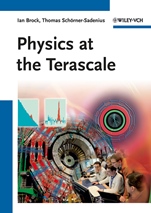
Physics at the Terascale
ISBN 9783527410019
Autor: Ian Brock, Thomas Schörner–Sadenius
Wydawca: Wiley
Dostępność: 3-6 tygodni
Cena: 811,65 zł
Przed złożeniem zamówienia prosimy o kontakt mailowy celem potwierdzenia ceny.
ISBN13: |
9783527410019 |
ISBN10: |
3527410015 |
Autor: |
Ian Brock, Thomas Schörner–Sadenius |
Oprawa: |
Hardback |
Rok Wydania: |
2011-04-20 |
Ilość stron: |
514 |
Wymiary: |
248x181 |
Tematy: |
PH |
Written by authors working at the forefront of research, this accessible treatment presents the current status of the field of collider–based particle physics at the highest energies available, as well as recent results and experimental techniques.
It is clearly divided into three sections; The first covers the physics –– discussing the various aspects of the Standard Model as well as its extensions, explaining important experimental results and highlighting the expectations from the Large Hadron Collider (LHC). The second is dedicated to the involved technologies and detector concepts, and the third covers the important – but often neglected – topics of the organisation and financing of high–energy physics research.
A useful resource for students and researchers from high–energy physics.
From the Contents:
PART I The Physics
Setting the Scene
The Standard Model: Our Picture of the Microcosm
Electroweak and Standard Model Tests: The Quest for Precision
Hard QCD: Still going strong
Monte Carlo Generators and Fixed–order Calculations: Predicting the (Un)Expected
The Higgs Boson: Still Elusive after 40 Years
Supersymmetry
Quark Flavour Physics
Top Quarks: The Peak of the Mass Hierarchy?
Beyond SUSY and the Standard Model: Exotica
Forward and Diffractive Physics: Bridging the Soft and the Hard
PART II The Technology
Accelerators: The Particle Smashers
Detector Concepts: From Technologies to Physics Results
Tracking Detectors: Following the Charges
Calorimetry: Precise Energy Measurements
Muon Detectors: Catching Penetrating Particles
Luminosity Determination: Normalising the Rates
Trigger Systems in High–Energy Physics Experiments
Grid Computing in High–Energy Physics
PART III The Organisation
The Sociology and Management of Terascale Experiments: Organisation and Community
Funding of High Energy Physics
Th
e Role of the Big Labs
Communication, Outreach and the Terascale
Spis treści:
Foreword.
Preface.
List of Authors.
The Authors.
List of Abbreviations.
Part One The Physics.
1 Setting the Scene (Ian C. Brock and Thomas Schörner–Sadenius).
1.1 From the 1970s into the Twenty–first Century.
1.2 Problems of the Standard Model.
1.3 Other Topics Connected to High Energy Physics.
Further Reading.
2 The Standard Model: Our Picture of the Microcosm (Markus Diehl and Wolfgang Hollik).
2.1 Introduction.
2.2 Local Gauge Invariance.
2.3 Formulation of QCD.
2.4 Formulation of the Electroweak Standard Model.
2.5 Renormalisation.
2.6 Electroweak Parameters and Observables.
2.7 Some Remarks on Quantum Chromodynamics.
2.8 Symmetries.
2.9 Mass Scales and Effective Theories.
References.
3 Electroweak and Standard Model Tests: the Quest for Precision (Klaus Mönig and Georg Steinbrück).
3.1 The Standard Model at Born Level.
3.2 The Gain from Additional Precision.
3.3 Measurements.
3.4 Constraints from Precision Data.
References.
4 Hard QCD: Still Going Strong (Sven–Olaf Moch and Klaus Rabbertz).
4.1 Introduction.
4.2 The Strong Coupling.
4.3 Perturbative QCD at Colliders.
4.4 Hard Parton Scattering.
4.5 Parton Luminosity.
4.6 Fragmentation Functions and Event Shapes.
4.7 Jet Production.
4.8 Gauge–Boson Production.
4.9 Jet Shapes.
4.10 Tests of the QCD Gauge Structure.
4.11 Outlook.
References.
5 Monte Carlo Generators and Fixed–order Calculations: Predicting the (Un)Expected (Stefan Gieseke and Zoltán Nagy).
5.1 Fixed–Order Born–Level Calculations.
5.2 Next–to–Leading Order Calculations.
5.3 Next–to–Next–to–Leading Order Calcula
tions.
5.4 Leading–Order Parton Showers.
5.5 Implementations and Shower Schemes.
5.6 Matching Parton Showers to Fixed–Order Calculations.
5.7 Hadronisation.
5.8 The Underlying Event.
References.
6 The Higgs Boson: Still Elusive After 40 Years (Markus Schumacher and Michael Spira).
6.1 The Higgs Boson Mass.
6.2 Higgs Boson Decays.
6.3 Higgs Boson Production at the LEP Collider.
6.4 Higgs Boson Production at Hadron Colliders.
6.5 Past and Present Searches at LEP and Tevatron.
6.6 Prospects for Higgs Boson Searches at the LHC.
6.7 Implications of Observation or Exclusion.
References.
7 Supersymmetry (Herbert Dreiner and Peter Wienemann).
7.1 Introduction.
7.2 Supersymmetry Transformations and Fields.
7.3 Superfields and Superpotential.
7.4 Discrete Symmetries.
7.5 R–Parity Conservation (P6 Model) vs. R–Parity Violation (B3 Model).
7.6 Measuring Supersymmetry.
7.7 Summary and Conclusions.
References.
8 Quark Flavour Physics (Gudrun Hiller and Ulrich Uwer).
8.1 FlavourWithin the Standard Model.
8.2 Flavour and New Physics.
8.3 B–Meson Key Measurements.
8.4 Flavour at the Terascale – Outlook.
References.
9 Top Quarks: the Peak of the Mass Hierarchy? (Peter Uwer and Wolfgang Wagner).
9.1 Introduction.
9.2 Top–Quark Pair Production in Hadronic Collisions.
9.3 Single Top–Quark Production.
9.4 Top–Quark Decay.
9.5 Top–Quark Mass.
9.6 The Top Quark as a Window to New Physics.
References.
10 Beyond SUSY and the Standard Model: Exotica (Christophe Grojean, Thomas Hebbeker and Arnd Meyer).
10.1 Alternative Higgs.
10.2 Technicolour, Composite Higgs and Partial Compositeness.
10.3 Extra Dimensions, Strings and Branes.
10.4 Grand Unified Theories.
10.5 Extra Gauge Bosons.
10.6 Leptoquark
s.
10.7 Unexpected Physics: Hidden Valley, Quirks, Unparticles . . .
10.8 Model–Independent Search for New Physics.
References.
11 Forward and Diffractive Physics: Bridging the Soft and the Hard (Jochen Bartels and Kerstin Borras).
11.1 Introduction.
11.2 Cross Sections in p p and ep Scattering.
11.3 Parton Densities, Small–x and BFKL Dynamics.
11.4 Saturation.
11.5 Diffractive Final States.
11.6 Multiple Scattering, Underlying Event and AGK.
11.7 Necessary Instrumentation at the LHC.
References.
Part Two The Technology.
12 Accelerators: the Particle Smashers (Helmut Burkhardt, Jean–Pierre Delahaye and Günther Geschonke).
12.1 Introduction.
12.2 LEP.
12.3 Tevatron.
12.4 HERA.
12.5 LHC.
12.6 Linear Collider.
References.
13 Detector Concepts: from Technologies to Physics Results (Ian C. Brock, Karsten Büßer and Thomas Schörner–Sadenius).
13.1 Introduction.
13.2 Technical Concepts.
13.3 Infrastructure.
13.4 Organisation.
13.5 ALEPH, DELPHI, L3 and OPAL at LEP.
13.6 H1 and ZEUS at HERA.
13.7 CDF and DØ at the Tevatron.
13.8 ATLAS and CMS at the LHC.
13.9 ILD – a Detector Concept for the International Linear Collider.
References.
14 Tracking Detectors: Following the Charges (Jörn Große–Knetter, Rainer Mankel and Christoph Rembser).
14.1 Introduction.
14.2 Gaseous Detectors.
14.3 Semiconductor Detectors.
14.4 Track Reconstruction.
14.5 Alignment.
14.6 Tagging of Heavy Flavours.
References.
15 Calorimetry: Precise Energy Measurements (Felix Sefkow and Christian Zeitnitz).
15.1 Introduction.
15.2 Basic Principles of Particle Detection.
15.3 Particle Showers.
15.4 Calorimeters: Response and Resolution.
15.5 New Concepts.
15.6 Summary.
References.
16 Muon Detect
ors: Catching Penetrating Particles (Kerstin Hoepfner and Oliver Kortner).
16.1 Sources of Muons.
16.2 Energy Loss of Muons and Muon Identification.
16.3 Measurement of Muon Momenta.
16.4 Muon Identification in ATLAS and CMS.
16.5 ATLAS and CMS Muon Chambers.
16.6 Muon Track Reconstruction and Identification.
References.
17 Luminosity Determination: Normalising the Rates (Ian C. Brock and Hasko Stenzel).
17.1 Outline.
17.2 Luminosity Determination in eCeMachines.
17.3 Luminosity Determination at HERA.
17.4 Luminosity Determination at Hadron Colliders.
References.
18 Trigger Systems in High Energy Physics Experiments (Eckhard Elsen and Johannes Haller).
18.1 Introduction.
18.2 Elements of a Trigger System.
18.3 Trigger Systems in Modern HEP Experiments.
18.4 Trigger Systems and HEP Data Analysis.
18.5 Summary and Outlook.
References.
19 Grid Computing in High Energy Physics (Wolfgang Ehrenfeld and Thomas Kreß).
19.1 Introduction.
19.2 Access to the Grid.
19.3 Tier–0 Grid Layer.
19.4 Tier–1 Grid Layer.
19.5 Tier–2 Grid Layer.
19.6 Tier Centres’ Hardware Components.
19.7 Tier–3 Grid layer.
19.8 User Analysis on the Grid.
19.9 National Analysis Facility.
19.10 Last Steps of a Typical HEP Analysis.
19.11 Cloud Computing – the Future?
19.12 Data Preservation.
References.
Part Three The Organisation.
20 The Sociology and Management of Terascale Experiments: Organisation and Community (R. Michael Barnett and Markus Nordberg).
20.1 Introduction.
20.2 Performance and Instruments of Funding.
20.3 Technology, Project Structures and Organisation.
20.4 From Data Analysis to Physics Publications – the Case of ATLAS.
20.5 Budget and Time Considerations.
20.6 Conclusions.
Further Reading.
21 Funding of High Energy Ph
ysics (Klaus Ehret).
21.1 Outline.
21.2 High Energy Physics – an International Effort between Accelerator Laboratories and Universities.
21.3 Funding and Interplay with Politics.
21.4 Federal Structure of Science Policy and Funding in Germany.
21.5 European Research Area and EC Funding.
21.6 Strategic Decision–Making.
21.7 Funding of the LHC and Its Experiments.
21.8 Summary and Outlook.
22 The Role of the Big Labs (Albrecht Wagner).
22.1 Why Does Particle Physics Need Large Laboratories?
22.2 Examples of Large Laboratories.
22.3 Complementarities of Universities and Large Laboratories.
22.4 Key Functions and Assets of Large Laboratories.
22.5 Collaborations and Their Individual Members.
22.6 Organisational Models for Particle Physics Facilities.
22.7 Access to Large Laboratories and Their Facilities.
22.8 Strategic Planning for Different Laboratories and Regions.
22.9 Decision Process and the Role of Politics.
22.10 Possible Future Developments.
22.11 Summary and Outlook.
23 Communication, Outreach and the Terascale (James Gillies and Barbara Warmbein).
23.1 Why Communicate?
23.2 The Place of CommunicationWithin an Organisation.
23.3 Audiences and Tools – the Basics.
23.4 How to Engage with Your Audience.
23.5 Communication at the Terascale.
Appendix: CERN Strategic Communication Plan 2009–2013, Summary.
Index.
Nota biograficzna:
Ian Brock is the Scientific Manager of the Helmholtz Alliance "Physics at the Terascale". He is an experimental physics professor currently on leave of absence from the University of Bonn. During his career he has worked on seven different high–energy physics experiments in Europe and the USA (TASSO, Crystal Ball, CLEO, L3, ZEUS, ATLAS and CLEOc). He has a wide experience in the building and maintaining of detectors, data analysis and statistical tools. He w
as the main author of the Mn—Fit software package, which was widely used in the high–energy physics community over the past 20 years.
Thomas Schorner–Sadenius studied physics in Hamburg an Munich and worked on experiments at CERN (Crystal Barrel, OPAL, ATLAS, CMS) and at DESY (H1, ZEUS). His main expertise is in data analysis in the field of QCD studies, in triggering in high–energy physics experiments and in the running and maintenance of large detector systems. Currently Thomas Schorner–Sadenius is the leader of Analysis Centre of the Helmholtz Alliance "Physics at the Terascale" and responsible for the shaping of the analysis–related programme of the Alliance.
Okładka tylna:
Written by authors working at the forefront of research, this accessible treatment presents the current status of the field of collider–based particle physics at the highest energies available, as well as recent results and experimental techniques.
It is clearly divided into three sections; The first covers the physics –– discussing the various aspects of the Standard Model as well as its extensions, explaining important experimental results and highlighting the expectations from the Large Hadron Collider (LHC). The second is dedicated to the involved technologies and detector concepts, and the third covers the important – but often neglected – topics of the organisation and financing of high–energy physics research.
A useful resource for students and researchers from high–energy physics.
From the Contents:
PART I The Physics
Setting the Scene
The Standard Model: Our Picture of the Microcosm
Electroweak and Standard Model Tests: The Quest for Precision
Hard QCD: Still going strong
Monte Carlo Generators and Fixed–order Calculations: Predicting the (Un)Expected
The Higgs Boson: Still Elusive after 40 Years
Supersymmetry
Quark Flavour Ph
ysics
Top Quarks: The Peak of the Mass Hierarchy?
Beyond SUSY and the Standard Model: Exotica
Forward and Diffractive Physics: Bridging the Soft and the Hard
PART II The Technology
Accelerators: The Particle Smashers
Detector Concepts: From Technologies to Physics Results
Tracking Detectors: Following the Charges
Calorimetry: Precise Energy Measurements
Muon Detectors: Catching Penetrating Particles
Luminosity Determination: Normalising the Rates
Trigger Systems in High–Energy Physics Experiments
Grid Computing in High–Energy Physics
PART III The Organisation
The Sociology and Management of Terascale Experiments: Organisation and Community
Funding of High Energy Physics
The Role of the Big Labs
Communication, Outreach and the Terascale
Koszyk
Książek w koszyku: 0 szt.
Wartość zakupów: 0,00 zł
Informacje


Kontakt
Gambit
Centrum Oprogramowania
i Szkoleń Sp. z o.o.
Al. Pokoju 29b/22-24
31-564 Kraków
Siedziba Księgarni
ul. Kordylewskiego 1
31-542 Kraków
+48 12 410 5991
+48 12 410 5987
+48 12 410 5989
Subskrypcje
Administratorem danych osobowych jest firma Gambit COiS Sp. z o.o. Na podany adres będzie wysyłany wyłącznie biuletyn informacyjny.
Autoryzacja płatności

Informacje na temat autoryzacji płatności poprzez PayU.

© Copyright 2012: GAMBIT COiS Sp. z o.o. Wszelkie prawa zastrzeżone.
Projekt i wykonanie: Alchemia Studio Reklamy