


Wydawcy
Katalog tematyczny
- Archeologia (109)
- Ekonomia, finanse, business (13704)
- Filozofia (1445)
- Historia (3040)
- Języki i językoznawstwo (2356)
- Lifestyle, hobby i rozrywka (475)
- Medycyna (9704)
- Nauki humanistyczne (4)
- Nauki o Ziemi i środowisku (2638)
- Nauki ścisłe (20412)
- Astronomia (294)
- Biologia (5119)
- Chemia (6540)
- Fizyka (3309)
- Elektryczność i magnetyzm (90)
- Fizyka atomowa i molekularna (110)
- Fizyka cząstek elementarnych (36)
- Fizyka jądra atomowego (36)
- Fizyka kwantowa (210)
- Fizyka matematyczna (121)
- Fizyka relatywistyczna (36)
- Fizyka statystyczna (51)
- Fizyka stosowana (498)
- Mechanika klasyczna (186)
- Optyka i światło (133)
- Stany materii (202)
- Matematyka (4574)
- Nauki ścisłe, ogólnie (503)
- Nauki społeczne (8486)
- Nauki techniczne (13450)
- Prawo (1696)
- Publikacje informacyjne i interdyscyplinarne (1288)
- Religia i wierzenia (917)
- Technika komputerowa (4067)
- Zdrowie, relacje międzyludzkie i rozwój osobisty (657)





Informacje szczegółowe o książce
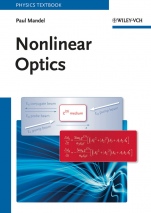
Nonlinear Optics: An Analytical Approach
ISBN 9783527409235
Autor: Paul Mandel
Wydawca: Wiley
Dostępność: 3-6 tygodni
Cena: 394,80 zł
Przed złożeniem zamówienia prosimy o kontakt mailowy celem potwierdzenia ceny.
ISBN13: |
9783527409235 |
ISBN10: |
3527409238 |
Autor: |
Paul Mandel |
Oprawa: |
Paperback |
Rok Wydania: |
2010-03-24 |
Ilość stron: |
259 |
Wymiary: |
241x173 |
Tematy: |
PH |
Based on the author′s extensive teaching experience and lecture notes, this textbook provides a substantially analytical rather than descriptive presentation of nonlinear optics.
Divided into five parts, with most chapters corresponding to a two–hour lecture, the book begins with a unique account of the historical development from Kirchhoff′s law for the black–body radiation to Planck′s quantum hypothesis and Einstein′s discovery of spontaneous emission – providing all the explicit proofs. The subsequent sections deal with matter quantization, ultrashort pulse propagation in 2–level media, cavity nonlinear optics, chi(2) and chi(3) media.
For graduate and PhD students in nonlinear optics or photonics, while also representing a valuable reference for researchers in these fields.
Spis treści:
Preface
1 Historical Background
1.1 Introduction
1.2 Kirchhoff (1859)
1.2.1 The Birth of Spectroscopy
1.2.2 The First Law
1.2.3 The Second Law
1.3 Stefan (1879) and Boltzmann (1884)
1.3.1 Experimental Background
1.3.2 Maxwell′s Theory and Thermodynamics
1.4 Wien (1893)
1.5 Planck (1900)
1.5.1 Modeling Matter
1.5.2 The Quantum Hypothesis
1.6 Einstein (1905, 1907, and 1916)
1.6.1 Quantization of Light Absorption (1905)
1.6.2 Specific Heat of Solids (1907)
1.6.3 Spontaneous Emission (1916)
I Quantized Matter
2 Two–Level Medium
2.1 Electric Field Equation
2.2 Material Equations
2.3 Phenomenology: Incoherent Pumping and Decay
3 Propagation Regimes
3.1 Linear Propagation Regime
3.2 Nonlinear Susceptibility
3.3 Nonlinear Steady Propagation
3.4 Group and Phase Velocity
4 Coherence and Atomic Interference
4.1 Atomic Interference
4.2 Semiclassical Formulation
4.3 Electromagnetically Induced Transparency
4.4 Slow Light
II Sine–Gordon Solitons
5 Self–Induced Transparency
5.1 De
rivation of the Area Theorem
5.2 Properties of the Area
6 Sine–Gordon Equation
6.1 The Backlund Transformation
6.2 2pi Solitons
6.3 Short Bibliography on Solitons
7 Higher–Order Sine–Gordon Solitons
7.1 The Bianchi Theorem
7.2 4pi Solitons
7.3 Unstable 0pi Solitons
7.4 Stable 0pi Solitons
7.5 Solutions in an Amplifyer
III Cavity Nonlinear Optics
8 Laser Theory
8.1 Introduction
8.2 Single–Mode Ring Laser
8.2.1 Steady States
8.2.2 Rate Equations
8.2.3 Good Cavity Limit
8.3 Single–Mode Fabry–Perot Laser
8.3.1 Semiclassical Equations
8.3.2 Population Gratings in Steady State
8.3.3 Rate Equations
8.4 Warning
8.5 Short Bibliography on Cavity Optics
9 Optical Bistability I
9.1 Introduction
9.2 Steady–State Solutions
9.3 Optical Devices
9.4 Generic Description
9.5 Nonlinear Stability
9.6 Address Pulses
9.7 Pulse Area Law
9.8 Appendix: the Schmitt Trigger
10 Optical Bistability II
10.1 Delay–Differential Equations
10.2 Discrete Maps
10.3 Deterministic Chaos
10.4 Bibliography
10.4.1 Ikeda Delay–Differential Equations
10.4.2 Deterministic Chaos
IV Weakly Nonlinear Systems: chi(2) Media
11 Frequency Mixing
11.1 Tensor to Vector to Scalar Description
11.2 Multiple Time–Scales
11.3 chi(2) Media
11.4 Bibliography
11.4.1 Founding Papers of Nonlinear Optics
11.4.2 Nonlinear Optics (chi(2) and chi(3) Media)
12 Second Harmonic Generation
12.1 Formulation
12.2 Free–Running Second Harmonic Generation
12.2.1 Perfect Matching and G = 0 .
12.2.2 Perfect Matching but G > 0
12.2.3 Imperfect Phase Matching
12.2.4 Phase Matching
12.3 Intra–Cavity Second Harmonic Generation
13 Sum and Difference Frequency Generation
13.1 Sum Frequency Generation
13.1.1 Formulation
13.1.2 Free–Running Sum Frequency Generation
13.2 Difference Fre
quency Generation
13.2.1 Two Intense Input Fields
13.2.2 One Intense Input Field
14 Optical Parametric Oscillator
14.1 Formulation
14.2 Threshold Condition
14.3 Degenerate Optical Parametric Oscillator
14.4 Ring and Fabry–Perot Cavities
V Weakly Nonlinear Systems: chi(3) Media
15 Multiwave Frequency Mixing
15.1 Introduction
15.2 Monochromatic Input Field
15.3 Three–Wave Mixing
15.4 Optical Phase Conjugation
15.4.1 Fresnel′s Laws
15.4.2 Optical Phase Conjugation
15.5 Degenerate Four–Wave Mixing
16 Nonlinear Schrodinger Solitons
16.1 Introduction
16.2 Formulation
16.3 Mathematical Digression
16.4 Perturbation Expansion
16.4.1 The O(0) Equation
16.4.2 The O(1) Equation
16.4.3 The O(2) Equation
16.5 The Nonlinear Schrodinger Equation
16.6 Basic Solutions of the Nonlinear Schrodinger Equation
16.7 Comments
17 Higher–Order Nonlinear Schrodinger Solitons
17.1 Inverse Scattering Method
17.2 First–Order Solutions
17.2.1 Turing/Modulational Instability (Time–Periodic Solutions)
17.2.2 Aperiodic Solution
17.2.3 Space–Periodic Solutions
17.2.4 Space– and Time–Periodic Solutions
17.3 Second–Order Solutions
17.3.1 Colliding Bright Solitons
17.3.2 Breathers (Space–Periodic)
17.3.3 Aperiodic Solution
17.4 Colliding Dark Solitons
17.5 Existence and Stability
17.6 Short Bibliography on Patterns
References
Index
Nota biograficzna:
Paul Mandel is the founder and was Head of the Theoretical Nonlinear Optics group at the Universite Libre de Bruxelles (ULB) until his retirement in 2008. He obtained his academic degrees at the ULB under Professor I. Prigogine. His career was spent with the National Science Foundation of Belgium with full–time research positions. He has been working in quantum and semi–classical optics since 1971, managing nati
onal and European research contracts, and has chaired research conferences in the EU and the USA. Lately, he has been a part–time Professor of Optics at the ULB. He has published over 250 research papers in refereed journals and a book with Cambridge University Press.
Koszyk
Książek w koszyku: 0 szt.
Wartość zakupów: 0,00 zł
Informacje


Kontakt
Gambit
Centrum Oprogramowania
i Szkoleń Sp. z o.o.
Al. Pokoju 29b/22-24
31-564 Kraków
Siedziba Księgarni
ul. Kordylewskiego 1
31-542 Kraków
+48 12 410 5991
+48 12 410 5987
+48 12 410 5989
Subskrypcje
Administratorem danych osobowych jest firma Gambit COiS Sp. z o.o. Na podany adres będzie wysyłany wyłącznie biuletyn informacyjny.
Autoryzacja płatności

Informacje na temat autoryzacji płatności poprzez PayU.

© Copyright 2012: GAMBIT COiS Sp. z o.o. Wszelkie prawa zastrzeżone.
Projekt i wykonanie: Alchemia Studio Reklamy