


Wydawcy
Katalog tematyczny
- Archeologia (109)
- Ekonomia, finanse, business (13704)
- Filozofia (1445)
- Historia (3040)
- Języki i językoznawstwo (2356)
- Lifestyle, hobby i rozrywka (475)
- Medycyna (9704)
- Nauki humanistyczne (4)
- Nauki o Ziemi i środowisku (2638)
- Nauki ścisłe (20412)
- Astronomia (294)
- Biologia (5119)
- Chemia (6540)
- Fizyka (3309)
- Elektryczność i magnetyzm (90)
- Fizyka atomowa i molekularna (110)
- Fizyka cząstek elementarnych (36)
- Fizyka jądra atomowego (36)
- Fizyka kwantowa (210)
- Fizyka matematyczna (121)
- Fizyka relatywistyczna (36)
- Fizyka statystyczna (51)
- Fizyka stosowana (498)
- Mechanika klasyczna (186)
- Optyka i światło (133)
- Stany materii (202)
- Matematyka (4574)
- Nauki ścisłe, ogólnie (503)
- Nauki społeczne (8486)
- Nauki techniczne (13450)
- Prawo (1696)
- Publikacje informacyjne i interdyscyplinarne (1288)
- Religia i wierzenia (917)
- Technika komputerowa (4067)
- Zdrowie, relacje międzyludzkie i rozwój osobisty (657)





Informacje szczegółowe o książce
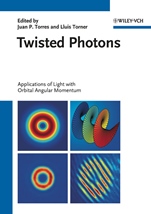
Twisted Photons: Applications of Light with Orbital Angular Momentum
ISBN 9783527409075
Autor: Juan P. Torres, Lluis Torner
Wydawca: Wiley
Dostępność: 3-6 tygodni
Cena: 746,55 zł
Przed złożeniem zamówienia prosimy o kontakt mailowy celem potwierdzenia ceny.
ISBN13: |
9783527409075 |
ISBN10: |
3527409076 |
Autor: |
Juan P. Torres, Lluis Torner |
Oprawa: |
Hardback |
Rok Wydania: |
2011-02-09 |
Ilość stron: |
288 |
Wymiary: |
252x182 |
Tematy: |
PH |
The book deals with applications in several areas of science as technology that make use of light which carries orbital angular momentum. In most practical scenarios, the angular momentum can be decomposed into two independent contributions: the spin angular momentum and the orbital angular momentum. The orbital contribution affords a fundamentally new degree of freedom, with fascinating and wide–spread applications. Unlike spin angular momentum, which is associated with the polarization of light, the orbital angular momentum arises as a consequence of the spatial distribution of the intensity and phase of an optical field, even down to the single photon limit. Researchers have begun to appreciate its implications for our understanding of the ways in which light and matter can interact, and its practical potential in different areas of science and technology.
From the contents:The orbital angular momentum (OAM) of a light beamGeneration and detection of the OAMThe rotational Doppler frequency shift and the OAMTransfer of OAM to trapped particlesTorques in liquid crystalsMicro–machines made and driven by OAMApplications in microfluidicsApplications in microphysicsSpiral phase contrast microscopyImaging membranes between different biological tissuesOAM of single and entangled photonsRotating atoms with lightVortices everywhere
Spis treści:
Preface.
List of Contributors.
Color Plates.
1 The Orbital Angular Momentum of Light: An Introduction (Les Allen and Miles Padgett).
1.1 Introduction.
1.2 The Phenomenology of Orbital Angular Momentum.
References.
2 Vortex Flow of Light: ‘‘Spin’’ and ‘‘Orbital’’ Flows in a Circularly Polarized Paraxial Beam (Aleksandr Bekshaev and Mikhail Vasnetsov).
2.1 Introduction.
2.2 Spin and Orbital Flows: Gener
al Concepts.
2.3 Transverse Energy Flows in Circularly Polarized Paraxial Beams.
2.4 Orbital Rotation without Orbital Angular Momentum.
2.5 Conclusion.
References.
3 Helically Phased Beams, and Analogies with Polarization (Miles Padgett).
3.1 Introduction.
3.2 Representation of Helically Phased Beams.
3.3 Exploiting the Analogous Representations of Spin and Orbital Angular Momentum.
3.4 Conclusions.
References.
4 Trapping and Rotation of Particles in Light Fields with Embedded Optical Vortices (Michael Mazilu and Kishan Dholakia).
4.1 Introduction.
4.2 Laguerre–Gaussian Light Beams.
4.3 Origin of Optical Torques and Forces.
4.4 Optical Vortex Fields for the Rotation of Trapped Particles.
4.5 Optical Vortex Fields for Advanced Optical Manipulation.
4.6 Conclusions.
Acknowledgments.
References.
5 Optical Torques in Liquid Crystals (Enrico Santamato and Bruno Piccirillo).
5.1 The Optical Reorientation and the Photon Angular Momentum Flux.
5.2 Dynamical Effects Induced in Liquid Crystals by Photon SAM and OAM Transfer.
5.3 Conclusions.
References.
6 Driving Optical Micromachines with Orbital Angular Momentum (Vincent L.Y. Loke, Theodor Asavei, Simon Parkin, Norman R. Heckenberg, Halina Rubinsztein–Dunlop, and Timo A. Nieminen).
6.1 Introduction.
6.2 Symmetry, Scattering, and Optically Driven Micromachines.
6.3 Experimental Demonstration.
6.4 Computational Optimization of Design.
6.5 Conclusion.
References.
7 Rotational Optical Micromanipulation with Specific Shapes Built by Photopolymerization (Péter Galaja, Lóránd Kelemen, László Oroszi, and Pál Ormos).
7.1 Introduction.
7.2 Microfabrication by Photopolymerization.
7.3 Light–Driven Rotors, Micromachines.
7.4 Integrated Optical Motor.
7.5 Angular Trapping of Flat Objects in Optical Tweezers For
med by Linearly Polarized Light.
7.6 Torsional Manipulation of DNA.
7.7 Conclusion.
Acknowledgment.
References.
8 Spiral Phase Contrast Microscopy (Christian Maurer, Stefan Bernet, and Monika Ritsch–Marte).
8.1 Phase Contrast Methods in Light Microscopy.
8.2 Fourier Filtering in Optical Imaging.
8.3 Spiral Phase Fourier Filtering.
8.4 Implementation and Performance.
8.5 Conclusions.
References.
9 Applications of Electromagnetic OAM in Astrophysics and Space Physics Studies (Bo Thidé, Nicholas M. Elias II, Fabrizio Tamburini, Siavoush M. Mohammadi, and José T.Mendonça).
9.1 Introduction.
9.2 Ubiquitous Astronomical POAM.
9.3 Applications of POAM in Astronomy.
9.4 Applications of POAM in Space Physics.
9.A. Appendix: Theoretical Foundations.
9.A.1 Classical Field Picture.
9.A.2 Photon Picture.
References.
10 Optical Vortex Cat States and their Utility for Creating Macroscopic Superpositions of Persistent Flows (Ewan M. Wright).
10.1 Introduction.
10.2 Optical Vortex Cat States.
10.3 Macroscopic Superposition of Persistent Flows.
10.4 Summary and Conclusions.
References.
11 Experimental Control of the Orbital Angular Momentum of Single and Entangled Photons (Gabriel Molina–Terriza and Anton Zeilinger).
11.1 Introduction to the Photon OAM.
11.2 Control of the OAM State of a Single Photon.
11.3 Control of the OAM State of Multiple Photons.
11.4 Applications in Quantum Information.
11.5 Discussion.
11.6 Conclusion.
References.
12 Rotating Atoms with Light (Kristian Helmerson and William D. Phillips).
12.1 Introduction.
12.2 Orbital Angular Momentum of Light.
12.3 The Mechanical Effects of Light.
12.4 Rotating Bose–Einstein Condensates.
12.5 Measuring the Rotational Motion of the Atoms.
12.6 Generating Other Rotational States of Atoms.
12.7 Superc
urrents.
12.8 Conclusion.
Acknowledgments.
References.
Index.
Nota biograficzna:
Juan P. Torres is one of the group leaders of ICFO–The Institute of Photonic Sciences in Barcelona, Spain, where he conducts research in nonlinear and quantum optics. He also holds a position as associate professor at the Technical University of Catalonia where he teaches in photonics and electrical engineering. Professor Torres obtained his PhD in Science from the Technical University of Catalonia and afterwards held a post–doctoral position at the University of California at Berkeley. He has authored about 100 articles and received an award for young investigators from the Government of Catalonia in 2002.
Lluis Torner is the founding Director of ICFO–The Institute of Photonic Sciences in Barcelona, Spain, and professor of photonics at the Technical University of Catalonia. He conducts research and innovation in photonics, with emphasis on fundamentals and applications of nonlinear optics, optical vortices and optical solitons. He has co–authored more than 300 articles in scientific journals. He is a Fellow of the Optical Society of America, the European Optical Society and the European Physical Society, and he currently serves as President of the Association of Research Institutions of Catalonia.
Okładka tylna:
The book deals with applications in several areas of science as technology that make use of light which carries orbital angular momentum. In most practical scenarios, the angular momentum can be decomposed into two independent contributions: the spin angular momentum and the orbital angular momentum. The orbital contribution affords a fundamentally new degree of freedom, with fascinating and wide–spread applications. Unlike spin angular momentum, which is associated with the polarization of light, the orbital angular momentum arises as a consequence of the spatial distribut
ion of the intensity and phase of an optical field, even down to the single photon limit. Researchers have begun to appreciate its implications for our understanding of the ways in which light and matter can interact, and its practical potential in different areas of science and technology.
From the contents:The orbital angular momentum (OAM) of a light beamGeneration and detection of the OAMThe rotational Doppler frequency shift and the OAMTransfer of OAM to trapped particlesTorques in liquid crystalsMicro–machines made and driven by OAMApplications in microfluidicsApplications in microphysicsSpiral phase contrast microscopyImaging membranes between different biological tissuesOAM of single and entangled photonsRotating atoms with lightVortices everywhere
Koszyk
Książek w koszyku: 0 szt.
Wartość zakupów: 0,00 zł
Informacje


Kontakt
Gambit
Centrum Oprogramowania
i Szkoleń Sp. z o.o.
Al. Pokoju 29b/22-24
31-564 Kraków
Siedziba Księgarni
ul. Kordylewskiego 1
31-542 Kraków
+48 12 410 5991
+48 12 410 5987
+48 12 410 5989
Subskrypcje
Administratorem danych osobowych jest firma Gambit COiS Sp. z o.o. Na podany adres będzie wysyłany wyłącznie biuletyn informacyjny.
Autoryzacja płatności

Informacje na temat autoryzacji płatności poprzez PayU.

© Copyright 2012: GAMBIT COiS Sp. z o.o. Wszelkie prawa zastrzeżone.
Projekt i wykonanie: Alchemia Studio Reklamy