


Wydawcy
Katalog tematyczny
- Archeologia (109)
- Ekonomia, finanse, business (13704)
- Filozofia (1445)
- Historia (3040)
- Języki i językoznawstwo (2356)
- Lifestyle, hobby i rozrywka (475)
- Medycyna (9704)
- Nauki humanistyczne (4)
- Nauki o Ziemi i środowisku (2638)
- Nauki ścisłe (20412)
- Astronomia (294)
- Biologia (5119)
- Chemia (6540)
- Fizyka (3309)
- Elektryczność i magnetyzm (90)
- Fizyka atomowa i molekularna (110)
- Fizyka cząstek elementarnych (36)
- Fizyka jądra atomowego (36)
- Fizyka kwantowa (210)
- Fizyka matematyczna (121)
- Fizyka relatywistyczna (36)
- Fizyka statystyczna (51)
- Fizyka stosowana (498)
- Mechanika klasyczna (186)
- Optyka i światło (133)
- Stany materii (202)
- Matematyka (4574)
- Nauki ścisłe, ogólnie (503)
- Nauki społeczne (8486)
- Nauki techniczne (13450)
- Prawo (1696)
- Publikacje informacyjne i interdyscyplinarne (1288)
- Religia i wierzenia (917)
- Technika komputerowa (4067)
- Zdrowie, relacje międzyludzkie i rozwój osobisty (657)





Informacje szczegółowe o książce
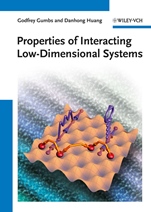
Properties of Interacting Low–Dimensional Systems
ISBN 9783527408948
Autor: Godfrey Gumbs, Danhong Huang
Wydawca: Wiley
Dostępność: 3-6 tygodni
Cena: 665,70 zł
Przed złożeniem zamówienia prosimy o kontakt mailowy celem potwierdzenia ceny.
ISBN13: |
9783527408948 |
ISBN10: |
3527408940 |
Autor: |
Godfrey Gumbs, Danhong Huang |
Oprawa: |
Hardback |
Rok Wydania: |
2011-06-15 |
Ilość stron: |
392 |
Wymiary: |
249x180 |
Tematy: |
PH |
Filling the gap for comprehensive coverage of the realistic fundamentals and approaches needed to perform cutting–edge research on mesoscopic systems, this textbook allows advanced students to acquire and use the skills at a highly technical, research–qualifying level.
Starting with a brief refresher to get all readers on an equal footing , the text moves on to a broad selection of advanced topics, backed by problems with solutions for use in classrooms as well as for self–study.
Written by authors with research and teaching backgrounds from eminent institutions and based on a tried–and–tested lecture, this is a must–have for researchers, research students and instructors involved with semiconductors junctions, nanostructures and thin film systems.
Spis treści:
Preface XI
References XII
Part One Linear Response of Low Dimensional Quantum Systems 1
1 Introduction 3
1.1 Second–Quantized Representation for Electrons 3
1.2 Second Quantization and Fock States 6
1.3 The Boson Case 6
1.4 The Fermion Case 9
1.5 The Hamiltonian of Electrons 12
1.6 Electron–Phonon Interaction 13
1.7 Effective Electron–Electron Interaction 14
1.8 Degenerate Electron Gases 16
1.9 Ground–State Energy in the High Density Limit 18
1.10 Wigner Solid 20
1.11 The Chemical Potential of an Ideal Bose Gas and Bose–Einstein Condensation 22
1.12 Problems 24
References 29
2 The Kubo–Greenwood Linear Response Theory 31
2.1 Fluctuations and Dissipation 31
2.2 Nyquist’s Relation 32
2.3 Linear Response Theory 33
2.3.1 Generalized Susceptibility 33
2.3.2 Kronig–Kramers Relations 35
2.3.3 Dielectric Function in Three Dimensions 36
2.4 The
Density Matrix and Quantum Statistics 36
2.4.1 The von Neumann Density Matrix 36
2.4.2 Entropy 37
2.5 Kubo’s Theory 38
2.6 The Kubo Equation 40
2.7 Fluctuation–Dissipation Theorem 41
2.8 Applications 43
2.8.1 Mobility and the Nernst–Einstein Relation 43
2.8.2 Electrical Conductivity and the Nyquist Relation 45
2.8.3 Magnetic Susceptibility 46
2.8.4 The Langevin Equation 46
2.8.5 Stochastic Model of Magnetic Resonance 47
2.8.6 Gaussian Process 48
2.9 Kinetic Equation for Elastic Processes 49
2.9.1 Boltzmann’s Transport Equation 49
2.9.2 The Collision Term 49
2.9.3 Solution in the Ohmic Regime 50
2.9.4 Conductivity and Mobility 52
2.10 Problems 52
References 55
3 Feynman Diagrammatic Expansion 57
3.1 General Formalism 57
3.2 Functional Derivative Techniques 63
3.3 Unrenormalized Expansion for G and S 67
3.4 Renormalized Expansion for Self–Energy S 70
3.5 The Schrödinger Equation in the Hartree–Fock Approximation 74
3.6 Screened External Potential 75
3.7 Retarded Polarization Function 76
3.8 RPA for the Polarization Function 77
3.9 Problems 78
References 81
4 Plasmon Excitations in Mesoscopic Structures 83
4.1 Linear Response Theory and Collective Excitations 83
4.1.1 Screening and the Self–Consistent Field Approximation 85
4.2 A Linear Array of Nanotubes 86
4.2.1 Tight–BindingModel 87
4.2.2 Numerical Results and Discussion 92
4.3 A Linear Array of Quantum Wires 93
4.4 Coupled Half–Plane Superlattices 95
4.4.1 Hydrodynamic Model 96
4.4.2 Numerical Results and Discussion 99
4.5 Problems
101
References 111
5 The Surface Response Function, Energy Loss and Plasma Instability 113
5.1 Surface Response Function 113
5.1.1 The Image Potential 114
5.1.2 A Bi–Layer System 115
5.1.3 A Dielectric Slab 117
5.1.4 A Layered 2DEG System 118
5.2 Electron Energy Loss for a Planar Surface 119
5.2.1 Transfer–Matrix Method 120
5.2.2 Motion Parallel to the Surface 122
5.2.3 Motion Perpendicular to the Surface 122
5.2.4 The Inverse Dielectric Function Formalism 123
5.3 Plasma Instability for a Planar Surface 125
5.4 Energy Transfer in Nanotubes 132
5.4.1 Energy Loss on a SingleWall Nanotube 132
5.5 Problems 141
References 145
6 The Rashba Spin–Orbit Interaction in 2DEG 147
6.1 Introduction to Spin–Orbit Coupling 147
6.2 Spin–Orbit Coupling in the Dirac Equation 148
6.3 Rashba Spin–Orbit Coupling for a Quantum Wire 151
6.4 SOI Effects on Conductance and Electron–Diffusion Thermoelectric Power 154
6.5 Problems 156
References 157
7 Electrical Conductivity: the Kubo and Landauer–Büttiker Formulas 159
7.1 Quantum Mechanical Current 159
7.2 The Statistical Current 160
7.3 A Green’s Function Formalism 161
7.4 The Static Limit 163
7.5 Model and Single–Particle Eigenstates 164
7.6 Averaged Conductivity 167
7.7 Applications to One–Dimensional Density Modulated 2DEG 171
7.8 Scattering Theory Formalism 175
7.9 Quantum Hall Effect 176
7.10 Problems 177
References 177
8 Nonlocal Conductivity for a Spin–Split Two–Dimensional Electron Liquid 179
8.1 Introduction 179
8.2 Kubo Formula for Conduct
ivity 180
8.3 The Self–Energy and Scattering Time 182
8.4 Drude–Type Conductivity for Spin–Split Subband Model 183
8.5 Vertex Corrections to the Local Conductivity 185
8.6 Numerical Results for Scattering Times 191
8.7 Related Results in 3D in the Absence of SOI 192
References 194
9 Integer Quantum Hall Effect 197
9.1 Basic Principles of the Integer Quantum Hall Effect 197
9.1.1 The Hall Effect 197
9.1.2 The Quantum Hall Effect 198
9.1.3 An Idealized Model 199
9.1.4 Effect of Finite Temperature 201
9.1.5 Effect of Impurities 202
9.1.6 Application of the Quantum Hall Effect 202
9.2 Fundamental Theories of the IQHE 203
9.2.1 Energy Spectrum and Wave functions 203
9.2.2 Perturbation and Scattering Theory 205
9.2.3 Gauge Symmetry Approach 206
9.2.4 The QHE in a Periodic Potential 207
9.2.5 Topological Equivalence of the Quantum Hall Conductance 208
9.3 Corrections to the Quantization of the Hall Conductance 210
9.3.1 Properties of the Green’s Function 210
References 212
10 Fractional Quantum Hall Effect 215
10.1 The Laughlin Ground State 215
10.1.1 The Lowest Landau Level 215
10.1.2 Laughlin’s Wave Function 216
10.1.3 Properties of the Laughlin Wave Function 218
10.1.4 Justification of the Laughlin State 219
10.2 Elementary Excitations 220
10.2.1 Fractional Charge 220
10.2.2 The Complete Set of Quasi–Hole States 222
10.3 The Ground State: Degeneracy and Ginzburg–Landau Theory 224
10.3.1 Ground State Degeneracy 224
10.3.2 Ginzburg–Landau Theory of the Quantum Hall Effect 225
10.4 Problems 228
References 229
11 Quantized Adiabatic Cha
rge Transport in 2D Electron Systems and Nanotubes 231
11.1 Introduction 231
11.2 Theory for Current Quantization 232
11.3 Tunneling Probability and Current Quantization for Interacting Two–Electron System 235
11.3.1 Spin Unpolarized Case 236
11.4 Adiabatic Charge Transport in Carbon Nanotubes 238
11.5 Summary and Remarks 240
References 241
12 Graphene 243
12.1 Introduction 243
12.2 Electronic Properties of Graphene 245
12.3 Graphene Nanoribbons and Their Spectrum 249
12.3.1 Zigzag Edge 251
12.3.2 Armchair Nanoribbon 253
12.4 Valley–Valve Effect and Perfect Transmission in GNR’s 255
12.5 GNR’s Electronic and Transport Properties in External Fields 262
12.6 Problems 267
12.A Energy Eigen States 270
12.B The Conductance 271
References 273
13 Semiclassical Theory for Linear Transport of Electrons 275
13.1 Roughness Scattering 276
13.1.1 Model for Elastic Scattering 277
13.1.2 Numerical Results for Roughness Scattering Effect 280
13.2 Phonon Scattering 282
13.2.1 Model for Inelastic Scattering 283
13.2.2 Numerical Results for Phonon Scattering Effect 285
13.3 Thermoelectric Power 287
13.3.1 Model for Non–equilibrium Phonons 288
13.3.2 Numerical Results for Thermoelectric Power 291
13.4 Electron–Electron Scattering 293
13.4.1 Model for Pair Scattering 293
13.4.2 Numerical Results for Coulomb Scattering Effect 295
References 298
Part Two Nonlinear Response of Low Dimensional Quantum Systems 301
14 Theory for Nonlinear Electron Transport 303
14.1 Semiclassical Theory 303
14.1.1 Transient Boltzmann Equation 303
14.1.2 Numerical Proce
dure 306
14.1.3 Numerical Results for Bloch Oscillations and Dynamical Localization 309
14.2 Quantum Theory 312
14.2.1 Force Balance Equation 312
14.2.2 Boltzmann Scattering Equation 315
References 318
15 Spontaneous and Stimulated Nonlinear Wave Mixing of Multiexcitons 319
15.1 Spontaneous, Stimulated, Coherent and Incoherent Nonlinear Wave Mixing 323
15.2 n C 1 Wave Mixing in QD Fluids and Polymer QDs Molecule Solutions 328
15.2.1 Stimulated and Spontaneous Incoherent Signals 329
15.2.2 Spontaneous Coherent Signal 330
15.3 Application to Two–Photon–Induced Signals 333
15.A Semiclassical vs. Quantum Field Derivation of Heterodyne Detected Signals 337
15.B Generalized Susceptibility and Its CTPL Representation 340
References 342
16 Probing Excitons and Biexcitons in Coupled QDs by Coherent Optical Spectroscopy 345
16.1 Model Hamiltonian for Two Coupled Quantum Dots 346
16.2 Single–exciton Manifold and the Absorption Spectrum 348
16.3 Two–exciton Manifold and the 2D Spectra 351
16.4 Summary 357
16.A Transformation of the Electron–Hole Hamiltonian Using Excitonic Variables 357
16.B The Nonlinear Exciton Equations 359
16.C The 2D Signals 360
References 361
17 Non–thermal Distribution of Hot Electrons 363
17.1 Introduction 363
17.2 Boltzmann Scattering Equation 364
17.3 Numerical Results for Effective Electron Temperature 367
17.4 Summary 369
References 370
Index 373
Nota biograficzna:
Godfrey A. Gumbs received his undergraduate degree in Applied Mathematics and theoretical physics and his doctorate in condensed matter physics from the University of Toronto. He is currently
at the Chianta–Stoll Chair of Physics at Hunter College and a Distinguished Professor of the City University of New York. He has focused his research on electron transport and optical response in semiconductor heterostructures such as the two–dimensional electron and hole gases. In addition, he has done work on lower dimensional quantum structures. Prof. Gumbs was a National Research Council of Canada postdoctoral Fellow in Ottawa. He was an Alexander von Humboldt Fellow as well as a Senior Fulbright Scholar. He is a Fellow of the Institute of Physics and a Fellow of the American Physical Society.
Danhong Huang is Senior Research Physicist with the Space Based Advanced Sensing and Protection Branch of the US Air Force Research Lab, with prior assignments e.g. at the University of Texas and with the MIT. His research centers on development of theoretical understanding of solid state and heterostructure physics and developing tools for computational modeling. He was a Research Assistant Professor at the Wayne State University working on electronic quantum interference in semiconductor quantum wells, an NSERC Fellow working on many–body theories on quantum transport and optical transition, an NRC Fellow working on semiconductor infrared photodetectors, a IPA contractor at the Air Force Research Laboratory working on Magneto–quantum transport and magneto–optical absorption in low–dimensional semiconductor systems.
Okładka tylna:
Filling the gap for comprehensive coverage of the realistic fundamentals and approaches needed to perform cutting–edge research on mesoscopic systems, this textbook allows advanced students to acquire and use the skills at a highly technical, research–qualifying level.
Starting with a brief refresher to get all readers on an equal footing , the text moves on to a broad selection of advanced topics, backed by problems with solutions for use in classrooms as well a
s for self–study.
Written by authors with research and teaching backgrounds from eminent institutions and based on a tried–and–tested lecture, this is a must–have for researchers, research students and instructors involved with semiconductors junctions, nanostructures and thin film systems.
Koszyk
Książek w koszyku: 0 szt.
Wartość zakupów: 0,00 zł
Informacje


Kontakt
Gambit
Centrum Oprogramowania
i Szkoleń Sp. z o.o.
Al. Pokoju 29b/22-24
31-564 Kraków
Siedziba Księgarni
ul. Kordylewskiego 1
31-542 Kraków
+48 12 410 5991
+48 12 410 5987
+48 12 410 5989
Subskrypcje
Administratorem danych osobowych jest firma Gambit COiS Sp. z o.o. Na podany adres będzie wysyłany wyłącznie biuletyn informacyjny.
Autoryzacja płatności

Informacje na temat autoryzacji płatności poprzez PayU.

© Copyright 2012: GAMBIT COiS Sp. z o.o. Wszelkie prawa zastrzeżone.
Projekt i wykonanie: Alchemia Studio Reklamy