


Wydawcy
Katalog tematyczny
- Archeologia (109)
- Ekonomia, finanse, business (13704)
- Filozofia (1445)
- Historia (3040)
- Języki i językoznawstwo (2356)
- Lifestyle, hobby i rozrywka (475)
- Medycyna (9704)
- Nauki humanistyczne (4)
- Nauki o Ziemi i środowisku (2638)
- Nauki ścisłe (20412)
- Astronomia (294)
- Biologia (5119)
- Chemia (6540)
- Fizyka (3309)
- Elektryczność i magnetyzm (90)
- Fizyka atomowa i molekularna (110)
- Fizyka cząstek elementarnych (36)
- Fizyka jądra atomowego (36)
- Fizyka kwantowa (210)
- Fizyka matematyczna (121)
- Fizyka relatywistyczna (36)
- Fizyka statystyczna (51)
- Fizyka stosowana (498)
- Mechanika klasyczna (186)
- Optyka i światło (133)
- Stany materii (202)
- Matematyka (4574)
- Nauki ścisłe, ogólnie (503)
- Nauki społeczne (8486)
- Nauki techniczne (13450)
- Prawo (1696)
- Publikacje informacyjne i interdyscyplinarne (1288)
- Religia i wierzenia (917)
- Technika komputerowa (4067)
- Zdrowie, relacje międzyludzkie i rozwój osobisty (657)





Informacje szczegółowe o książce
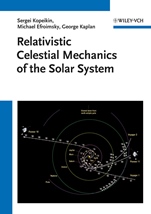
Relativistic Celestial Mechanics of the Solar System
ISBN 9783527408566
Autor: Sergei Kopeikin, Michael Efroimsky, George Kaplan
Wydawca: Wiley
Dostępność: 3-6 tygodni
Cena: 962,85 zł
Przed złożeniem zamówienia prosimy o kontakt mailowy celem potwierdzenia ceny.
ISBN13: |
9783527408566 |
ISBN10: |
3527408568 |
Autor: |
Sergei Kopeikin, Michael Efroimsky, George Kaplan |
Oprawa: |
Hardback |
Rok Wydania: |
2011-08-24 |
Ilość stron: |
892 |
Wymiary: |
243x180 |
Tematy: |
PH |
This authoritative book presents the theoretical development of gravitational physics as it applies to the dynamics of celestial bodies and the analysis of precise astronomical observations. In so doing, it fills the need for a textbook that teaches modern dynamical astronomy with a strong emphasis on the relativistic aspects of the subject produced by the curved geometry of four–dimensional spacetime.
The first three chapters review the fundamental principles of celestial mechanics and of special and general relativity. This background material forms the basis for understanding relativistic reference frames, the celestial mechanics of N–body systems, and high–precision astrometry, navigation, and geodesy, which are then treated in the following five chapters. The final chapter provides an overview of the new field of applied relativity, based on recent recommendations from the International Astronomical Union.
The book is suitable for teaching advanced undergraduate honors programs and graduate courses, while equally serving as a reference for professional research scientists working in relativity and dynamical astronomy.
The authors bring their extensive theoretical and practical experience to the subject. Sergei Kopeikin is a professor at the University of Missouri, while Michael Efroimsky and George Kaplan work at the United States Naval Observatory, one of the world’s premier institutions for expertise in astrometry, celestial mechanics, and timekeeping.
Spis treści:
Preface.
Symbols and Abbreviations.
References.
1 Newtonian Celestial Mechanics.
1.1 Prolegomena – Classical Mechanics in a Nutshell.
1.2 The N–body Problem.
1.3 The Reduced Two–Body Problem.
1.4 A Perturbed Two–Body Problem.
1.5 Re–examining the Obvious.
1.6 Epilogue to the Chapter.
References.
2 Introduction to Special Relativity.
2.1 From Ne
wtonian Mechanics to Special Relativity.
2.2 Building the Special Relativity.
2.3 Minkowski Spacetime as a Pseudo–Euclidean Vector Space.
2.4 Tensor Algebra.
2.5 Kinematics.
2.6 Accelerated Frames.
2.7 Relativistic Dynamics.
2.8 Energy–Momentum Tensor.
3 General Relativity.
3.1 The Principle of Equivalence.
3.2 The Principle of Covariance.
3.3 A Differentiable Manifold.
3.4 Affine Connection on Manifold.
3.5 The Levi–Civita Connection.
3.6 Lie Derivative.
3.7 The Riemann Tensor and Curvature of Manifold.
3.8 Mathematical and Physical Foundations of General Relativity.
3.9 Variational Principle in General Relativity.
3.10 GravitationalWaves.
4 Relativistic Reference Frames.
4.1 Historical Background.
4.2 Isolated Astronomical Systems.
4.3 Global Astronomical Coordinates.
4.4 Gravitational Multipoles in the Global Coordinates.
4.5 Local Astronomical Coordinates.
5 Post–Newtonian Coordinate Transformations.
5.1 The Transformation from the Local to Global Coordinates.
5.2 Matching Transformation of the Metric Tensor and Scalar Field.
6 Relativistic Celestial Mechanics.
6.1 Post–Newtonian Equations of Orbital Motion.
6.2 Rotational Equations of Motion of Extended Bodies.
6.3 Motion of Spherically–Symmetric and Rigidly–Rotating Bodies.
6.4 Post–Newtonian Two–Body Problem.
7 Relativistic Astrometry.
7.1 Introduction.
7.2 Gravitational Liénard–Wiechert Potentials.
7.3 Mathematical Technique for Integrating Equations of Propagation of Photons.
7.4 Gravitational Perturbations of Photon’s Trajectory.
7.5 Observable Relativistic Effects.
7.6 Applications to Relativistic Astrophysics and Astrometry.
7.7 Relativistic Astrometry in the Solar System.
7.8 Doppler Tracking of Interplanetary Spacecrafts.
7.9 Astrometric Experiments with the Solar System Pl
anets.
8 Relativistic Geodesy.
8.1 Introduction.
8.2 Basic Equations.
8.3 Geocentric Reference Frame.
8.4 Topocentric Reference Frame.
8.5 Relationship Between the Geocentric and Topocentric Frames.
8.6 Post–Newtonian Gravimetry.
8.7 Post–Newtonian Gradiometry.
8.8 Relativistic Geoid.
9 Relativity in IAU Resolutions.
9.1 Introduction.
9.2 Relativity.
9.3 Time Scales.
9.4 The Fundamental Celestial Reference System.
9.5 Ephemerides of the Major Solar System Bodies.
9.6 Precession and Nutation.
9.7 Modeling the Earth’s Rotation.
Appendix A Fundamental Solution of the Laplace Equation.
References.
Appendix B Astronomical Constants.
References.
Appendix C Text of IAU Resolutions.
C.1 Text of IAU Resolutions of 1997 Adopted at the XXIIIrd General Assembly, Kyoto.
C.2 Text of IAU Resolutions of 2000 Adopted at the XXIVth General Assembly, Manchester.
C.3 Text of IAU Resolutions of 2006 Adopted at the XXVIth General Assembly, Prague.
C.4 Text of IAU Resolutions of 2009 Adopted at the XXVIIth General Assembly, Rio de Janeiro.
Index.
Nota biograficzna:
Sergei Kopeikin studied general relativity at the Department of Astronomy of Moscow State University, Russia. He obtained his PhD in relativistic astrophysics from Moscow State University in 1986, where he was then employed as an associate professor. In 1993, he moved to Japan to teach astronomy at Hitotsubashi University, Tokyo. He was an adjunct staff member and thereafter visiting professor at the National Astronomical Observatory of Japan. In 1997, Professor Kopeikin moved to Germany and worked at the Institute of Theoretical Physics of the Friedrich Schiller University, Jena. Three years later he accepted the position of a professor of physics at the University of Missouri, Columbia, USA.
Michael Efroimsky is a research scientist at the United States
Naval Observatory. His research focuses on celestial mechanics and solar system studies. He received his Ph.D. from Oxford in 1995 and he subsequently worked at Tufts, Harvard, and the University of Minnesota. An experienced teacher, having taught numerous courses to Harvard and Tufts students, Dr. Efroimsky is in a unique position to convey this complicated topic to interested readers.
George Kaplan was a staff astronomer at the U.S. Naval Observatory in Washington, D.C., from 1971 to 2007, and now works as an independent consultant. He received his PhD degree from the University of Maryland, USA, in 1985. His professional interests focus on the fi eld of positional astronomy, both its observational and theoretical aspects. His work includes publications in astrometry, celestial reference systems, solar system ephemerides, Earth rotation, navigation algorithms, and astronomical software. Dr. Kaplan is currently the president of Commission 4 (Ephemerides) of the International Astronomical Union. The minor planet 16074 is named in his honor.
Koszyk
Książek w koszyku: 0 szt.
Wartość zakupów: 0,00 zł
Informacje


Kontakt
Gambit
Centrum Oprogramowania
i Szkoleń Sp. z o.o.
Al. Pokoju 29b/22-24
31-564 Kraków
Siedziba Księgarni
ul. Kordylewskiego 1
31-542 Kraków
+48 12 410 5991
+48 12 410 5987
+48 12 410 5989
Subskrypcje
Administratorem danych osobowych jest firma Gambit COiS Sp. z o.o. Na podany adres będzie wysyłany wyłącznie biuletyn informacyjny.
Autoryzacja płatności

Informacje na temat autoryzacji płatności poprzez PayU.

© Copyright 2012: GAMBIT COiS Sp. z o.o. Wszelkie prawa zastrzeżone.
Projekt i wykonanie: Alchemia Studio Reklamy