


Wydawcy
Katalog tematyczny
- Archeologia (109)
- Ekonomia, finanse, business (13704)
- Filozofia (1445)
- Historia (3040)
- Języki i językoznawstwo (2356)
- Lifestyle, hobby i rozrywka (475)
- Medycyna (9704)
- Nauki humanistyczne (4)
- Nauki o Ziemi i środowisku (2638)
- Nauki ścisłe (20412)
- Astronomia (294)
- Biologia (5119)
- Chemia (6540)
- Fizyka (3309)
- Elektryczność i magnetyzm (90)
- Fizyka atomowa i molekularna (110)
- Fizyka cząstek elementarnych (36)
- Fizyka jądra atomowego (36)
- Fizyka kwantowa (210)
- Fizyka matematyczna (121)
- Fizyka relatywistyczna (36)
- Fizyka statystyczna (51)
- Fizyka stosowana (498)
- Mechanika klasyczna (186)
- Optyka i światło (133)
- Stany materii (202)
- Matematyka (4574)
- Nauki ścisłe, ogólnie (503)
- Nauki społeczne (8486)
- Nauki techniczne (13450)
- Prawo (1696)
- Publikacje informacyjne i interdyscyplinarne (1288)
- Religia i wierzenia (917)
- Technika komputerowa (4067)
- Zdrowie, relacje międzyludzkie i rozwój osobisty (657)





Informacje szczegółowe o książce
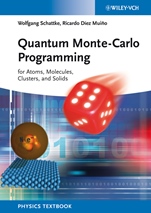
Quantum Monte–Carlo Programming: For Atoms, Molecules, Clusters, and Solids
ISBN 9783527408511
Autor: Wolfgang Schattke, Ricardo Díez Muiño
Wydawca: Wiley
Dostępność: 3-6 tygodni
Cena: 345,45 zł
Przed złożeniem zamówienia prosimy o kontakt mailowy celem potwierdzenia ceny.
ISBN13: |
9783527408511 |
ISBN10: |
3527408517 |
Autor: |
Wolfgang Schattke, Ricardo Díez Muiño |
Oprawa: |
Paperback |
Rok Wydania: |
2013-07-17 |
Ilość stron: |
296 |
Wymiary: |
238x172 |
Tematy: |
PH |
This is a book that initiates the reader into the basic concepts and practical applications of Quantum Monte Carlo. Because of the simplicity of its theoretical concept, the authors focus on the variational Quantum Monte Carlo scheme. The reader is enabled to proceed from simple examples as the Hydrogen
atom to advanced ones as the Lithium solid. In between, several intermediate steps are introduced, including the Hydrogen molecule (2 electrons), the Lithium atom (3 electrons) and expanding to an arbitrary number of electrons to finally treat the three–dimensional periodic array of Lithium atoms in a crystal.
The book is unique because it provides both theory and numerical programs. It pedagogically explains how to transfer into computational tools what is usually described in a theoretical textbook. It also includes the detailed physical understanding of methodology that cannot be found in a code manual.
The combination of both aspects allows the reader to assimilate the fundamentals of Quantum Monte Carlo not only by reading but also by practice.
From the contents:
A first Monte Carlo example Variational Quantum Monte Carlo for a One–Electron System Two electrons with two adiabatically decoupled nuclei: Hydrogen molecule Three electrons: Lithium Atom Many–electron confined systems Many–electron atomic aggregates: Lithium cluster Infinite number of electrons: Lithium solid Diffusion Quantum Monte Carlo: One–dimensional exampleA first monte–carlo example
Variational Quantum–Monte–Carlo for a One–Electron System
Two electrons with two adiabatically decoupled nuclei: Hydrogen molecule
Three electrons: Lithium Atom
Many– electron confined systems
Many– electron atomic aggregates: Lithium cluster
Infinite number of electrons: Lithium solid
Diffusion quantum Monte– Carlo (DQMC)
Wolfgang Schattke is a retired member of the Institut für Theoretische Physik und Astrophysik der Christian–Albrechts–University Kiel where his teaching covered the branch of theoretical physics from the basic courses to advanced topics of the PhD curriculum. His research interests focus on material properties of the solid state and its surfaces investigated with ab–initio electronic structure methods. Besides studying numerical access to photoemission spectroscopy, his scientific efforts point to many–body theory where Quantum Monte–Carlo offers a central tool to complete the successful application of Density Functional Theory to material sciences.
Ricardo Diez Muino is Vice Director of the Centro de Fisica de Materiales, a Joint Center between the University of the Basque Country UPV/EHU and the Spanish Research Council CSIC in San Sebastian. Previously, he developed his research activity in the Donostia International Physics Center DIPC (Spain), the Lawrence Berkeley National Laboratory (USA), and the Université de Bordeaux (France). His main field of research is condensed matter theory, particularly electronic excitations in metallic systems, with some excursions into atomic and molecular physics.
The combination of both aspects allows the reader to assimilate the fundamentals of Quantum Monte Carlo not only by reading but also by practice. (ETDE Energy Database, 1 November 2013)
Preface IX
1 A First Monte Carlo Example 1
1.1 Energy of Interacting Classical Gas 1
1.1.1 Classical Many-Particle Statistics and Some Thermodynamics 2
1.1.2 How to Sample the Particle Density? 18
2 Variational Quantum Monte Carlo for a One-Electron System 23
3 Two Electrons with Two Adiabatically Decoupled Nuclei: Hydrogen Molecule 39
3.1 Theoretical Description of the System 39
3.2 Numerical Results of Moderate Accuracy 42
3.3 Controlling the Accuracy 46
3.4 Details of Numerical Program 53
4 Three Electrons: Lithium Atom 61
4.1 More Electrons, More Problems: Particle and Spin Symmetry 63
4.1.1 Antisymmetry and Decomposition of theMany-BodyWave Function 63
4.1.2 Three-Electron Wave Function 65
4.1.3 General Wave Function 67
4.1.4 Relaxing Symmetry of Total Spin 70
4.2 Electron Orbitals for the Slater Determinant 71
4.3 Slater Determinants: Evaluation and Update 76
4.4 Some Important Observables in Atoms? 82
4.4.1 The Module “observables” 87
4.5 Statistical Accuracy 91
4.6 Ground State Results 93
4.6.1 Results for Lithium Atom 93
4.6.2 Code of Main Program, Modules of Variables, of Statistic, of Jastrow Factor, and of Output 103
4.7 Optimization? 115
5 Many-Electron Confined Systems 121
5.1 Model Systems with Few Electrons 121
5.2 Orthorhombic Quantum Dot 122
5.2.1 Confined Single-ParticleWave Functions 122
5.2.2 Details of Program 123
5.2.3 Energy and Radial Density 125
5.2.4 Pair-Correlation Function 131
5.2.5 Program of the Pair-Correlation Function 134
5.3 Spherical Quantum Dot 136
5.3.1 Fundamentals of DFT 137
5.3.2 DFT Calculation of the Jellium Cluster: Methodology 138
5.3.3 QMC Calculation of the Jellium Cluster: Methodology 140
5.3.4 QMC Code for the Calculation of Jellium Clusters 141
5.3.5 Comparison between DFT and QMC Calculations of Jellium Clusters 142
6 Many-Electron Atomic Aggregates: Lithium Cluster 147
6.1 Clusters and Nanophysics 147
6.2 Cubic BCC Arrangement of Lithium Atoms 150
6.2.1 Structure of the Main Program 150
6.2.2 Single-ElectronWave Functions and Structure of the Determinant 150
6.2.3 Geometric Setting of the Cluster 153
6.2.4 Changes in the Program 156
6.3 The Cluster: Intermediate between Atom and Solid 163
6.3.1 1 1 1 Cluster: Li2 164
6.3.2 2 2 2 Cluster 167
6.3.3 3 3 3 Cluster 172
6.3.4 4 4 4 Cluster 174
6.3.5 Cluster Size 178
7 Infinite Number of Electrons: Lithium Solid 181
7.1 Infinite Lattice 183
7.1.1 The Lattices 183
7.1.2 Structure of the Electrostatic Potential 186
7.1.3 Ewald Summation and Tabulation 191
7.1.4 Finite-Size Effects 204
7.2 Wave Function 208
7.2.1 Linear Combination of Atomic Orbitals 208
7.2.2 Plane Waves 210
7.3 Jastrow Factor 212
7.3.1 Standard Choice 213
7.3.2 Principal Ideas and Extensions 215
7.4 Results for the 3 3 3 and 4 4 4 Superlattice Solid 216
8 Diffusion Quantum Monte Carlo (DQMC) 223
8.1 Towards a First DQMC Program 224
8.1.1 Relating Schrödinger Equation to Diffusion 224
8.1.2 Generate Gaussian Random Numbers 228
8.1.3 Application 229
8.1.3.1 Harmonic Oscillator 229
8.2 Conclusion 235
9 Epilogue 237
Appendix 239
A.1 The Interacting Classical Gas: High Temperature Asymptotics 239
A.2 Pseudorandom Number Generators 241
A.3 Some Generalization of the Jastrow Factor 247
A.4 Series Expansion 249
A.5 Wave Function Symmetry and Spin 257
A.5.1 Four Electrons 257
A.6 Infinite Lattice: Ewald Summation 259
A.7 Lattice Sums: Calculation 263
References 269
Index 273
Koszyk
Książek w koszyku: 0 szt.
Wartość zakupów: 0,00 zł
Informacje


Kontakt
Gambit
Centrum Oprogramowania
i Szkoleń Sp. z o.o.
Al. Pokoju 29b/22-24
31-564 Kraków
Siedziba Księgarni
ul. Kordylewskiego 1
31-542 Kraków
+48 12 410 5991
+48 12 410 5987
+48 12 410 5989
Subskrypcje
Administratorem danych osobowych jest firma Gambit COiS Sp. z o.o. Na podany adres będzie wysyłany wyłącznie biuletyn informacyjny.
Autoryzacja płatności

Informacje na temat autoryzacji płatności poprzez PayU.

© Copyright 2012: GAMBIT COiS Sp. z o.o. Wszelkie prawa zastrzeżone.
Projekt i wykonanie: Alchemia Studio Reklamy