


Wydawcy
Katalog tematyczny
- Archeologia (109)
- Ekonomia, finanse, business (13704)
- Filozofia (1445)
- Historia (3040)
- Języki i językoznawstwo (2356)
- Lifestyle, hobby i rozrywka (475)
- Medycyna (9704)
- Nauki humanistyczne (4)
- Nauki o Ziemi i środowisku (2638)
- Nauki ścisłe (20412)
- Astronomia (294)
- Biologia (5119)
- Chemia (6540)
- Fizyka (3309)
- Elektryczność i magnetyzm (90)
- Fizyka atomowa i molekularna (110)
- Fizyka cząstek elementarnych (36)
- Fizyka jądra atomowego (36)
- Fizyka kwantowa (210)
- Fizyka matematyczna (121)
- Fizyka relatywistyczna (36)
- Fizyka statystyczna (51)
- Fizyka stosowana (498)
- Mechanika klasyczna (186)
- Optyka i światło (133)
- Stany materii (202)
- Matematyka (4574)
- Nauki ścisłe, ogólnie (503)
- Nauki społeczne (8486)
- Nauki techniczne (13450)
- Prawo (1696)
- Publikacje informacyjne i interdyscyplinarne (1288)
- Religia i wierzenia (917)
- Technika komputerowa (4067)
- Zdrowie, relacje międzyludzkie i rozwój osobisty (657)





Informacje szczegółowe o książce
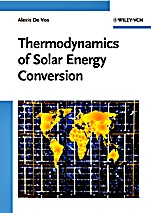
Thermodynamics of Solar Energy Conversion
ISBN 9783527408412
Autor: Alexis De Vos
Wydawca: Wiley
Dostępność: 3-6 tygodni
Cena: 584,85 zł
Przed złożeniem zamówienia prosimy o kontakt mailowy celem potwierdzenia ceny.
ISBN13: |
9783527408412 |
ISBN10: |
352740841X |
Autor: |
Alexis De Vos |
Oprawa: |
Hardback |
Rok Wydania: |
2008-02-13 |
Ilość stron: |
205 |
Wymiary: |
248x180 |
Tematy: |
PH |
The physical framework used to describe the various conversions is endoreversible thermodynamics, a subset of irreversible thermodynamics. Thermodynamics of Solar Energy Conversion provides an excellent generalized introduction into principles of solar energy conversion for everybody knowing some basics of university mathematics. Described are situations which are not in equilibrium and in which entropy is continuously created, but which are nevertheless stationary. In dealing with endoreversible thermodynamics, the given information in this book enables the reader to calculate the explicit values for a broad class of processes. It is demonstrated that solar energy conversion is a process particularly suited to being described in this way.
"De Vos is a wonderful storyteller"
—Prof. Dr. B. Andresen
Spis treści:
1 Radiation.
1.1 Introduction.
1.2 Photon Modes.
1.3 Photon Statistics.
1.4 Planck’s Law.
1.5 The Stefan–Boltzmann Law.
1.6 Kirchhoff’s Law.
1.7 Why T4?
1.8 Exercises.
References.
2 The Solar System.
2.1 The Sun.
2.2 The Planets.
2.3 Starlight.
2.4 Moonlight.
2.5 Radiation from “Empty” Space.
2.6 Internal Heat Sources.
2.7 Conclusion.
2.8 Exercises.
References.
3 Thermodynamical Engines.
3.1 Introduction.
3.2 The Carnot Engine.
3.3 The Curzon–Ahlborn Engine.
3.4 Endoreversible Engines.
3.5 An Example.
3.6 The Stefan–Boltzmann Engine.
3.7 Conclusion.
3.8 An Example.
3.9 Exercises.
References.
4 Wind Energy Creation.
4.1 Introduction.
4.2 Preliminary Model.
4.3 Final Model.
4.4 Why 8%?
4.5 Tidal Winds and ZonalWinds.
4.6 Two Examples.
4.7 Exercises.
References.
5 Photothermal Conversion.
5.1 Introduction.
5.2 Solar Energy Efficiency.
5.3 The Müser Engine.
5.4 Why 13%?
5.5 Concentrators.
5.6 The M&#
252;ser Engine with Concentrator.
5.7 Selective Black Bodies.
5.8 The Müser Engine with Bandgap.
5.9 Conclusion.
5.10 An Example.
5.11 Exercises.
References.
6 Photovoltaic Conversion.
6.1 Introduction.
6.2 Semiconductors.
6.3 The Solar Cell.
6.4 An Example.
6.5 Exercises.
References.
7 Hybrid Conversion.
7.1 Introduction.
7.2 Is a Solar Cell Really an Endoreversible Engine?
7.3 A Unified Model.
7.4 Alternative Model.
7.5 Onsager’s Principle.
7.6 Examples.
7.7 Exercises.
References.
8 Multicolor Conversion.
8.1 Introduction.
8.2 PhotothermalMulticolor Converters.
8.3 Photovoltaic Multicolor Converters.
8.4 Omnicolor Converters.
8.5 Two–Terminal Omnicolor Converters.
8.6 The Bose Engine.
8.7 Conclusion.
8.8 Two Examples.
8.9 Exercises.
References.
9 Chemical Reactions.
9.1 Introduction.
9.2 Reversible and Irreversible Chemical Engines.
9.3 The Generalized Endoreversible Engine.
9.4 Two Alternative Generalized Models.
9.5 The Endoreversible Chemical Reactor.
9.6 Conclusion.
9.7 Exercises.
References.
10 Photosynthesis.
10.1 Introduction.
10.2 The Photosynthesis Engine.
10.3 An Example.
10.4 Exercises.
References.
Post scriptum.
References.
Appendices.
A Constants.
A.1 Mathematical Constants.
A.2 Physical Constants.
B About the n–Dimensional Sphere.
C Kepler’s Second Law.
D About a Fourth–Degree Equation.
E The General Chemical Reaction.
F List of Symbols.
Index.
Nota biograficzna:
Alexis De Vos is electrical engineer and physicist, graduated from the Universiteit Gent (Belgium). He is currently part–time system engineer of the Flemish interuniversity microelectronics research centre, and part–time professor at the department of Elektronica en informatiesystemen of the Univ
ersiteit Gent. His research is concerned with material science (polymers, semiconductors, metals, liquid crystals), microelectronics (thin films, chips) and energy sciences (thermodynamics, solar energy, endoreversible engines, reversible computing). Besides writing this book, he was co–editor of the book "Thermodynamics of energy conversion and transport" (published 2000). Since 1993, he is the coordinator of the pan–European Carnot Network on thermodynamics and thermo– economics of energy conversion and transport.
Koszyk
Książek w koszyku: 0 szt.
Wartość zakupów: 0,00 zł
Informacje


Kontakt
Gambit
Centrum Oprogramowania
i Szkoleń Sp. z o.o.
Al. Pokoju 29b/22-24
31-564 Kraków
Siedziba Księgarni
ul. Kordylewskiego 1
31-542 Kraków
+48 12 410 5991
+48 12 410 5987
+48 12 410 5989
Subskrypcje
Administratorem danych osobowych jest firma Gambit COiS Sp. z o.o. Na podany adres będzie wysyłany wyłącznie biuletyn informacyjny.
Autoryzacja płatności

Informacje na temat autoryzacji płatności poprzez PayU.

© Copyright 2012: GAMBIT COiS Sp. z o.o. Wszelkie prawa zastrzeżone.
Projekt i wykonanie: Alchemia Studio Reklamy