


Wydawcy
Katalog tematyczny
- Archeologia (109)
- Ekonomia, finanse, business (13704)
- Filozofia (1445)
- Historia (3040)
- Języki i językoznawstwo (2356)
- Lifestyle, hobby i rozrywka (475)
- Medycyna (9704)
- Nauki humanistyczne (4)
- Nauki o Ziemi i środowisku (2638)
- Nauki ścisłe (20412)
- Astronomia (294)
- Biologia (5119)
- Chemia (6540)
- Fizyka (3309)
- Elektryczność i magnetyzm (90)
- Fizyka atomowa i molekularna (110)
- Fizyka cząstek elementarnych (36)
- Fizyka jądra atomowego (36)
- Fizyka kwantowa (210)
- Fizyka matematyczna (121)
- Fizyka relatywistyczna (36)
- Fizyka statystyczna (51)
- Fizyka stosowana (498)
- Mechanika klasyczna (186)
- Optyka i światło (133)
- Stany materii (202)
- Matematyka (4574)
- Nauki ścisłe, ogólnie (503)
- Nauki społeczne (8486)
- Nauki techniczne (13450)
- Prawo (1696)
- Publikacje informacyjne i interdyscyplinarne (1288)
- Religia i wierzenia (917)
- Technika komputerowa (4067)
- Zdrowie, relacje międzyludzkie i rozwój osobisty (657)





Informacje szczegółowe o książce
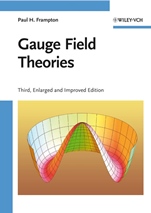
Gauge Field Theories
ISBN 9783527408351
Autor: Paul H. Frampton
Wydawca: Wiley
Dostępność: 3-6 tygodni
Cena: 976,50 zł
Przed złożeniem zamówienia prosimy o kontakt mailowy celem potwierdzenia ceny.
ISBN13: |
9783527408351 |
ISBN10: |
3527408355 |
Autor: |
Paul H. Frampton |
Oprawa: |
Hardback |
Rok Wydania: |
2008-08-13 |
Numer Wydania: |
3rd Edition |
Ilość stron: |
353 |
Wymiary: |
243x175 |
Tematy: |
PH |
Gauge theories provide a unified framework to describe three of the four universal forces known so far: the quantum field theories of electromagnetism, the weak force and the strong force. They are an essential part of the so–called standard model of particles and matter.
The first edition of this work was quickly adopted by universities and other institutions of higher learning around the world. Completely updated, this third edition continues to be an ideal reference on the subject. In total, more than a quarter of the content has been changed or added. The tried–and–tested logical structuring of the material on gauge invariance, quantization, and renormalization has been retained, while the chapters on electroweak interactions and model building have been revised. Completely new is the chapter on conformality. As in the past, Frampton emphasizes formalism rather than experiments and provides sufficient detail for readers wishing to do their own calculations or pursue theoretical physics research.Gauge InvarianceQuantizationRenormalizationElectroweak ForcesRenormalization GroupQuantum ChromodynamicsModel BuildingConformality
Spis treści:
Preface to the Third Edition.
Preface to the Second Edition.
1. Gauge Invariance.
1.1 Introduction.
1.2 Symmetries and Conservation Law.
1.3 Local Gauge Invariance.
1.4 Nambu–Goldstone Conjecture.
1.5 Higgs Mechanism.
1.6 Summary.
2. Quantization.
2.1 Introduction.
2.2 Path Integrals.
2.3 Faddeev–Popov Ansatz.
2.4 Feynman Rules.
2.5 Effects of Loop Corrections.
2.6 Summary.
3. Renormalization.
3.1 Introduction.
3.2 Dimensional Regularization.
3.3 Triangle Anomalies.
3.4 Becchi–Rouet–Stora–Tyutin Transformation.
3.5 Proof of Renormalizability.
3.6 "T" Hooft Gauges.
3.7 Summary.
4. Electroweak Forces.
4.1 Introduct
ion.
4.2 Lepton and Quark Masses.
4.3 Weak Interactions of Quarks and Leptons.
4.4 Charm.
4.5 Bottom and Top Quarks.
4.6 Precision Electroweak Data.
4.7 Higgs Boson.
4.8 Quark Flavor Mixing and CP Violation.
4.9 Summary.
5. Renormalization Group.
5.1 Introduction.
5.2 Renormalization Group Equations.
5.3 QCD Asymptotic Freedom.
5.4 Grand Unification.
5.5 Scaling Violations.
5.6 Background Field Method.
5.7 Summary.
6. Quantum Chromodynamics.
6.1 Introduction.
6.2 Renormalization Schemes.
6.3 Jets in Electron–Positron Annihilation.
6.4 Instantons.
6.5 1/N Expansion.
6.6 Lattice Gauge Theories.
6.7 Summary.
7. Model Building.
7.1 Introduction.
7.2 Puzzles of the Standard Model.
7.3 Left–Right Model.
7.4 Chiral Color.
7.5 Three Families and the 331 Model.
7.6 Conformality Constraints.
7.7 Summary.
8. Conformality.
8.1 Introduction.
8.2 Quiver Gauge Theories.
8.3 Conformality Phenomenology.
8.4 Tabulation of the Simplest Abelian Quivers.
8.5 Chiral Fermions.
8.6 Model Building.
8.7 Summary.
Index.
Nota biograficzna:
Paul H. Frampton is distinguished professor of physics at the University of North Carolina. After he received his D. Phil degree from the University of Oxford, UK, he conducted research at various institutions, among them Harvard University, and CERN (Geneva, Switzerland). His research focuses on theoretical high energy physics and cosmology. Professor Frampton has lectured on physics in 30 countries and is best known for chiral color and the 331–model.
Okładka tylna:
Gauge theories provide a unified framework to describe three of the four universal forces known so far: the quantum field theories of electromagnetism, the weak force and the strong force. They are an essential part of the so–called standard model of particles and matte
r.
The first edition of this work was quickly adopted by universities and other institutions of higher learning around the world. Completely updated, this third edition continues to be an ideal reference on the subject. In total, more than a quarter of the content has been changed or added. The tried–and–tested logical structuring of the material on gauge invariance, quantization, and renormalization has been retained, while the chapters on electroweak interactions and model building have been revised. Completely new is the chapter on conformality. As in the past, Frampton emphasizes formalism rather than experiments and provides sufficient detail for readers wishing to do their own calculations or pursue theoretical physics research.Gauge InvarianceQuantizationRenormalizationElectroweak ForcesRenormalization GroupQuantum ChromodynamicsModel BuildingConformality
Koszyk
Książek w koszyku: 0 szt.
Wartość zakupów: 0,00 zł
Informacje


Kontakt
Gambit
Centrum Oprogramowania
i Szkoleń Sp. z o.o.
Al. Pokoju 29b/22-24
31-564 Kraków
Siedziba Księgarni
ul. Kordylewskiego 1
31-542 Kraków
+48 12 410 5991
+48 12 410 5987
+48 12 410 5989
Subskrypcje
Administratorem danych osobowych jest firma Gambit COiS Sp. z o.o. Na podany adres będzie wysyłany wyłącznie biuletyn informacyjny.
Autoryzacja płatności

Informacje na temat autoryzacji płatności poprzez PayU.

© Copyright 2012: GAMBIT COiS Sp. z o.o. Wszelkie prawa zastrzeżone.
Projekt i wykonanie: Alchemia Studio Reklamy