


Wydawcy
Katalog tematyczny
- Archeologia (109)
- Ekonomia, finanse, business (13704)
- Filozofia (1445)
- Historia (3040)
- Języki i językoznawstwo (2356)
- Lifestyle, hobby i rozrywka (475)
- Medycyna (9704)
- Nauki humanistyczne (4)
- Nauki o Ziemi i środowisku (2638)
- Nauki ścisłe (20412)
- Astronomia (294)
- Biologia (5119)
- Chemia (6540)
- Fizyka (3309)
- Elektryczność i magnetyzm (90)
- Fizyka atomowa i molekularna (110)
- Fizyka cząstek elementarnych (36)
- Fizyka jądra atomowego (36)
- Fizyka kwantowa (210)
- Fizyka matematyczna (121)
- Fizyka relatywistyczna (36)
- Fizyka statystyczna (51)
- Fizyka stosowana (498)
- Mechanika klasyczna (186)
- Optyka i światło (133)
- Stany materii (202)
- Matematyka (4574)
- Nauki ścisłe, ogólnie (503)
- Nauki społeczne (8486)
- Nauki techniczne (13450)
- Prawo (1696)
- Publikacje informacyjne i interdyscyplinarne (1288)
- Religia i wierzenia (917)
- Technika komputerowa (4067)
- Zdrowie, relacje międzyludzkie i rozwój osobisty (657)





Informacje szczegółowe o książce
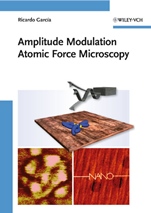
Amplitude Modulation Atomic Force Microscopy
ISBN 9783527408344
Autor: Ricardo García
Wydawca: Wiley
Dostępność: 3-6 tygodni
Cena: 757,05 zł
Przed złożeniem zamówienia prosimy o kontakt mailowy celem potwierdzenia ceny.
ISBN13: |
9783527408344 |
ISBN10: |
3527408347 |
Autor: |
Ricardo García |
Oprawa: |
Hardback |
Rok Wydania: |
2010-10-06 |
Ilość stron: |
193 |
Wymiary: |
249x181 |
Tematy: |
PH |
Filling a gap in the literature, this book features in–depth discussions on amplitude modulation AFM, providing an overview of the theory, instrumental considerations and applications of the technique in both academia and industry. As such, it includes examples from material science, soft condensed matter, molecular biology, and biophysics, among others. The text is written in such a way as to enable readers from different backgrounds and levels of expertise to find the information suitable for their needs.
Spis treści:
Part 1: Introduction
1.1 Nanoscale imaging in the XXI century
1.2 Nanomechanics and force microscopy
1.3 Evolution, key developments and their protagonists
1.4 Tapping mode or amplitude modulation force microscopy
Part 2: Instrumental aspects
2.1 Elements of an amplitude modulation force microscope
2.1.1 Feedback control
2.1.2 Optical detection
2.1.3 Scanners
2.2 Cantilevers
2.2.1 Calibration
2.3 Tips and probes
2.4 Resonance curves in air and liquids
2.5 Amplitude and phase shift curves
2.6 Optimum imaging conditions
2.6.1 Imaging artefacts
Part 3: Theory of amplitude modulation AFM
3.1 Introduction
3.2 Long–range and short range interaction forces
3.3 Contact mechanics models
3.4 Driven damped harmonic oscillator
3.5 Equation of motion based on point–mass models
3.5.1 Q–control
3.6 Attractive and repulsive interactions regimes
3.8 Equation of motion based on the Euler–Bernoulli model
3.9 Forces and observables
Part 4: Non–linear dynamics
4.1 Nonlinear dynamics and AFM
4.2 Non–linear resonance curves
4.3 Bistability
Part 5: Amplitude modulation AFM in liquids
5.1 Introduction
5.2 Interaction forces in liquids
5.3 Equation of motion based on point–mass models
5.4 Equation of motion based on continuous models
5.5 Numerical and finite element simulations
5.6 Experim
ental considerations
5.6.1 Fluid cells
Part 6: Phase imaging force microscopy
6.1 Theory of phase imaging force microscopy
6.2 Energy dissipation and phase shifts
6.2.1 Dynamic dissipation curves
6.2.2 Atomic and nanoscale dissipation processes
Part 7: Imaging material properties
7.1 Introduction
7.2 Compositional mapping versus chemical identification
7.3 Molecular recognition imaging
Part 8: Resolution, noise and sensitivity
8.1 Sources of noise
8.2 Forces and compositional sensitivity
8.3 Force induced surface deformations
8.4 Spatial resolution in air and liquids
Part 9: Applications
9.1 Some applications in soft–condensed matter
9.2 Some applications in biology
9.3 Some applications in material sciences
Part 10: Nanofabrication and Nanolithography
10.1 Nanofabrication by AFM
10.1.1 Instrumental aspects
10.1.2 Physical processes
10.2 Some examples of AM–AFM based–nanolithographies
Part 11: New trends
11.1 Operation beyond the fundamental resonance
11.1.1 Higher harmonics imaging
11.1.2 Higher eigenmode imaging
11.1.3 Bi–modal excitation
11.2 Fast–scanning
11.3 Other feedback mechanisms
Part 12: Other dynamics AFM methods
12.1 Frequency modulation AFM
12.1.1 Ultra high vacuum
12.1.2 Liquids
12.2 Kelvin probe and electrostatic force microscopies
References
Nota biograficzna:
Ricardo García is a Professor at the Instituto de Microelectrónica de Madrid (CSIC), one of the Institutes of the Spanish Council for Scientific Research. He graduated from the University of Valladolid, Spain, in 1984 and received his Ph.D. degree in physics from the Universidad Autónoma de Madrid in 1990. From 1990 to 1993 he was a post–doctoral associate at the Universities of New Mexico and Oregon. Professor García is the author and co–author of 86 articles published in international peer reviewed
journals and of 13 book chapters, and has contributed some highly regarded papers on the development and optimization of amplitude modulation AFM (tapping mode AFM) as well as on the emergence of scanning probe nanolithographies. In 2007, Professor García was elected fellow of the American Physical Society.
Koszyk
Książek w koszyku: 0 szt.
Wartość zakupów: 0,00 zł
Informacje


Kontakt
Gambit
Centrum Oprogramowania
i Szkoleń Sp. z o.o.
Al. Pokoju 29b/22-24
31-564 Kraków
Siedziba Księgarni
ul. Kordylewskiego 1
31-542 Kraków
+48 12 410 5991
+48 12 410 5987
+48 12 410 5989
Subskrypcje
Administratorem danych osobowych jest firma Gambit COiS Sp. z o.o. Na podany adres będzie wysyłany wyłącznie biuletyn informacyjny.
Autoryzacja płatności

Informacje na temat autoryzacji płatności poprzez PayU.

© Copyright 2012: GAMBIT COiS Sp. z o.o. Wszelkie prawa zastrzeżone.
Projekt i wykonanie: Alchemia Studio Reklamy