


Wydawcy
Katalog tematyczny
- Archeologia (109)
- Ekonomia, finanse, business (13704)
- Filozofia (1445)
- Historia (3040)
- Języki i językoznawstwo (2356)
- Lifestyle, hobby i rozrywka (475)
- Medycyna (9704)
- Nauki humanistyczne (4)
- Nauki o Ziemi i środowisku (2638)
- Nauki ścisłe (20412)
- Astronomia (294)
- Biologia (5119)
- Chemia (6540)
- Fizyka (3309)
- Elektryczność i magnetyzm (90)
- Fizyka atomowa i molekularna (110)
- Fizyka cząstek elementarnych (36)
- Fizyka jądra atomowego (36)
- Fizyka kwantowa (210)
- Fizyka matematyczna (121)
- Fizyka relatywistyczna (36)
- Fizyka statystyczna (51)
- Fizyka stosowana (498)
- Mechanika klasyczna (186)
- Optyka i światło (133)
- Stany materii (202)
- Matematyka (4574)
- Nauki ścisłe, ogólnie (503)
- Nauki społeczne (8486)
- Nauki techniczne (13450)
- Prawo (1696)
- Publikacje informacyjne i interdyscyplinarne (1288)
- Religia i wierzenia (917)
- Technika komputerowa (4067)
- Zdrowie, relacje międzyludzkie i rozwój osobisty (657)





Informacje szczegółowe o książce
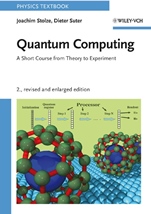
Quantum Computing: A Short Course from Theory to Experiment Revised and Enlarged
ISBN 9783527407873
Autor: Joachim Stolze, Dieter Suter
Wydawca: Wiley
Dostępność: 3-6 tygodni
Cena: 394,80 zł
Przed złożeniem zamówienia prosimy o kontakt mailowy celem potwierdzenia ceny.
ISBN13: |
9783527407873 |
ISBN10: |
3527407871 |
Autor: |
Joachim Stolze, Dieter Suter |
Oprawa: |
Paperback |
Rok Wydania: |
2008-01-23 |
Numer Wydania: |
2nd Edition |
Ilość stron: |
282 |
Wymiary: |
242x170 |
Tematy: |
PH |
The book gives an impressive description of current experiments. Despite of the high density of information, the authors succeeded to describe the fundamental concepts and methods. As it contains numerous references and links, this book also forms a solid starting point for further studies."
—Quoted from Physik Journal on the first edition
New to this editionWorking with single PhotonsReport on progress in the trapping and manipulation of neutral particlesQuantum simulations of strongly correlated many–particle modelsEnd–of–chapter problems
Spis treści:
Preface.
1 Introduction and Survey.
1.1 Information, Computers, and Quantum Mechanics.
1.2 Quantum Computer Basics.
1.3 History of Quantum Information Processing.
2 Physics of Computation.
2.1 Physical Laws and Information Processing.
2.2 Limitations on Computer Performance.
2.3 The Ultimate Laptop.
3 Elements of Classical Computer Science.
3.1 Bits of History.
3.2 Boole an Algebra and LogicGates.
3.3 Universal Computers.
3.4 Complexity and Algorithms.
4 Quantum Mechanics.
4.1 General Structure.
4.2 Quantum States.
4.3 Measurement Revisited.
5 Quantum Bits and Quantum Gates.
5.1 Single–Qubit Gates.
5.2 Two–Qubit Gates.
5.3 Universal Sets of Gates.
6 Feynman’s Contribution.
6.1 Simulating Physics with Computers.
6.2 Quantum Mechanical Computers.
7 Errors and Decoherence.
7.1 Motivation.
7.2 Decoherence.
7.3 Error Correction.
7.4 Avoiding Errors.
8 Tasks for Quantum Computers.
8.1 Quantum Versus Classical Algorithms.
8.2 The Deutsch Algorithm: Looking at Both Sides of a Coin at the Same Time.
8.3 The Shor Algorithm: It’s Prime Time.
8.4 The Grover Algorithm: Looking for a Needle in a Haystack.
8.5 Quantum Simulations.
9 How to Build
a Quantum Computer.
9.1 Components.
9.2 Requirements for Quantum Information Processing Hardware.
9.3 Converting Quantum to Classical Information.
9.4 Alternatives to the Network Model.
10 Liquid State NMR Quantum Computer.
10.1 Basics of NMR.
10.2 NMR as a Molecular Quantum Computer.
10.3 NMR Implementation of Shor’s Algorithm.
11 Trapped Ions and Atoms.
11.1 Trapping Ions.
11.2 Interaction with Light.
11.3 Quantum Information Processing with Trapped Ions.
11.4 Experimental Implementations.
11.5 Neutral Atoms.
11.6 Interacting Atoms in Optical Lattices.
12 Solid–State Quantum Computers.
12.1 Solid State NMR/EPR.
12.2 Superconducting Systems.
12.3 Semiconductor Qubits.
13 Photons for Quantum Information.
13.1 “QuantumOnly” Tasks.
13.2 A Few Bits of Classical Information Theory.
13.3 A Few Bits of Quantum Information Theory.
Appendix.
A Two Spins–1/2: Singlet and Triplet States.
Bibliography.
Index.
Nota biograficzna:
Dieter Suter is an experimentalist and well known for his NMR–work. He is currently working on quantum computation projects.
Juergen Stolze is an expert on the theory of quantum computation. His topic research area is quantum spin chains. Both authors are known to have excellent didactic skills.
Okładka tylna:
"The book gives an impressive description of current experiments. Despite of the high density of information, the authors succeeded to describe the fundamental concepts and methods. As it contains numerous references and links, this book also forms a solid starting point for further studies."
—Quoted from Physik Journal on the first edition
New to this editionWorking with single PhotonsReport on progress in the trapping and manipulation of neutral particlesQuantum simulations
of strongly correlated many–particle modelsEnd–of–chapter problems
Koszyk
Książek w koszyku: 0 szt.
Wartość zakupów: 0,00 zł
Informacje


Kontakt
Gambit
Centrum Oprogramowania
i Szkoleń Sp. z o.o.
Al. Pokoju 29b/22-24
31-564 Kraków
Siedziba Księgarni
ul. Kordylewskiego 1
31-542 Kraków
+48 12 410 5991
+48 12 410 5987
+48 12 410 5989
Subskrypcje
Administratorem danych osobowych jest firma Gambit COiS Sp. z o.o. Na podany adres będzie wysyłany wyłącznie biuletyn informacyjny.
Autoryzacja płatności

Informacje na temat autoryzacji płatności poprzez PayU.

© Copyright 2012: GAMBIT COiS Sp. z o.o. Wszelkie prawa zastrzeżone.
Projekt i wykonanie: Alchemia Studio Reklamy