


Wydawcy
Katalog tematyczny
- Archeologia (109)
- Ekonomia, finanse, business (13704)
- Filozofia (1445)
- Historia (3040)
- Języki i językoznawstwo (2356)
- Lifestyle, hobby i rozrywka (475)
- Medycyna (9704)
- Nauki humanistyczne (4)
- Nauki o Ziemi i środowisku (2638)
- Nauki ścisłe (20412)
- Astronomia (294)
- Biologia (5119)
- Chemia (6540)
- Fizyka (3309)
- Elektryczność i magnetyzm (90)
- Fizyka atomowa i molekularna (110)
- Fizyka cząstek elementarnych (36)
- Fizyka jądra atomowego (36)
- Fizyka kwantowa (210)
- Fizyka matematyczna (121)
- Fizyka relatywistyczna (36)
- Fizyka statystyczna (51)
- Fizyka stosowana (498)
- Mechanika klasyczna (186)
- Optyka i światło (133)
- Stany materii (202)
- Matematyka (4574)
- Nauki ścisłe, ogólnie (503)
- Nauki społeczne (8486)
- Nauki techniczne (13450)
- Prawo (1696)
- Publikacje informacyjne i interdyscyplinarne (1288)
- Religia i wierzenia (917)
- Technika komputerowa (4067)
- Zdrowie, relacje międzyludzkie i rozwój osobisty (657)





Informacje szczegółowe o książce
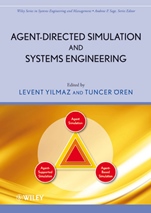
Agent–Directed Simulation and Systems Engineering
ISBN 9783527407811
Autor: Levent Yilmaz, Tuncer Ören
Wydawca: Wiley
Dostępność: 3-6 tygodni
Cena: 1 058,40 zł
Przed złożeniem zamówienia prosimy o kontakt mailowy celem potwierdzenia ceny.
ISBN13: |
9783527407811 |
ISBN10: |
3527407812 |
Autor: |
Levent Yilmaz, Tuncer Ören |
Oprawa: |
Hardback |
Rok Wydania: |
2009-09-23 |
Ilość stron: |
550 |
Wymiary: |
248x181 |
Tematy: |
PH |
The only book to present the synergy of modeling and simulation (M&S), systems engineering, and agent technologies; takes into account all three aspects of the synergy of M&S and agents, i.e. agent simulation, agent–supported simulation, and agent–based simulation.
Accessible to practitioners, researchers, and managers, it systematically addresses designing and building advanced agent–directed modelling and simulation systems from a systems engineering perspective.
Spis treści:
Foreword.
Preface.
List of Contributors.
Part One. Background.
1. Modeling and Simulation: a Comprehensive and Integrative View (Tuncer I. Ören).
1.1 Introduction.
1.2 Simulation: Several Perspectives.
1.3 Model–Based Activities.
1.4 Synergies of M&S: Mutual and Higher–Order Contributions.
1.5 Advancement of M&S.
1.6 Preeminence of M&S.
1.7 Summary and Conclusions.
2. Autonomic Introspective Simulation Systems (Levent Yilmaz and Bradley Mitchell).
2.1 Introduction.
2.2 Perspective and Background on Autonomic Systems.
2.3 Decentralized Autonomic Simulation Systems: Prospects and Issues.
2.4 Symbiotic Adaptive Multisimulation: An Autonomic Simulation System.
2.5 Cast Study: UAV Search and Attack Scenario.
2.6 Validation and Preliminary Experimentation with SAMS.
2.7 Summary.
Part Two. Agents and Modeling and Simulation.
3. Agents: Agenthood, Agent Architectures, and Agent Taxonomies (Andreas Tolk and Adelinde M. Uhrmacher)
3.1 Introduction.
3.2 Agenthood.
3.3 Agent Architectures.
3.4 Agenthood Implications for Practical Applications.
3.5 Agent Taxonomies.
3.6 Concluding Discussion.
4. Agent–directed Simulation (Levent Yilmaz and Tuncer I. Ören).
4.1 Introduction.
4.2 Background.
4.3 Categorizing the Use of Agents in Simul
ation.
4.4 Agent Simulation.
4.5 Agent–Based Simulation.
4.6 Agent–Supported Simulation.
4.7 Summary.
Part Three. Systems Engineering and Quality Assurance for Agent–Directed Simulation.
5. Systems Engineering: Basic Concepts and Life Cycle (Steven M. Biemer and Andrew P. Sage).
5.1 Introduction.
5.2 Agent–Based Systems Engineering.
5.3 Systems Engineering Definition and Attributes.
5.4 The System Life Cycle.
5.5 Key Concepts of Systems Engineering.
5.6 Summary.
6. Quality Assurance of Simulation Studies of Complex Networked Agent Systems (Osman Balci, William F. Ormsby, and Levent Yilmaz).
6.1 Introduction.
6.2 Characteristics of Open Agent Systems.
6.3 Issues in the Quality Assurance of Agent Simulations.
6.4 Large–Scale Open Complex Systems – The Network–Centric System Metaphor.
6.5 M&S Challenges for Large–Scale Open Complex Systems.
6.6 Quality Assessment of Simulations of Large–Scale Open Systems.
6.7 Conclusions.
7. Failure Avoidance in Agent–directed Simulation: Beyond Conventional v&v and qa (Tuncer I. Ören and Levent Yilmaz).
7.1 Introduction.
7.2 What Can Go Wrong.
7.3 Assessment for M&S.
7.4 Need for Multiparadigm Approach for Successful M&S Projects.
7.5 Failure Avoidance for Agent–Based Modeling.
7.6 Failure Avoidance for Systems Engineering.
7.7 Conclusion.
8. Toward Systems Engineering for Agent–directed Simulation (Levent Yilmaz).
8.1 Introduction.
8.2 What Is a System?
8.3 Modeling and Simulation.
8.4 The Synergy of M&S and SE.
8.5 Toward Systems Engineering for Agent–Directed Simulation.
8.6 Sociocognitive Framework for ADS–SE.
8.7 Case Study: Human–Centered Work Systems.
8.8 Conclusion.
9. Design and Analysis of Organization Adaptation in Agent Systems (
Virginia Dignum, Frank Dignum, and Liz Sonenberg).
9.1 Introduction.
9.2 Organizational Model.
9.3 Organizational Structure.
9.4 Organization and Environment.
9.5 Organization and Autonomy.
9.6 Reorganization.
9.7 Organizational Design.
9.8 Understanding Simulation of Reorganization.
9.9 Conclusions.
10. Programming Languages, Environments, and Tools for Agent–directed Simulation (Yu Zhang, Mark Lewis, and Maarten Sierhuis).
10.1 Introduction.
10.2 Architectural Style for ADS.
10.3 Agent–Directed Simulation – An Overview.
10.4 A Survey of Five ADS Platforms.
10.5 Brahms – A Multiagent Simulation for Work System Analysis and Design.
10.6 CASESim – A Multiagent Simulation for Cognitive Agents for Social Environment
10.7 Conclusion.
11. Simulation for Systems Engineering (Joachim Fuchs).
11.1 Introduction.
11.2 The Systems Engineering Process.
11.3 Modeling and Simulation Support.
11.4 Facilities.
11.5 An Industrial Use Case: Space Systems.
11.6 Outlook.
11.7 Conclusions.
12. Agent–directed Simulation for Systems Engineering (Philip S. Barry, Matthew T.K. Koehler, and Brian F. Tivnan).
12.1 Introduction.
12.2 New Approaches Are Needed.
12.3 Agent–Directed Simulation for the Systems Engineering of Human Complex Systems.
12.4 A Model–Centered Science of Human Complex Systems.
12.5 An Infrastructure for the Engineering of Human Complex Systems.
12.6 Case Studies.
12.7 Summary.
Part Four. Agent–Directed Simulation for Systems Engineering.
13. Agent–implemented Experimental Frames for Net–centric Systems Test and Evaluation (Bernard P. Zeigler, Dane Hall, and Manuel Salas).
13.1 Introduction.
13.2 The Need for Verification Requirements.
13.3 Experimental Frames and System Entity Structures.
13.4 Decomposition and Design of System Architecture.
13.5
Employing Agents in M&S–Based Design, Verification and Validation.
13.6 Experimental Frame Concepts for Agent Implementation.
13.7 Agent–Implemented Experimental Frames.
13.8 DEVS–SOA: Net–Centric Execution Using Simulation Service.
13.9 Summary and Conclusions.
14. Agents and Decisions Support Systems (Andreas Tolk, Poornima Madhavan, Jeffrey W. Tweedale, and Lakhmi C. Jain).
14.1 Introduction.
14.2 Cognitive Foundations for Decision Support.
14.3 Technical Foundations for Decision Support.
14.4 Examples for Intelligent and Agent–Directed Decision Support Simulation Systems.
14.5 Conclusion.
15. Agent Simulation for Software Process Performance Analysis (Levent Yilmaz and Jared Phillips).
15.1 Introduction.
15.2 Related Work.
15.3 Team–RUP: A Framework for Agent Simulation of Software Development Organizations.
15.4 Design and Implementation of Team–RUP.
15.5 Results and Discussion.
15.6 Conclusions.
16. Agent–Directed Simulation for Manufacturing System Engineering (Jeffrey S. Smith, Erdal Sahin, and Levent Yilmaz).
16.1 Introduction.
16.2 Simulation Modeling and Analysis for Manufacturing Systems.
16.3 Agent–Directed Simulation for Manufacturing Systems.
16.4 Summary.
17. Organization and Work Systems Design and Engineering: from Simulation to Implementation of Multiagent Systems (Maarten Sierhuis, William J. Clancey, and Chin H. Seah).
17.1 Introduction.
17.2 Work Systems Design.
17.3 Modeling and Simulation of Work Systems.
17.4 Work Practice Modeling and Simulation.
17.5 The Brahms Language.
17.6 Systems Engineering: From Simulation to Implementation.
17.7 A Case Study: The OCA Mirroring System.
17.8 Conclusion.
Index.
Nota biograficzna:
Levent Yilmaz is associate professor at the departments of Computer Science and Software Engineerin
g and Industrial and Systems Engineering in the College of Engineering, Auburn University, USA. Professor Yilmaz received his Ph.D. and M.S. degrees from Virginia Polytechnic Institute and State University (Virginia Tech), Blacksburg, USA. His research interests include modeling and computer simulation, agent–directed simulation, and complex adaptive systems. Professor Yilmaz has contributed to the advancement of the theory and methodology of modeling and simulation via novel formalisms such as generative simulation, autonomic introspective simulation and their use in decision/creativity support systems. He is the Editor–in–Chief of the journal Simulation: Transactions of the Society for Computer Simulation International.
Tuncer I. Ören is professor emeritus of Computer Science at the School of Information Technology and Engineering (SITE) of the University of Ottawa, Canada where he started 1970. He received his Ph.D. in Systems Engineering from the University of Arizona, Tucson, USA. His research interests include advanced methodologies for modeling and simulation, agent–directed simulation, cognitive simulation, reliability, quality, and ethics in simulation as well as body of knowledge and terminology of simulation. He has published over 300 papers and 20 books and contributed to over 370 conferences and seminars held in 30 countries.
Okładka tylna:
The only book to present the synergy of modeling and simulation (M&S), systems engineering, and agent technologies; takes into account all three aspects of the synergy of M&S and agents, i.e. agent simulation, agent–supported simulation, and agent–based simulation.
Accessible to practitioners, researchers, and managers, it systematically addresses designing and building advanced agent–directed modelling and simulation systems from a systems engineering perspective.
Koszyk
Książek w koszyku: 0 szt.
Wartość zakupów: 0,00 zł
Informacje


Kontakt
Gambit
Centrum Oprogramowania
i Szkoleń Sp. z o.o.
Al. Pokoju 29b/22-24
31-564 Kraków
Siedziba Księgarni
ul. Kordylewskiego 1
31-542 Kraków
+48 12 410 5991
+48 12 410 5987
+48 12 410 5989
Subskrypcje
Administratorem danych osobowych jest firma Gambit COiS Sp. z o.o. Na podany adres będzie wysyłany wyłącznie biuletyn informacyjny.
Autoryzacja płatności

Informacje na temat autoryzacji płatności poprzez PayU.

© Copyright 2012: GAMBIT COiS Sp. z o.o. Wszelkie prawa zastrzeżone.
Projekt i wykonanie: Alchemia Studio Reklamy