


Wydawcy
Katalog tematyczny
- Archeologia (109)
- Ekonomia, finanse, business (13704)
- Filozofia (1445)
- Historia (3040)
- Języki i językoznawstwo (2356)
- Lifestyle, hobby i rozrywka (475)
- Medycyna (9704)
- Nauki humanistyczne (4)
- Nauki o Ziemi i środowisku (2638)
- Nauki ścisłe (20412)
- Astronomia (294)
- Biologia (5119)
- Chemia (6540)
- Fizyka (3309)
- Elektryczność i magnetyzm (90)
- Fizyka atomowa i molekularna (110)
- Fizyka cząstek elementarnych (36)
- Fizyka jądra atomowego (36)
- Fizyka kwantowa (210)
- Fizyka matematyczna (121)
- Fizyka relatywistyczna (36)
- Fizyka statystyczna (51)
- Fizyka stosowana (498)
- Mechanika klasyczna (186)
- Optyka i światło (133)
- Stany materii (202)
- Matematyka (4574)
- Nauki ścisłe, ogólnie (503)
- Nauki społeczne (8486)
- Nauki techniczne (13450)
- Prawo (1696)
- Publikacje informacyjne i interdyscyplinarne (1288)
- Religia i wierzenia (917)
- Technika komputerowa (4067)
- Zdrowie, relacje międzyludzkie i rozwój osobisty (657)





Informacje szczegółowe o książce
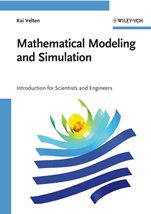
Mathematical Modeling and Simulation: Introduction for Scientists and Engineers
ISBN 9783527407583
Autor: Kai Velten
Wydawca: Wiley
Dostępność: 3-6 tygodni
Cena: 656,25 zł
Przed złożeniem zamówienia prosimy o kontakt mailowy celem potwierdzenia ceny.
ISBN13: |
9783527407583 |
ISBN10: |
3527407588 |
Autor: |
Kai Velten |
Oprawa: |
Paperback |
Rok Wydania: |
2008-12-17 |
Ilość stron: |
362 |
Wymiary: |
249x172 |
Tematy: |
PH |
This concise and clear introduction to the topic requires only basic knowledge of calculus and linear algebra—all other concepts and ideas are developed in the course of the book. Lucidly written so as to appeal to undergraduates and practitioners alike, it enables readers to set up simple mathematical models on their own and to interpret their results and those of others critically. To achieve this, many examples have been chosen from various fields, such as biology, ecology, economics, medicine, agricultural, chemical, electrical, mechanical and process engineering, which are subsequently discussed in detail.
Based on the author′s modeling and simulation experience in science and engineering and as a consultant, the book answers such basic questions as: What is a mathematical model? What types of models do exist? Which model is appropriate for a particular problem? What are simulation, parameter estimation, and validation?
The book relies exclusively upon open–source software which is available to everybody free of charge. The entire book software including 3D CFD and structural mechanics simulation software—can be used based on a free CAELinux–Live–DVD that is available in the Internet (works on most machines and operating systems).
From the Contents:Principles of mathematical modelingPhenomenological and mechanistic modelsDifferential equation models (ODE′s and PDE′s)Open–Source Software, e.g. for 3D CFD and structural mechanicsIntroduction into CAELinux, Calc, Code–Saturne, Maxima, R, Salome–Meca
Spis treści:
Preface.
1. Principles of Mathematical Modeling.
1.1 A Complex World Needs Models.
1.2 Systems, Models, Simulations.
1.3 Mathematics is The Natural Modeling Language.
1.4 Definition of Mathematical Models.
1.5 Examples and Some More Definitions.
1.6 Even More Definitions.
1.7 Cla
ssification of Mathematical Models.
1.8 Everything Looks Like a Nail?
2. Phenomenological Models.
2.1 Elementary Statistics.
2.2 Linear Regression.
2.3 Multiple Linear Regression.
2.4 Nonlinear Regression.
2.5 Neural Networks.
2.6 Design of Experiments.
2.7 Other Phenomenological Modeling Approaches.
3. Mechanistic Models I: ODE′s.
3.1 Distinguished Role of Differential Equations.
3.2 Introductory Examples.
3.3 General Idea of ODE′s.
3.4 Setting up ODE Models.
3.5 Some Theory you Should Know.
3.6 Solution of ODE′s: Overview.
3.7. Closed Form Solution.
3.8 Numerical Solutions.
3.9 Fitting ODE′s to Data.
3.10 More Examples.
4. Mechanistic Models II: PDE′s.
4.1. Introduction.
4.2. The Heat Equation.
4.3. Some Theory you Should Know.
4.4 Closed Form Solution.
4.5 Numerical Solution of PDE′s.
4.6 The Finite Difference Method.
4.7 The Finite Element Method.
4.8 Finite Element Software.
4.9 A Sample Session Using Salome–Meca.
4.10 A Look Beyond the Heat Equation.
4.11 Other Mechanistic Modeling Approaches.
A. CAElinux and the Book Software.
B. R (Programming Language and Software Environment).
C. Maxima.
Index.
Nota biograficzna:
Kai Velten is a professor of mathematics at the University of Applied Sciences, Wiesbaden, Germany, and a modeling and simulation consultant. Having studied mathematics, physics and economics at the Universities of Gottingen and Bonn, he worked at Braunschweig Technical University (Institute of Geoecology, 1990–93) and at Erlangen University (Institute of Applied Mathematics, 1994–95). From 1996–2000, he held a post as project manager and group leader at the Fraunhofer–ITWM in Kaiserslautern (consultant projects for the industry). His research emphasizes differential equation models and is documented in 34 scientific publications a
nd one patent.
Okładka tylna:
This concise and clear introduction to the topic requires only basic knowledge of calculus and linear algebra—all other concepts and ideas are developed in the course of the book. Lucidly written so as to appeal to undergraduates and practitioners alike, it enables readers to set up simple mathematical models on their own and to interpret their results and those of others critically. To achieve this, many examples have been chosen from various fields, such as biology, ecology, economics, medicine, agricultural, chemical, electrical, mechanical and process engineering, which are subsequently discussed in detail.
Based on the author′s modeling and simulation experience in science and engineering and as a consultant, the book answers such basic questions as: What is a mathematical model? What types of models do exist? Which model is appropriate for a particular problem? What are simulation, parameter estimation, and validation?
The book relies exclusively upon open–source software which is available to everybody free of charge. The entire book software including 3D CFD and structural mechanics simulation software—can be used based on a free CAELinux–Live–DVD that is available in the Internet (works on most machines and operating systems).
From the Contents:Principles of mathematical modelingPhenomenological and mechanistic modelsDifferential equation models (ODE′s and PDE′s)Open–Source Software, e.g. for 3D CFD and structural mechanicsIntroduction into CAELinux, Calc, Code–Saturne, Maxima, R, Salome–Meca
Koszyk
Książek w koszyku: 0 szt.
Wartość zakupów: 0,00 zł
Informacje


Kontakt
Gambit
Centrum Oprogramowania
i Szkoleń Sp. z o.o.
Al. Pokoju 29b/22-24
31-564 Kraków
Siedziba Księgarni
ul. Kordylewskiego 1
31-542 Kraków
+48 12 410 5991
+48 12 410 5987
+48 12 410 5989
Subskrypcje
Administratorem danych osobowych jest firma Gambit COiS Sp. z o.o. Na podany adres będzie wysyłany wyłącznie biuletyn informacyjny.
Autoryzacja płatności

Informacje na temat autoryzacji płatności poprzez PayU.

© Copyright 2012: GAMBIT COiS Sp. z o.o. Wszelkie prawa zastrzeżone.
Projekt i wykonanie: Alchemia Studio Reklamy