


Wydawcy
Katalog tematyczny
- Archeologia (109)
- Ekonomia, finanse, business (13704)
- Filozofia (1445)
- Historia (3040)
- Języki i językoznawstwo (2356)
- Lifestyle, hobby i rozrywka (475)
- Medycyna (9704)
- Nauki humanistyczne (4)
- Nauki o Ziemi i środowisku (2638)
- Nauki ścisłe (20412)
- Astronomia (294)
- Biologia (5119)
- Chemia (6540)
- Fizyka (3309)
- Elektryczność i magnetyzm (90)
- Fizyka atomowa i molekularna (110)
- Fizyka cząstek elementarnych (36)
- Fizyka jądra atomowego (36)
- Fizyka kwantowa (210)
- Fizyka matematyczna (121)
- Fizyka relatywistyczna (36)
- Fizyka statystyczna (51)
- Fizyka stosowana (498)
- Mechanika klasyczna (186)
- Optyka i światło (133)
- Stany materii (202)
- Matematyka (4574)
- Nauki ścisłe, ogólnie (503)
- Nauki społeczne (8486)
- Nauki techniczne (13450)
- Prawo (1696)
- Publikacje informacyjne i interdyscyplinarne (1288)
- Religia i wierzenia (917)
- Technika komputerowa (4067)
- Zdrowie, relacje międzyludzkie i rozwój osobisty (657)





Informacje szczegółowe o książce
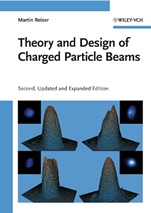
Theory and Design of Charged Particle Beams
ISBN 9783527407415
Autor: Martin Reiser
Wydawca: Wiley
Dostępność: 3-6 tygodni
Cena: 1 140,30 zł
Przed złożeniem zamówienia prosimy o kontakt mailowy celem potwierdzenia ceny.
ISBN13: |
9783527407415 |
ISBN10: |
3527407413 |
Autor: |
Martin Reiser |
Oprawa: |
Hardback |
Rok Wydania: |
2008-03-26 |
Numer Wydania: |
2nd Edition, Updated and Expanded |
Ilość stron: |
674 |
Wymiary: |
252x181 |
Tematy: |
PH |
Most advanced accelerator applications require beams with high–power and high brightness, which are determined by space–charge effects at low energy. Examples are the giant High Energy Physics Large Hadron Collider (LHC) at CERN, to be launched in 2008, and the International Linear Collider (ILC) being considered to follow the LHC. Other examples are Spallation Neutron Sources, the proposed Heavy Ion Inertial Fusion driver for energy production, Free Electron Lasers, and Muon Colliders.
This revised and updated monograph offers a broad synoptic description of beams in accelerators and other devices with negligible to strong space charge effects. The book develops material in a systematic way and discusses the underlying physics and validity of theoretical relationships, design formulas and scaling laws. Assumptions and approximations are clearly indicated throughout.
The new edition of Theory and Design of Charged Particle Beams has significant additional content, which covers experiments, theory, and simulation in beam physics research since 1993, when the first edition was published. It includes the University of Maryland Electron Ring for studying space–charge dominated beams in rings and re–circulators.
From the Contents:Review of Charged Particle DynamicsBeam Optics and Focusing Systems without Space ChargeLinear Beam Optics with Space ChargeSelf–Consistent Theory of BeamsEmittance VariationBeam Physics Research from 1999 to 2007
Spis treści:
Preface for 2nd Edition.
Preface for 1st Edition.
Acknowledgments for 2nd Edition.
Acknowledgments for 1st Edition.
1 Introduction.
1.1 Exposition.
1.2 Historical Developments and Applications.
1.3 Sources of Charged Particles.
References.
2 Review of Charged Particle Dynamics.
2.1 The Lorentz Force and the Equation of Motion.
2.2 The
Energy Integral and Some General Formulas.
2.3 The Lagrangian and Hamiltonian Formalisms.
2.4 The Euler Trajectory Equations.
2.5 Analytic Examples of Charged Particle Motion.
Reference.
Problems.
3 Beam Optics and Focusing Systems without Space Charge.
3.1 Beam Emittance and Brightness.
3.2 Liouville’s Theorem.
3.3 The Paraxial Ray Equation for Axially Symmetric Systems.
3.4 Axially Symmetric Fields as Lenses.
3.5 Focusing by Quadrupole Lenses.
3.6 Constant–Gradient Focusing in Circular Systems.
3.7 Sector Magnets and Edge Focusing.
3.8 Periodic Focusing.
3.9 Adiabatic Damping of the Betatron Oscillation Amplitudes.
References.
Problems.
4 Linear Beam Optics with Space Charge.
4.1 Theoretical Models of Beams with Space Charge.
4.2 Axisymmetric Beams in Drift Space.
4.3 Axisymmetric Beams with Applied and Self Fields.
4.4 Periodic Focusing of Intense Beams (Smooth–Approximation Theory).
4.5 Space–Charge Tune Shift and Current Limits in Circular Accelerators.
4.6 Charge Neutralization Effects.
References.
Problems.
5 Self–Consistent Theory of Beams.
5.1 Introduction.
5.2 Laminar Beams in Uniform Magnetic Fields.
5.3 The Vlasov Model of Beams with Momentum Spread.
5.4 The Maxwell–Boltzmann Distribution.
References.
Problems.
6 Emittance Growth.
6.1 Causes of Emittance Change.
6.2 Free Energy and Emittance Growth in Nonstationary Beams.
6.3 Instabilities.
6.4 Collisions.
6.5 Beam Cooling Methods in Storage Rings.
6.6 Concluding Remarks.
References.
Problems.
7 Beam Physics Research from 1993 to 2007.
7.1 Introduction.
7.2 Longitudinal Beam Physics Research.
7.3 Transverse Beam Physics.
7.4 The University of Maryland Electron Ring.
7.5 Issues Related to Electron Photoinjectors.
7.6 Concluding Remarks.
References.
Problems.
Appendix 1. Example
of a Pierce–Type Electron Gun with Shielded Cathode.
References.
Appendix 2. Example of a Magnetron Injection Gun.
References.
Appendix 3. Four–Vectors and Covariant Lorentz Transformations.
References.
Appendix 4. Equipartitioning in High–Current rf Linacs.
References.
Appendix 5. Radial Defocusing and Emittance Growth in High–Gradient rf Structures (Example: The rf Photocathode Electron Gun).
References.
List of Frequently Used Symbols.
Bibliography (Selected List of Books).
Index.
Nota biograficzna:
Martin Reiser received his Ph.D. in physics in 1960 from the University of Mainz, Germany. From 1961 to 1964 he was assistant professor of physics at Michigan State University. In 1965, he joined the University of Maryland as associate professor of Electrical Engineering and Physics. He has been a full professor there since 1970. He was co–founder of the University of Maryland′s Institute for Research in Electronics and Applied Physics (IREAP). His research interests are in the space charge physics of intense beams. Professor Reiser is the author of more than 300 research papers and served on numerous committees. In 1997/98 he was chair of the Executive Committee of the APS Division of Physics of Beams. He retired in 1998 as Professor Emeritus of Electrical and Computer Engineering from his teaching position and continues to work part–time with his research group in IREAP.
Okładka tylna:
Most advanced accelerator applications require beams with high–power and high brightness, which are determined by space–charge effects at low energy. Examples are the giant High Energy Physics Large Hadron Collider (LHC) at CERN, to be launched in 2008, and the International Linear Collider (ILC) being considered to follow the LHC. Other examples are Spallation Neutron Sources, the proposed Heavy I
on Inertial Fusion driver for energy production, Free Electron Lasers, and Muon Colliders.
This revised and updated monograph offers a broad synoptic description of beams in accelerators and other devices with negligible to strong space charge effects. The book develops material in a systematic way and discusses the underlying physics and validity of theoretical relationships, design formulas and scaling laws. Assumptions and approximations are clearly indicated throughout.
The new edition of Theory and Design of Charged Particle Beams has significant additional content, which covers experiments, theory, and simulation in beam physics research since 1993, when the first edition was published. It includes the University of Maryland Electron Ring for studying space–charge dominated beams in rings and re–circulators.
From the Contents:Review of Charged Particle DynamicsBeam Optics and Focusing Systems without Space ChargeLinear Beam Optics with Space ChargeSelf–Consistent Theory of BeamsEmittance VariationBeam Physics Research from 1999 to 2007
Koszyk
Książek w koszyku: 0 szt.
Wartość zakupów: 0,00 zł
Informacje


Kontakt
Gambit
Centrum Oprogramowania
i Szkoleń Sp. z o.o.
Al. Pokoju 29b/22-24
31-564 Kraków
Siedziba Księgarni
ul. Kordylewskiego 1
31-542 Kraków
+48 12 410 5991
+48 12 410 5987
+48 12 410 5989
Subskrypcje
Administratorem danych osobowych jest firma Gambit COiS Sp. z o.o. Na podany adres będzie wysyłany wyłącznie biuletyn informacyjny.
Autoryzacja płatności

Informacje na temat autoryzacji płatności poprzez PayU.

© Copyright 2012: GAMBIT COiS Sp. z o.o. Wszelkie prawa zastrzeżone.
Projekt i wykonanie: Alchemia Studio Reklamy