


Wydawcy
Katalog tematyczny
- Archeologia (109)
- Ekonomia, finanse, business (13704)
- Filozofia (1445)
- Historia (3040)
- Języki i językoznawstwo (2356)
- Lifestyle, hobby i rozrywka (475)
- Medycyna (9704)
- Nauki humanistyczne (4)
- Nauki o Ziemi i środowisku (2638)
- Nauki ścisłe (20412)
- Astronomia (294)
- Biologia (5119)
- Chemia (6540)
- Fizyka (3309)
- Elektryczność i magnetyzm (90)
- Fizyka atomowa i molekularna (110)
- Fizyka cząstek elementarnych (36)
- Fizyka jądra atomowego (36)
- Fizyka kwantowa (210)
- Fizyka matematyczna (121)
- Fizyka relatywistyczna (36)
- Fizyka statystyczna (51)
- Fizyka stosowana (498)
- Mechanika klasyczna (186)
- Optyka i światło (133)
- Stany materii (202)
- Matematyka (4574)
- Nauki ścisłe, ogólnie (503)
- Nauki społeczne (8486)
- Nauki techniczne (13450)
- Prawo (1696)
- Publikacje informacyjne i interdyscyplinarne (1288)
- Religia i wierzenia (917)
- Technika komputerowa (4067)
- Zdrowie, relacje międzyludzkie i rozwój osobisty (657)





Informacje szczegółowe o książce
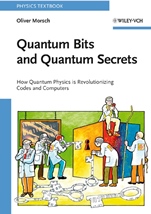
Quantum Bits and Quantum Secrets: How Quantum Physics is revolutionizing Codes and Computers
ISBN 9783527407101
Autor: Oliver Morsch
Wydawca: Wiley
Dostępność: 3-6 tygodni
Cena: 422,10 zł
Przed złożeniem zamówienia prosimy o kontakt mailowy celem potwierdzenia ceny.
ISBN13: |
9783527407101 |
ISBN10: |
3527407103 |
Autor: |
Oliver Morsch |
Oprawa: |
Paperback |
Rok Wydania: |
2008-02-13 |
Ilość stron: |
189 |
Wymiary: |
237x176 |
Tematy: |
PH |
A concise, "no–frills" introduction to quantum computation and quantum cryptography for non–experts. Rather than concentrating on stories about scientists and philosophical concepts, it provides a step–by–step approach to quantum information. Starting from the idea of quantum cryptography, it presents the basic principles of quantum mechanics and explains how this can be used to make cryptography absolutely secure against eavesdropping. Subsequently, technical problems in realizing quantum computers are discussed, followed by a presentation of recent experiments –– some of which are found here in a textbook for the first time.
Easily accessible for undergraduates and graduates –– especially those studying subjects other than physics –– who need an introduction to this rapidly developing topic.
Spis treści:
1 Introduction.
2 The Colors of the Rainbow.
A Prelude.
2.1 The Early Beginnings.
2.2 How Fast is Light?
2.3 Particle or Wave?
2.4 Ripples on a Lake.
2.5 A Spark Flies.
2.6 In Search of the Ether.
2.7 Enter Einstein.
3 Light, Waves and Oscillations.
Some Useful Facts.
3.1 Wavelength, Phase and Interference.
3.2 Coherence.
3.3 Polarization.
4 Nature’s Currency.
The Story of the Quantum.
4.1 An act of Desperation.
4.2 Photons Galore.
4.3 Uncertainty.
4.4 Have You Ever Seen an Atom?
4.5 A Question of Stability.
5 Surprising Discoveries.
A Glimpse at Quantum Mechanics.
5.1 Young Again.
5.2 Which Way to the Screen?
5.3 Distant Relations.
6 When Alice Met Bob.
The Principles of Quantum Cryptography.
6.1 A History of Secrets.
6.2 Zeroes and Ones.
6.3 One–time Pads.
6.4 Secret Photons.
6.5 An Element of Randomness.
6.6 Sifting Keys.
6.7 The BB84 Protocol.
6.8 No Cloning, Please.
6.9 Noisy Bu
siness.
6.10 Growing Secrecy.
6.11 Ekert’s Idea.
6.12 Real–world Quantum Cryptography.
7 The Logic of Superpositions.
How Quantum Computing Works.
7.1 Logic Gates.
7.2 The Basic Idea.
7.3 Reversibility.
7.4 The CNOT Gate.
7.5 Something New.
7.6 A Magic Test.
7.7 Balanced and Unbalanced.
7.8 One Step Closer . . . .
8 Shor’s Revolution.
An Introduction to Quantum Algorithms.
8.1 Grover’s Database Search.
8.2 How Fast?
8.3 Shor’s Factorization Algorithm.
8.3.1 Slow Calculations.
8.3.2 A Nice Trick.
8.3.3 Finding the Period.
8.3.4 The RSA Code.
9 Promising Prototypes.
How Quantum Computers Might be Built.
9.1 Moore’s End.
9.2 The DiVincenzo Criteria.
9.3 Qubits in Different Physical Systems.
9.3.1 Ions in Electric Traps.
9.3.2 Optical Lattices.
9.3.3 Superconducting Qubits.
9.3.4 Electrons in Quantum Dots.
9.3.5 Nuclear Magnetic Resonance.
9.3.6 Photonic Quantum Computers.
10 Sensitive States.
Why Quantum Error Correction is Important.
10.1 Classical Error Correction.
10.2 A Simple Case.
11 Trying the Impossible.
More Quantum Tricks.
11.1 Teleportation.
11.2 Dense Coding.
12 Dream or Reality?
The Past, Present and Future of Quantum Information.
12.1 The Past.
12.1.1 Feynman’s Input.
12.2 The Present.
12.3 The ARDA Roadmap.
12.4 Quantum Simulators.
12.5 Commercial Systems.
12.6 The Future.
Internet Resources.
Further Reading.
Glossary.
Bibliography.
Index.
Nota biograficzna:
Oliver Morsch, born in 1970, received his Ph.D. in physics from Oxford University in 1999. He then accepted a post as senior researcher at the National Research Council of the National Institute for the Physics of Matter in Pisa, Italy. Dr. Morsch′s
research interests concentrate on ultracold atoms, Bose–Einstein condensation and quantum computers. He works as a freelance science journalist for various newspapers and journals and has published two popular science books with Wiley–VCH.
Okładka tylna:
A concise, "no–frills" introduction to quantum computation and quantum cryptography for non–experts. Rather than concentrating on stories about scientists and philosophical concepts, it provides a step–by–step approach to quantum information. Starting from the idea of quantum cryptography, it presents the basic principles of quantum mechanics and explains how this can be used to make cryptography absolutely secure against eavesdropping. Subsequently, technical problems in realizing quantum computers are discussed, followed by a presentation of recent experiments –– some of which are found here in a textbook for the first time.
Easily accessible for undergraduates and graduates –– especially those studying subjects other than physics –– who need an introduction to this rapidly developing topic.
Koszyk
Książek w koszyku: 0 szt.
Wartość zakupów: 0,00 zł
Informacje


Kontakt
Gambit
Centrum Oprogramowania
i Szkoleń Sp. z o.o.
Al. Pokoju 29b/22-24
31-564 Kraków
Siedziba Księgarni
ul. Kordylewskiego 1
31-542 Kraków
+48 12 410 5991
+48 12 410 5987
+48 12 410 5989
Subskrypcje
Administratorem danych osobowych jest firma Gambit COiS Sp. z o.o. Na podany adres będzie wysyłany wyłącznie biuletyn informacyjny.
Autoryzacja płatności

Informacje na temat autoryzacji płatności poprzez PayU.

© Copyright 2012: GAMBIT COiS Sp. z o.o. Wszelkie prawa zastrzeżone.
Projekt i wykonanie: Alchemia Studio Reklamy