


Wydawcy
Katalog tematyczny
- Archeologia (109)
- Ekonomia, finanse, business (13704)
- Filozofia (1445)
- Historia (3040)
- Języki i językoznawstwo (2356)
- Lifestyle, hobby i rozrywka (475)
- Medycyna (9704)
- Nauki humanistyczne (4)
- Nauki o Ziemi i środowisku (2638)
- Nauki ścisłe (20412)
- Astronomia (294)
- Biologia (5119)
- Chemia (6540)
- Fizyka (3309)
- Elektryczność i magnetyzm (90)
- Fizyka atomowa i molekularna (110)
- Fizyka cząstek elementarnych (36)
- Fizyka jądra atomowego (36)
- Fizyka kwantowa (210)
- Fizyka matematyczna (121)
- Fizyka relatywistyczna (36)
- Fizyka statystyczna (51)
- Fizyka stosowana (498)
- Mechanika klasyczna (186)
- Optyka i światło (133)
- Stany materii (202)
- Matematyka (4574)
- Nauki ścisłe, ogólnie (503)
- Nauki społeczne (8486)
- Nauki techniczne (13450)
- Prawo (1696)
- Publikacje informacyjne i interdyscyplinarne (1288)
- Religia i wierzenia (917)
- Technika komputerowa (4067)
- Zdrowie, relacje międzyludzkie i rozwój osobisty (657)





Informacje szczegółowe o książce
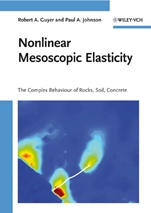
Nonlinear Mesoscopic Elasticity: The Complex Behaviour of Rocks, Soil, Concrete
ISBN 9783527407033
Autor: Robert A. Guyer, Paul A. Johnson
Wydawca: Wiley
Dostępność: 3-6 tygodni
Cena: 827,40 zł
Przed złożeniem zamówienia prosimy o kontakt mailowy celem potwierdzenia ceny.
ISBN13: |
9783527407033 |
ISBN10: |
3527407030 |
Autor: |
Robert A. Guyer, Paul A. Johnson |
Oprawa: |
Hardback |
Rok Wydania: |
2009-08-19 |
Ilość stron: |
410 |
Wymiary: |
248x179 |
Tematy: |
PH |
This volume brings together a great deal of new data on the static and dynamic elastic properties of granular and other composite material. The authors are at the very center of today s research and present new and imported theoretical tools that have enabled our current understanding of the complex behavior of rocks.
There are three central themes running throughout the presentation:
Rocks as the prototype material for defining a class of materials The PM space model as a useful theoretical construct for developing a phenomenology A sequencer of refined analysis methods.This suite of new methods for both recording and analyzing data is more than a single framework for interpretation; it is also a toolbox for the experiment. This comprehensive and systematic book if of utmost interest to anybody involved in non–destructive testing, civil engineering, and geophysics.
Preface .
Acknowledgements.
1 Introduction.
1.1 Systems.
1.2 Examples of Phenomena.
1.3 The Domain of Exploration.
1.4 Outline.
References.
2 Microscopic/Macroscopic Formulation of the Traditional Theory of Linear and Nonlinear Elasticity.
2.1 Prefatory Remarks.
2.2 From Microscopic to Continuum.
2.3 Continuum Elasticity and Macroscopic Phenomenology.
2.4 Thermodynamics.
2.5 Energy Scales.
References.
3 Traditional Theory of Nonlinear Elasticity, Results.
3.1 Quasistatic Response; Linear and Nonlinear.
3.2 Dynamic Response; Linear.
3.3 Quasistatic/Dynamic Response; Nonlinear.
3.4 Dynamic Response; Nonlinear.
3.5 Exotic Response; Nonlinear.
3.6 Green Functions.
References.
4 Mesoscopic Elastic Elements and Macroscopic Equations of State.
4.1 Background.
4.2 Elastic Elements.
4.3 Effective Medium Theory.
4.4 Equations of State; Examples.
References.
5 Auxiliary Fields.
5.1 Temperature.
5.2 Saturation.
5.3 The Conditioning Field, X.
References.
6 Hysteretic Elastic Elements.
6.1 Finite Displacement Elastic Elements; Quasistatic Response.
6.2 Finite Displacement Elastic Elements: Inversion.
6.3 Finite Displacement Elastic Elements: Dynamic Response.
6.4 Models with Hysteresis.
6.5 Summary.
6.6 Models with Hysteresis, Detail.
References.
7 The Dynamics of Elastic Systems; Fast and Slow.
7.1 Fast/Slow Linear Dynamics.
7.2 Fast Nonlinear Dynamics.
7.3 Auxiliary Fields and Slow Dynamics.
7.4 Summary.
References.
8 Q and Issues of Data Modeling/Analysis.
8.1 Attenuation in Linear Elastic Systems.
8.2 Nonlinear Attenuation.
8.3 Why Measure Q?
8.4 How to Measure Q.
8.5 Resonant Bar Revisited.
References.
9 Elastic State Spectroscopies and Elastic State Tomographies.
9.1 Spectroscopies.
9.2 Tomographies, Linear, Inhomogeneous.
9.3 Tomographies, Nonlinear, Inhomogeneous.
References.
10 Quasistatic Measurements.
10.1 Some Basic Observations.
10.2 Quasistatic Stress–Strain Data; Hysteresis.
10.3 Coupling to Auxiliary Fields.
10.4 Inversion.
References.
11 Dynamic Measurements.
11.1 Quasistatic–Dynamic.
11.2 Dynamic Dynamic.
11.3 Examples of Systems.
References.
12 Field Observations.
12.1 Active Probes.
12.2 Passive Probes.
References.
13 Nonlinear Elasticity and Nondestructive Evaluation and Imaging.
13.1 Overview.
13.2 Historical Context.
13.3 Simple Conceptual Model of a Crack in an Otherwise Elastically Linear Solid.
13.4 Nonlinear Elastic Wave Spectroscopy in Nondestructive Evaluation (NEWS).
13.5 Progressive Mechanical Damage Probed by NEWS Techniques.
13.6 Mechanical Damage Location and Imaging.
13.7 Other Methods for Extracting the Elastic Nonlinearity.
13.8 Summary.
References.
Color Plates.
Index.
Paul Johnson is a Senior Technical Staff Member at Los Alamos National Laboratory and head of the group working on elastic nonlinearity. He obtained his Doctorate in Physical Acoustics from the Sorbonne (Paris VII) in 1997, after obtaining an MS degree in Geophysics from the University of Arizona, and a BS degree in Geology from the University of New Mexico. His interests include nonlinear and disordered systems in general, seismic strong ground motion and source characteristics, and nonlinear nondestructive evolution, time reverse acoustics and rock physics. Prof. Johnson is a fellow of the Acoustical Society of America and of the Los Alamos National Laboratory. He (co)–authored approximately 100 research papers and holds three patents.
Robert Guyer received his Ph.D. degree in physics from Cornell University, Ithaca, New York. He holds a post as a Full Professor of Physics at the University of Massachusetts, Amherst, from which he retired in 2006. Professor Guyer s interests focus on quantum fluids and solids, transport in disordered media, linear/nonlinear elasticity and perspicacious data analysis.
Koszyk
Książek w koszyku: 0 szt.
Wartość zakupów: 0,00 zł
Informacje


Kontakt
Gambit
Centrum Oprogramowania
i Szkoleń Sp. z o.o.
Al. Pokoju 29b/22-24
31-564 Kraków
Siedziba Księgarni
ul. Kordylewskiego 1
31-542 Kraków
+48 12 410 5991
+48 12 410 5987
+48 12 410 5989
Subskrypcje
Administratorem danych osobowych jest firma Gambit COiS Sp. z o.o. Na podany adres będzie wysyłany wyłącznie biuletyn informacyjny.
Autoryzacja płatności

Informacje na temat autoryzacji płatności poprzez PayU.

© Copyright 2012: GAMBIT COiS Sp. z o.o. Wszelkie prawa zastrzeżone.
Projekt i wykonanie: Alchemia Studio Reklamy