


Wydawcy
Katalog tematyczny
- Archeologia (94)
- Ekonomia, finanse, business (11664)
- Filozofia (1411)
- Historia (2972)
- Języki i językoznawstwo (2311)
- Lifestyle, hobby i rozrywka (411)
- Medycyna (5054)
- Nauki humanistyczne (2)
- Nauki o Ziemi i środowisku (1033)
- Nauki ścisłe (10005)
- Astronomia (12)
- Biologia (1261)
- Chemia (5074)
- Fizyka (1553)
- Elektryczność i magnetyzm (14)
- Fizyka atomowa i molekularna (13)
- Fizyka cząstek elementarnych (1)
- Fizyka jądra atomowego (1)
- Fizyka relatywistyczna (1)
- Fizyka stosowana (39)
- Mechanika klasyczna (18)
- Optyka i światło (14)
- Stany materii (20)
- Matematyka (1875)
- Nauki ścisłe, ogólnie (177)
- Nauki społeczne (6049)
- Nauki techniczne (5313)
- Prawo (160)
- Publikacje informacyjne i interdyscyplinarne (706)
- Religia i wierzenia (900)
- Technika komputerowa (2101)
- Zdrowie, relacje międzyludzkie i rozwój osobisty (632)





Informacje szczegółowe o książce
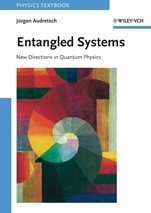
Entangled Systems: New Directions in Quantum Physics
ISBN 9783527406845
Autor: Jürgen Audretsch
Wydawca: Wiley
Dostępność: 3-6 tygodni
Cena: 368,55 zł
Przed złożeniem zamówienia prosimy o kontakt mailowy celem potwierdzenia ceny.
ISBN13: |
9783527406845 |
ISBN10: |
3527406840 |
Autor: |
Jürgen Audretsch |
Oprawa: |
Paperback |
Rok Wydania: |
2007-02-23 |
Ilość stron: |
357 |
Wymiary: |
245x173 |
Tematy: |
PH |
An introductory textbook for advanced students of physics, chemistry and computer science, covering an area of physics that has lately witnessed rapid expansion. The topics treated here include quantum information, quantum communication, quantum computing, teleportation and hidden parameters, thus imparting not only a well–founded understanding of quantum theory as such, but also a solid basis of knowledge from which readers can follow the rapid development of the topic or delve deeper into a more specialized branch of research. Commented recommendations for further reading as well as end–of–chapter problems help the reader to quickly access the theoretical basics of future key technologies.
Spis treści:
Preface to the English Edition.
Preface to the German Edition.
1 The Mathematical Framework.
1.1 Hilbert Vector Space.
1.2 Liouville Operator Space.
1.3 The Elements of Probability Theory.
1.4 Complementary Topics and Further Reading.
1.5 Problems for Chapter 1.
2 Basic Concepts of Quantum Theory.
2.1 First Version of the Postulates (pure states of isolated quantum systems).
2.2 Outlook.
2.3 Manipulation of the Evolution of the States by Projective Measurements.
2.4 The Structure of Physical Theories.
2.5 Interpretations of Quantum Theory and Physical Reality.
2.6 Complementary Topics and Further Reading.
3 The Simplest Quantum Systems: Qubits.
3.1 Pauli Operators.
3.2 Visualisation of Qubits on the Bloch Sphere.
3.3 Visualisation of the Measurement Dynamics and the Unitary Dynamics.
3.4 Quantum Gates for Single Qubit Systems.
3.5 Spin–1/2.
3.6 Photon Polarisations.
3.7 Single Photons in a Beam Splitter and in an Interferometer.
3.8 Locating a Bomb Without Exploding It by Using a Null Measurement.
3.9 Complementary Topics and Further Reading.
3.10 Problems for Chapter 3.
4 Mixed States and the Density Oper
ator.
4.1 Density Operators for a Given Ensemble (Statistical Mixture).
4.2 The Generalised Quantum State.
4.3 Different Ensemble Decompositions of a Density Operator and the Ignorance Interpretation.
4.4 Density Operators of Qubits.
4.5 Complementary Topics and Further Reading.
4.6 Problems for Chapter 4.
5 Shannon’s Entropy and Classical Information.
5.1 Definition and Properties.
5.2 Shannon’s Theorem.
5.3 Classical Information.
5.4 Classical Relative Entropy.
5.5 Mutual Information as a Measure of the Correlation between Two Messages.
5.6 Complementary Topics and Further Reading.
5.7 Problems for Chapter 5.
6 The von Neumann Entropy and Quantum Information.
6.1 The Quantum Channel and Quantum Entropy.
6.2 Qubits as the Unit of Quantum Information.
6.3 Properties.
6.4 The Interfaces of Preparation and Measurement.
6.5 Quantum Information.
6.6 Complementary Topics and Further Reading.
6.7 Problems for Chapter 6.
7 Composite Systems.
7.1 Subsystems.
7.2 The Product Hilbert Space.
7.3 The Fundamentals of the Physics of Composite Quantum Systems.
7.4 Manipulationson aSubsystem.
7.5 Separate Manipulations on both Subsystems.
7.6 The Unitary Dynamics of Composite Systems.
7.7 A First Application of Entanglement: a Conjuring Trick.
7.8 Quantum Gates for Multiple Qubit Systems.
7.9 Systems of Identical Particles.
7.10 Complementary Topics and Further Reading.
7.11 Problems for Chapter 7.
8 Entanglement.
8.1 Correlations andEntanglement.
8.2 Outlook.
8.3 Entangled Pure States.
8.4 The PPT Criterion for the Entanglement of Mixtures.
8.5 The Production of Entangled States.
8.6 The No–Cloning Theorem Prevents Transfer of Information Faster than the Velocity.of.Light.
8.7 Marking States by Entanglement.
8.8 Complementary Topics and Further Reading.
8.9 Problems for Chapter 8.
9 Corre
lations and Non–Local Measurements.
9.1 Entropies and the Correlations of Composite Quantum Systems.
9.2 Non–Local Measurements.
9.3 Complementary Topics and Further Reading.
9.4 Problems for Chapter 9.
10 There is no (Local–Realistic) Alternative to Quantum Theory.
10.1 EPR Experiments and Their Quantum–mechanical Explanation.
10.2 Correlated Gloves.
10.3 Local Realism.
10.4 Hidden Variables, Bell Inequalities and Contradictions of Experiments.
10.5 Separable Mixtures Obey the Bell Inequality.
10.6 Entanglement Witnesses.
10.7 3–Particle Entanglement and Quantum Locality.
10.8 Complementary Topics and Further Reading.
10.9 Problems for Chapter 10.
11 Working with Entanglement.
11.1 Quantum Cryptography.
11.2 One Qubit Transmits Two Bits (Dense Coding).
11.3 Quantum Teleportation.
11.4 Entanglement Swapping.
11.5 Spooky Action into the Past?
11.6 Entanglement Distillation.
11.7 A Measure of Entanglement for Mixtures: Entanglement of Formation and Concurrence.
11.8 Complementary Topics and Further Reading.
11.9 Problems for Chapter 11.
12 The Quantum Computer.
12.1 Registers and Networks.
12.2 Functional Computation.
12.3 Quantum Parallelism.
12.4 Two Simple Quantum Algorithms.
12.5 Grover’s Search Algorithm.
12.6 Shor’s Factorisation Algorithm.
12.7 Quantum Error Correction Using Non–local Measurements.
12.8 The Components of the Quantum Computer.
12.9 Complementary Topics and Further Reading.
12.10 Problems for Chapter 12.
13 Generalised Measurements, POVM.
13.1 The Function of a Generalised Dynamics of Open Quantum Systems.
13.2 The Non–optimal Stern–Gerlach Experiment and Generalised Measurements.
13.3 Generalised Measurements.
13.4 POVM Measurements.
13.5 Complementary Topics and Further Reading.
13.6 Problems for Chapter 13.
14 The General
Evolution of an Open Quantum System and Special Quantum Channels.
14.1 Quantum Operations and their Operator–Sum Decompositions.
14.2 The Master Equation.
14.3 Completely General Selective Measurements and POVM.
14.4 Quantum Channels.
14.5 The Scenario and the Rules of Quantum Theory Revisited.
14.6 Complementary Topics and Further Reading.
14.7 Problems for Chapter 14.
15 Decoherence and Approaches to the Description of the Quantum Measurement Process.
15.1 Channels which Produce Decoherence.
15.2 Environment–Induced Decoherence.
15.3 The Quantum Measurement Process.
15.4 Has the Problem of Measurements been Solved?
15.5 The Many–Worlds Interpretation.
15.6 Complementary Topics and Further Reading.
15.7 Problems for Chapter 15.
16 Two Implementations of Quantum Operations.
16.1 The Operator–Sum Decomposition.
16.2 The Unitary Implementation of Quantum Operations.
16.3 Implementation of a Completely General Selective Measurement by Unitary Transformation and Projection.
16.4 Complementary Topics and Further Reading.
16.5 Problems for Chapter 16.
References.
Reference categories.
Bibliography.
Subject Index.
Nota biograficzna:
Jurgen Audretsch studied physics at the Universities of Tubingen and Freiburg, Germany. In 1980, he was appointed to a professorship in theoretical physics at the University of Konstanz, Germany, where he still teaches. While putting a focus on research in general relativity and the quantum field theory in the past, he now concentrates on quantum optics and the quantum information theory. Professor Audretsch has published numerous articles in scientific journals and edited books. He is also the author of several popular science books.
Koszyk
Książek w koszyku: 0 szt.
Wartość zakupów: 0,00 zł
Informacje


Kontakt
Gambit
Centrum Oprogramowania
i Szkoleń Sp. z o.o.
Al. Pokoju 29b/22-24
31-564 Kraków
Siedziba Księgarni
ul. Kordylewskiego 1
31-542 Kraków
+48 12 410 5991
+48 12 410 5987
+48 12 410 5989
Subskrypcje
Administratorem danych osobowych jest firma Gambit COiS Sp. z o.o. Na podany adres będzie wysyłany wyłącznie biuletyn informacyjny.
Autoryzacja płatności

Informacje na temat autoryzacji płatności poprzez PayU.

© Copyright 2012: GAMBIT COiS Sp. z o.o. Wszelkie prawa zastrzeżone.
Projekt i wykonanie: Alchemia Studio Reklamy