


Wydawcy
Katalog tematyczny
- Archeologia (109)
- Ekonomia, finanse, business (13704)
- Filozofia (1445)
- Historia (3040)
- Języki i językoznawstwo (2356)
- Lifestyle, hobby i rozrywka (475)
- Medycyna (9704)
- Nauki humanistyczne (4)
- Nauki o Ziemi i środowisku (2638)
- Nauki ścisłe (20412)
- Astronomia (294)
- Biologia (5119)
- Chemia (6540)
- Fizyka (3309)
- Elektryczność i magnetyzm (90)
- Fizyka atomowa i molekularna (110)
- Fizyka cząstek elementarnych (36)
- Fizyka jądra atomowego (36)
- Fizyka kwantowa (210)
- Fizyka matematyczna (121)
- Fizyka relatywistyczna (36)
- Fizyka statystyczna (51)
- Fizyka stosowana (498)
- Mechanika klasyczna (186)
- Optyka i światło (133)
- Stany materii (202)
- Matematyka (4574)
- Nauki ścisłe, ogólnie (503)
- Nauki społeczne (8486)
- Nauki techniczne (13450)
- Prawo (1696)
- Publikacje informacyjne i interdyscyplinarne (1288)
- Religia i wierzenia (917)
- Technika komputerowa (4067)
- Zdrowie, relacje międzyludzkie i rozwój osobisty (657)





Informacje szczegółowe o książce
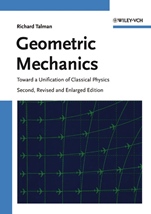
Geometric Mechanics: Toward a Unification of Classical Physics
ISBN 9783527406838
Autor: Richard Talman
Wydawca: Wiley
Dostępność: 3-6 tygodni
Cena: 1 071,00 zł
Przed złożeniem zamówienia prosimy o kontakt mailowy celem potwierdzenia ceny.
ISBN13: |
9783527406838 |
ISBN10: |
3527406832 |
Autor: |
Richard Talman |
Oprawa: |
Hardback |
Rok Wydania: |
2007-05-25 |
Numer Wydania: |
2nd, Revised and Enlarged Edition |
Ilość stron: |
605 |
Wymiary: |
248x181 |
Tematy: |
PH |
Mechanics is quite obviously geometric, yet the traditional approach to the subject is based mainly on differential equations. Setting out to make mechanics both accessible and interesting for non–mathematicians, Richard Talman augments this approach with geometric methods such as differential geometry, differential forms, and tensor analysis to reveal qualitative aspects of the theory.
For easy reference, the author treats Lagrangian, Hamiltonian, and Newtonian mechanics separately – exploring their geometric structure through vector fields, symplectic geometry, and gauge invariance respectively.
This second, fully revised edition has been expanded to further emphasize the importance of the geometric approach. Starting from Hamilton′s principle, the author shows, from a geometric perspective, how "all" of classical physics can be subsumed within classical mechanics. Having developed the formalism in the context of classical mechanics, the subjects of electrodynamics, relativistic strings and general relativity are treated as examples of classical mechanics. This modest unification of classical physics is intended to provide a background for the far more ambitious "grand unification" program of quantum field theory.
The final chapters develop approximate methods for the analysis of mechanical systems. Here the emphasis is more on practical perturbative methods than on the canonical transformation formalism. "Geometric Mechanics" features numerous illustrative examples and assumes only basic knowledge of Lagrangian mechanics.
Spis treści:
Preface.
Introduction.
Bibliography.
1 Review of Classical Mechanics and String Field Theory.
1.1 Preview and Rationale.
1.2 Review of Lagrangians and Hamiltonians.
1.3 Derivation of the Lagrange Equation from Hamilton′s Principle.
1.4 Linear, Multiparticle Systems.
1.5 Effective Potential and the Kepler Problem.
1.6 Multiparticle
Systems.
1.7 Longitudinal Oscillation of a Beaded String.
1.8 Field Theoretical Treatment and Lagrangian Density.
1.9 Hamiltonian Density for Transverse String Motion.
1.10 String Motion Expressed as Propagating and ReflectingWaves.
1.11 Problems.
Bibliography.
2 Geometry of Mechanics, I, Linear.
2.1 Pairs of Planes as Covariant Vectors.
2.2 Differential Forms.
2.3 Algebraic Tensors.
2.4 (Possibly Complex) Cartesian Vectors in Metric Geometry.
Bibliography.
3 Geometry of Mechanics, II, Curvilinear.
3.1 (Real) Curvilinear Coordinates in n–Dimensions.
3.2 Derivation of the Lagrange Equations from the Absolute Differential.
3.3 Intrinsic Derivatives and the Bilinear Covariant.
3.4 The Lie Derivative – Coordinate Approach.
3.5 The Lie Derivative – Lie Algebraic Approach.
3.6 Identification of Vector Fields with Differential Operators.
3.7 Coordinate Congruences.
3.8 Lie–Dragged Congruences and the Lie Derivative.
3.9 Commutators of Quasi–Basis–Vectors.
Bibliography.
4 Geometry of Mechanics, III, Multilinear.
4.1 Generalized Euclidean Rotations and Reflections.
4.2 Multivectors.
4.3 Curvilinear Coordinates in Euclidean Geometry (Continued).
4.4 Spinors in Three–Dimensional Space.
5 Lagrange–Poincaré Description of Mechanics.
5.1 The Poincaré Equation.
5.2 Variational Derivation of the Poincaré Equation.
5.3 Restricting the Poincaré Equation With Group Theory.
Bibliography.
6 Newtonian/Gauge Invariant Mechanics.
6.1 Vector Mechanics.
6.2 Single Particle Equations in Gauge Invariant Form.
6.3 Gauge Invariant Description of Rigid Body Motion.
6.4 The Foucault Pendulum.
6.5 Tumblers and Divers.
Bibliography.
7 Hamiltonian Treatment of Geometric Optics.
7.1 Analogy Between Mechanics and Geometric Optics.
7.2 Variational Princip
les.
7.3 Paraxial Optics, Gaussian Optics, Matrix Optics.
7.4 Huygens’ Principle.
Bibliography.
8 Hamilton–Jacobi Theory.
8.1 Hamilton–Jacobi Theory Derived from Hamilton’s Principle.
8.2 Trajectory Determination Using the Hamilton–Jacobi Equation.
8.3 The Kepler Problem.
8.4 Analogies Between Optics and Quantum Mechanics.
Bibliography.
9 Relativistic Mechanics.
9.1 Relativistic Kinematics.
9.2 Relativistic Mechanics.
9.3 Introduction of Electromagnetic Forces into Relativistic Mechanics.
Bibliography.
10 Conservation Laws and Symmetry.
10.1 Conservation of Linear Momentum.
10.2 Rate of Change of Angular Momentum: Poincaré Approach.
10.3 Conservation of Angular Momentum: Lagrangian Approach.
10.4 Conservation of Energy.
10.5 Cyclic Coordinates and Routhian Reduction.
10.6 Noether’s Theorem.
10.7 Conservation Laws in Field Theory.
10.8 Transition From Discrete to Continuous Representation.
10.9 Angular Momentum of a System of Particles.
10.10 Angular Momentum of a Field.
Bibliography.
11 Electromagnetic Theory.
11.1 The Electromagnetic Field Tensor.
11.2 The Electromagnetic Field Equations.
Bibliography.
12 Relativistic Strings.
12.1 Introduction.
12.2 Area Representation in Terms of the Metric.
12.3 The Lagrangian Density and Action for Strings.
12.4 Equations of Motion, Boundary Conditions, and Unexcited Strings.
12.5 The Action in Terms of Transverse Velocity.
12.6 Orthogonal Parameterization by Energy Content.
12.7 General Motion of a Free Open String.
12.8 A Rotating Straight String.
12.9 Conserved Momenta of a String.
12.10 Light Cone Coordinates.
12.11 Oscillation Modes of a Relativistic String.
Bibliography.
13 General Relativity.
13.1 Introduction.
13.2 Transformation to Locally Inertial Coordinates.
13.3 Parallel Transport on a Surface.
13.4 The Twin Paradox in General Relativity.
13.5 The Curvature Tensor.
13.6 The Lagrangian of General Relativity and the Energy–Momentum Tensor.
13.7 “Derivation” of the Einstein Equation.
13.8 Weak, Nonrelativistic Gravity.
13.9 The Schwarzschild Metric.
13.10 Gravitational Lensing and Red Shifts.
Bibliography.
14 Analytic Bases for Approximation.
14.1 Canonical Transformations.
14.2 Time–Independent Canonical Transformation.
14.3 Action–Angle Variables.
14.4 Examples of Adiabatic Invariance.
14.5 Accuracy of Conservation of Adiabatic Invariants.
14.6 Conditionally Periodic Motion.
Bibliography.
15 Linear Hamiltonian Systems.
15.1 Linear Hamiltonian Systems.
15.2 Periodic Linear Systems.
Bibliography.
16 Perturbation Theory.
16.1 The Lagrange Planetary Equations.
16.2 Advance of Perihelion of Mercury.
16.3 Iterative Analysis of Anharmonic Oscillations.
16.4 The Method of Krylov and Bogoliubov.
16.5 Superconvergent Perturbation Theory.
Bibliography.
17 Symplectic Mechanics.
17.1 The Symplectic Properties of Phase Space.
17.2 Symplectic Geometry.
17.3 Poisson Brackets of Scalar Functions.
17.4 Integral Invariants.
17.5 Invariance of the Poincaré–Cartan Integral Invariant I.I.
17.6 Symplectic System Evolution.
Bibliography.
Index.
Nota biograficzna:
Richard M. Talman is Professor of Physics at Cornell University, Ithaca, New York. He studied physics at the University of Western Ontario and received his Ph.D. at the California Institute of Technology in 1963. After accepting a full professorship for Physics at Cornell in 1971, he spent time as Visiting Scientist in Stanford, CERN, Berkeley, and the S.S.C. in Dallas and Saskatchewan. In addition, he has delivered lecture series at several institutions including Rice and Yale Universities. Professor Talman has bee
n engaged in the design and construction of a series of accelerators, with special emphasis on x–rays.
Okładka tylna:
Mechanics is quite obviously geometric, yet the traditional approach to the subject is based mainly on differential equations. Setting out to make mechanics both accessible and interesting for non–mathematicians, Richard Talman augments this approach with geometric methods such as differential geometry, differential forms, and tensor analysis to reveal qualitative aspects of the theory.
For easy reference, the author treats Lagrangian, Hamiltonian, and Newtonian mechanics separately – exploring their geometric structure through vector fields, symplectic geometry, and gauge invariance respectively.
This second, fully revised edition has been expanded to further emphasize the importance of the geometric approach. Starting from Hamilton′s principle, the author shows, from a geometric perspective, how "all" of classical physics can be subsumed within classical mechanics. Having developed the formalism in the context of classical mechanics, the subjects of electrodynamics, relativistic strings and general relativity are treated as examples of classical mechanics. This modest unification of classical physics is intended to provide a background for the far more ambitious "grand unification" program of quantum field theory.
The final chapters develop approximate methods for the analysis of mechanical systems. Here the emphasis is more on practical perturbative methods than on the canonical transformation formalism. "Geometric Mechanics" features numerous illustrative examples and assumes only basic knowledge of Lagrangian mechanics.
Koszyk
Książek w koszyku: 0 szt.
Wartość zakupów: 0,00 zł
Informacje


Kontakt
Gambit
Centrum Oprogramowania
i Szkoleń Sp. z o.o.
Al. Pokoju 29b/22-24
31-564 Kraków
Siedziba Księgarni
ul. Kordylewskiego 1
31-542 Kraków
+48 12 410 5991
+48 12 410 5987
+48 12 410 5989
Subskrypcje
Administratorem danych osobowych jest firma Gambit COiS Sp. z o.o. Na podany adres będzie wysyłany wyłącznie biuletyn informacyjny.
Autoryzacja płatności

Informacje na temat autoryzacji płatności poprzez PayU.

© Copyright 2012: GAMBIT COiS Sp. z o.o. Wszelkie prawa zastrzeżone.
Projekt i wykonanie: Alchemia Studio Reklamy