


Wydawcy
Katalog tematyczny
- Archeologia (109)
- Ekonomia, finanse, business (13704)
- Filozofia (1445)
- Historia (3040)
- Języki i językoznawstwo (2356)
- Lifestyle, hobby i rozrywka (475)
- Medycyna (9704)
- Nauki humanistyczne (4)
- Nauki o Ziemi i środowisku (2638)
- Nauki ścisłe (20412)
- Astronomia (294)
- Biologia (5119)
- Chemia (6540)
- Fizyka (3309)
- Elektryczność i magnetyzm (90)
- Fizyka atomowa i molekularna (110)
- Fizyka cząstek elementarnych (36)
- Fizyka jądra atomowego (36)
- Fizyka kwantowa (210)
- Fizyka matematyczna (121)
- Fizyka relatywistyczna (36)
- Fizyka statystyczna (51)
- Fizyka stosowana (498)
- Mechanika klasyczna (186)
- Optyka i światło (133)
- Stany materii (202)
- Matematyka (4574)
- Nauki ścisłe, ogólnie (503)
- Nauki społeczne (8486)
- Nauki techniczne (13450)
- Prawo (1696)
- Publikacje informacyjne i interdyscyplinarne (1288)
- Religia i wierzenia (917)
- Technika komputerowa (4067)
- Zdrowie, relacje międzyludzkie i rozwój osobisty (657)





Informacje szczegółowe o książce
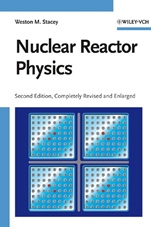
Nuclear Reactor Physics
ISBN 9783527406791
Autor: Weston M. Stacey
Wydawca: Wiley
Dostępność: 3-6 tygodni
Cena: 827,40 zł
Przed złożeniem zamówienia prosimy o kontakt mailowy celem potwierdzenia ceny.
ISBN13: |
9783527406791 |
ISBN10: |
3527406794 |
Autor: |
Weston M. Stacey |
Oprawa: |
Hardback |
Rok Wydania: |
2007-05-11 |
Numer Wydania: |
2nd, Completely Revised and Enlarged Edition |
Ilość stron: |
735 |
Wymiary: |
247x179 |
Tematy: |
PH |
Nuclear reactor physics is the core discipline of nuclear engineering. Nuclear reactors now account for a significant portion of the electrical power generated worldwide, and new power reactors with improved fuel cycles are being developed. At the same time, the past few decades have seen an ever–increasing number of industrial, medical, military, and research applications for nuclear reactors. The second edition of this successful comprehensive textbook and reference on basic and advanced nuclear reactor physics has been completely updated, revised and enlarged to include the latest developments.
From the Contents:Part 1: Basic Reactor PhysicsNuclear Reactor DynamicsFuel BurnupPart 2: Advanced Reactor PhysicsNeutron Transport TheoryNeutron Slowing Down
From reviews of the First Edition:"the first comprehensive book on the subject in 25 years." – La Doc STI"I hope that the publication of this impressive text, whose strength lies in its breadth and modernity, will accompany a renewed interest in nuclear power expressed through fission reactors." – Physics Today
Spis treści:
Preface.
Preface to 2nd Edition.
PART 1 BASIC REACTOR PHYSICS.
1 Neutron Nuclear Reactions.
1.1 Neutron–Induced Nuclear Fission.
1.2 Neutron Capture.
1.3 Neutron Elastic Scattering.
1.4 Summary of Cross–Section Data.
1.5 Evaluated Nuclear Data Files.
1.6 Elastic Scattering Kinematics.
2 Neutron Chain Fission Reactors.
2.1 Neutron Chain Fission Reactions.
2.2 Criticality.
2.3 Time Dependence of a Neutron Fission Chain Assembly.
2.4 Classification of Nuclear Reactors.
3 Neutron Diffusion Theory.
3.1 Derivation of One–Speed Diffusion Theory.
3.2 Solutions of the Neutron Diffusion Equation in Nonmultiplying Media.
3.3 Diffusion Kernels and Distributed Sources in a Homogeneous Medium.
3.4 Alb
edo Boundary Condition.
3.5 Neutron Diffusion and Migration Lengths.
3.6 Bare Homogeneous Reactor.
3.7 Reflected Reactor.
3.8 Homogenization of a Heterogeneous Fuel–Moderator Assembly.
3.9 Control Rods.
3.10 Numerical Solution of Diffusion Equation.
3.11 Nodal Approximation.
3.12 Transport Methods.
4 Neutron Energy Distribution.
4.1 Analytical Solutions in an Infinite Medium.
4.2 Multigroup Calculation of Neutron Energy Distribution in an Infinite Medium.
4.3 Resonance Absorption.
4.4 Multigroup Diffusion Theory.
5 Nuclear Reactor Dynamics.
5.1 Delayed Fission Neutrons.
5.2 Point Kinetics Equations.
5.3 Period–Reactivity Relations.
5.4 Approximate Solutions of the Point Neutron Kinetics Equations.
5.5 Delayed Neutron Kernel and Zero–Power Transfer Function.
5.6 Experimental Determination of Neutron Kinetics Parameters.
5.7 Reactivity Feedback.
5.8 Perturbation Theory Evaluation of Reactivity Temperature Coefficients.
5.9 Reactor Stability.
5.10 Measurement of Reactor Transfer Functions.
5.11 Reactor Transients with Feedback.
5.12 Reactor Fast Excursions.
5.13 Numerical Methods.
6 Fuel Burnup.
6.1 Changes in Fuel Composition.
6.2 Samarium and Xenon.
6.3 Fertile–to–Fissile Conversion and Breeding.
6.4 Simple Model of Fuel Depletion.
6.5 Fuel Reprocessing and Recycling.
6.6 Radioactive Waste.
6.7 Burning Surplus Weapons–Grade Uranium and Plutonium.
6.8 Utilization of Uranium Energy Content.
6.9 Transmutation of Spent Nuclear Fuel.
6.10 Closing the Nuclear Fuel Cycle.
7 Nuclear Power Reactors.
7.1 Pressurized Water Reactors.
7.2 Boiling Water Reactors.
7.3 Pressure Tube Heavy Water–Moderated Reactors.
7.4 Pressure Tube Graphite–Moderated Reactors.
7.5 Graphite–Moderated Gas–Cooled Reactors.
7.6 Liquid–Metal Fast Breeder Reactors.
7.7 Other P
ower Reactors.
7.8 Characteristics of Power Reactors.
7.9 Advanced Generation–III Reactors.
7.10 Advanced Generation–IV Reactors.
7.11 Advanced Sub–critical Reactors.
7.12 Nuclear Reactor Analysis.
7.13 Interaction of Reactor Physics and Reactor Thermal Hydraulics.
8 Reactor Safety.
8.1 Elements of Reactor Safety.
8.2 Reactor Safety Analysis.
8.3 Quantitative Risk Assessment.
8.4 Reactor Accidents.
8.5 Passive Safety.
PART 2 ADVANCED REACTOR PHYSICS.
9 Neutron Transport Theory.
9.1 Neutron Transport Equation.
9.2 Integral Transport Theory.
9.3 Collision Probability Methods.
9.4 Interface Current Methods in Slab Geometry.
9.5 Multidimensional Interface Current Methods.
9.6 Spherical Harmonics (PL) Methods in One–Dimensional Geometries.
9.7 Multidimensional Spherical Harmonics (PL) Transport Theory.
9.8 Discrete Ordinates Methods in One–Dimensional Slab Geometry.
9.9 Discrete Ordinates Methods in One–Dimensional Spherical Geometry.
9.10 Multidimensional Discrete Ordinates Methods.
9.11 Even–Parity Transport Formulation.
9.12 Monte Carlo Methods.
10 Neutron Slowing Down.
10.1 Elastic Scattering Transfer Function.
10.2 P1 and B1 Slowing–Down Equations.
10.3 Diffusion Theory.
10.4 Continuous Slowing–Down Theory.
10.5 Multigroup Discrete Ordinates Transport Theory.
11 Resonance Absorption.
11.1 Resonance Cross Sections.
11.2 Widely Spaced Single–Level Resonances in a Heterogeneous Fuel–Moderator Lattice.
11.3 Calculation of First–Flight Escape Probabilities.
11.4 Unresolved Resonances.
11.5 Multiband Treatment of Spatially Dependent Self–Shielding.
11.6 Resonance Cross–Section Representations.
12 Neutron Thermalization.
12.1 Double Differential Scattering Cross Section for Thermal Neutrons.
12.2
Neutron Scattering from a Monatomic Maxwellian Gas.
12.3 Thermal Neutron Scattering from Bound Nuclei.
12.4 Calculation of the Thermal Neutron Spectra in Homogeneous Media.
12.5 Calculation of Thermal Neutron Energy Spectra in Heterogeneous Lattices.
12.6 Pulsed Neutron Thermalization.
13 Perturbation and Variational Methods.
13.1 Perturbation Theory Reactivity Estimate.
13.2 Adjoint Operators and Importance Function.
13.3 Variational/Generalized Perturbation Reactivity Estimate.
13.4 Variational/Generalized Perturbation Theory Estimates of Reaction Rate Ratios in Critical Reactors.
13.5 Variational/Generalized Perturbation Theory Estimates of Reaction Rates.
13.6 Variational Theory.
13.7 Variational Estimate of Intermediate Resonance Integral.
13.8 Heterogeneity Reactivity Effects.
13.9 Variational Derivation of Approximate Equations.
13.10 Variational Even–Parity Transport Approximations.
13.11 Boundary Perturbation Theory.
14 Homogenization.
14.1 Equivalent Homogenized Cross Sections.
14.2 ABH Collision Probability Method.
14.3 Blackness Theory.
14.4 Fuel Assembly Transport Calculations.
14.5 Homogenization Theory.
14.6 Equivalence Homogenization Theory.
14.7 Multiscale Expansion Homogenization Theory.
14.8 Flux Detail Reconstruction.
15 Nodal and Synthesis Methods.
15.1 General Nodal Formalism.
15.2 Conventional Nodal Methods.
15.3 Transverse Integrated Nodal Diffusion Theory Methods.
15.4 Transverse Integrated Nodal Integral Transport Theory Models.
15.5 Transverse Integrated Nodal Discrete Ordinates Method.
15.6 Finite–Element Coarse Mesh Methods.
15.7 Variational Discrete Ordinates Nodal Method.
15.8 Variational Principle for Multigroup Diffusion Theory.
15.9 Single–Channel Spatial Synthesis.
15.10 Multichannel Spatial Synthesis.
15.11 Spectral Synthesis.
16 Space–Time Neutron Kinetics.
16.1
Flux Tilts and Delayed Neutron Holdback.
16.2 Spatially Dependent Point Kinetics.
16.3 Time Integration of the Spatial Neutron Flux Distribution.
16.4 Stability.
16.5 Xenon Spatial Oscillations.
16.6 Stochastic Kinetics.
APPENDICES.
A Physical Constants and Nuclear Data.
B Some Useful Mathematical Formulas.
C Step Functions, Delta Functions, and Other Functions.
C.1 Introduction.
C.2 Properties of the Dirac δ–Function.
A. Alternative Representations.
B. Properties.
C. Derivatives.
D Some Properties of Special Functions.
E Introduction to Matrices and Matrix Algebra.
E.1 Some Definitions.
E.2 Matrix Algebra.
F Introduction to Laplace Transforms.
F.1 Motivation.
F.2 "Cookbook" Laplace transforms.
Index.
Nota biograficzna:
Weston M. Stacey is Professor of Nuclear Engineering at the Georgia Institute of Technology. His career spans more than 40 years of research and teaching in nuclear reactor physics, fusion plasma physics and fusion and fission reactor conceptual design. He led the IAEA INTOR Workshop (1979–88) that led to the present ITER project, for which he was awarded the US Department of Energy Distinguished Associate Award and two Department of Energy Certificates of Appreciation. Professor Stacey is a Fellow of the American Nuclear Society and of the American Physical Society. He is the recipient of several prizes, among them the American Nuclear Society Seaborg Medal for Nuclear Research and the Wigner Reactor Physics Award, and the author of six previous books and numerous research papers.
Okładka tylna:
Nuclear reactor physics is the core discipline of nuclear engineering. Nuclear reactors now account for a significant portion of the electrical power generated worldwide, and new power reactors with improved fuel cycles are being developed. At the same time, the past f
ew decades have seen an ever–increasing number of industrial, medical, military, and research applications for nuclear reactors. The second edition of this successful comprehensive textbook and reference on basic and advanced nuclear reactor physics has been completely updated, revised and enlarged to include the latest developments.
From the Contents:Part 1: Basic Reactor PhysicsNuclear Reactor DynamicsFuel BurnupPart 2: Advanced Reactor PhysicsNeutron Transport TheoryNeutron Slowing Down
From reviews of the First Edition:"the first comprehensive book on the subject in 25 years." – La Doc STI"I hope that the publication of this impressive text, whose strength lies in its breadth and modernity, will accompany a renewed interest in nuclear power expressed through fission reactors." – Physics Today
Koszyk
Książek w koszyku: 0 szt.
Wartość zakupów: 0,00 zł
Informacje


Kontakt
Gambit
Centrum Oprogramowania
i Szkoleń Sp. z o.o.
Al. Pokoju 29b/22-24
31-564 Kraków
Siedziba Księgarni
ul. Kordylewskiego 1
31-542 Kraków
+48 12 410 5991
+48 12 410 5987
+48 12 410 5989
Subskrypcje
Administratorem danych osobowych jest firma Gambit COiS Sp. z o.o. Na podany adres będzie wysyłany wyłącznie biuletyn informacyjny.
Autoryzacja płatności

Informacje na temat autoryzacji płatności poprzez PayU.

© Copyright 2012: GAMBIT COiS Sp. z o.o. Wszelkie prawa zastrzeżone.
Projekt i wykonanie: Alchemia Studio Reklamy