


Wydawcy
Katalog tematyczny
- Archeologia (109)
- Ekonomia, finanse, business (13704)
- Filozofia (1445)
- Historia (3040)
- Języki i językoznawstwo (2356)
- Lifestyle, hobby i rozrywka (475)
- Medycyna (9704)
- Nauki humanistyczne (4)
- Nauki o Ziemi i środowisku (2638)
- Nauki ścisłe (20412)
- Astronomia (294)
- Biologia (5119)
- Chemia (6540)
- Fizyka (3309)
- Elektryczność i magnetyzm (90)
- Fizyka atomowa i molekularna (110)
- Fizyka cząstek elementarnych (36)
- Fizyka jądra atomowego (36)
- Fizyka kwantowa (210)
- Fizyka matematyczna (121)
- Fizyka relatywistyczna (36)
- Fizyka statystyczna (51)
- Fizyka stosowana (498)
- Mechanika klasyczna (186)
- Optyka i światło (133)
- Stany materii (202)
- Matematyka (4574)
- Nauki ścisłe, ogólnie (503)
- Nauki społeczne (8486)
- Nauki techniczne (13450)
- Prawo (1696)
- Publikacje informacyjne i interdyscyplinarne (1288)
- Religia i wierzenia (917)
- Technika komputerowa (4067)
- Zdrowie, relacje międzyludzkie i rozwój osobisty (657)





Informacje szczegółowe o książce
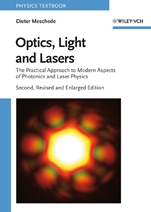
Optics, Light and Lasers: The Practical Approach to Modern Aspects of Photonics and Laser Physics
ISBN 9783527406289
Autor: Dieter Meschede
Wydawca: Wiley
Dostępność: 3-6 tygodni
Cena: 638,40 zł
Przed złożeniem zamówienia prosimy o kontakt mailowy celem potwierdzenia ceny.
ISBN13: |
9783527406289 |
ISBN10: |
352740628X |
Autor: |
Dieter Meschede |
Oprawa: |
Paperback |
Rok Wydania: |
2007-01-02 |
Numer Wydania: |
2nd, Revised and Enlarged Edition |
Ilość stron: |
559 |
Wymiary: |
240x176 |
Tematy: |
PH |
Starting from the concepts of classical optics, Optics, Light and Lasers introduces in detail the phenomena of linear and nonlinear light matter interaction, the properties of modern laser sources, and the concepts of quantum optics. Several examples taken from the scope of modern research are provided to emphasize the relevance of optics in current developments with in science and technology. The text has been written for newcomers to the topic and benefits from the author′s ability to explain difficult sequences and effects in a straightforward and easily comprehensively way. To this second, completely updated and enlarged edition, new chapters on quantum optics, photonic fibers and materials have been added, as well as more than 100 problems on laser physics and applied optics.
Spis treści:
Preface.
1 Light rays.
1.1 Light rays in human experience.
1.2 Ray optics.
1.3 Reflection.
1.4 Refraction.
1.5 Fermat’s principle: the optical path length.
1.6 Prisms.
1.7 Light rays in wave guides.
1.8 Lenses and curved mirrors.
1.9 Matrix optics.
1.10 Ray optics and particle optics.
Problems for chapter 1.
2 Wave optics.
2.1 Electromagnetic radiation fields.
2.2 Wave types.
2.3 Gaussian beams.
2.4 Polarization.
2.5 Diffraction.
Problems for chapter 2.
3 Light propagation in matter.
3.1 Dielectric interfaces.
3.2 Complex refractive index.
3.3 Optical wave guides and fibres.
3.4 Functional types and applications of optical fibres.
3.5 Photonic materials.
3.6 Light pulses in dispersive materials.
3.7 Anisotropic optical materials.
3.8 Optical modulators.
Problems for chapter 3.
4 Optical images.
4.1 The human eye.
4.2 Magnifying glass and eyepiece.
4.3 Microscopes.
4.4 Telescopes.
4.5 Lenses: designs and aberrations.
Problems for chapter 4.
5 Coherence and interferometry.
5.1
Young’s double slit.
5.2 Coherence and correlation.
5.3 The double–slit experiment.
5.4 Michelson interferometer: longitudinal coherence.
5.5 Fabry–Perot interferometer.
5.6 Optical cavities.
5.7 Thin optical films.
5.8 Holography.
5.9 Laser speckle (laser granulation).
Problems for chapter 5.
6 Light and matter.
6.1 Classical radiation interaction.
6.2 Two–level atoms.
6.3 Stimulated and spontaneous radiation processes.
6.4 Inversion and amplification.
Problems for chapter 6.
7 The laser.
7.1 The classic system: the He–Ne laser.
7.2 Mode selection in the He–Ne laser.
7.3 Spectral properties of the He–Ne laser.
7.4 Applications of the He–Ne laser.
7.5 Other gas lasers.
7.6 Molecular gas lasers.
7.7 The workhorses: solid–state lasers.
7.8 Selected solid–state lasers.
7.9 Tunable lasers with vibronic states.
7.10 Tunable ring lasers.
Problems for chapter 7.
8 Laser dynamics.
8.1 Basic laser theory.
8.2 Laser rate equations.
8.3 Threshold–less lasers and micro–lasers.
8.4 Laser noise.
8.5 Pulsed lasers.
Problems for chapter 8.
9 Semiconductor lasers.
9.1 Semiconductors.
9.2 Optical properties of semiconductors.
9.3 The heterostructure laser.
9.4 Dynamic properties of semiconductor lasers.
9.5 Laser diodes, diode lasers, laser systems.
9.6 High–power laser diodes.
Problems for chapter 9.
10 Sensors for light.
10.1 Characteristics of optical detectors.
10.2 Fluctuating opto–electronic quantities.
10.3 Photon noise and detectivity limits.
10.4 Thermal detectors.
10.5 Quantum sensors I: photomultiplier tubes.
10.6 Quantum sensors II: semiconductor sensors.
10.7 Position and image sensors.
Problems for chapter 10.
11 Laser spectroscopy.
11.1 Laser–induced fluorescence (LIF).
11.2 Abs
orption and dispersion.
11.3 The width of spectral lines.
11.4 Doppler–free spectroscopy.
11.5 Transient phenomena.
11.6 Light forces.
Problems for chapter 11.
12 Photons – an introduction to quantum optics.
12.1 Does light exhibit quantum character?
12.2 Quantization of the electromagnetic field.
12.3 Spontaneous emission.
12.4 Weak coupling and strong coupling.
12.5 Resonance fluorescence.
12.6 Light fields in quantum optics.
12.7 Two–photon optics.
12.8 Entangled photons.
Problems for chapter 12.
13 Nonlinear optics I: optical mixing processes.
13.1 Charged anharmonic oscillators.
13.2 Second–order nonlinear susceptibility.
13.3 Wave propagation in nonlinear media.
13.4 Frequency doubling.
13.5 Sum and difference frequency.
13.6 Optical parametric oscillators.
Problems for chapter 13.
14 Nonlinear optics II: four–wave mixing.
14.1 Frequency tripling in gases.
14.2 Nonlinear refraction coefficient (optical Kerr effect).
14.3 Self–phase modulation.
Problems for chapter 14.
Appendix.
A Mathematics for optics.
A.1 Spectral analysis of fluctuating measurable quantities.
A.2 Poynting theorem.
B Supplements in quantum mechanics.
B.1 Temporal evolution of a two–state system.
B.2 Density–matrix formalism.
B.3 Density of states.
Bibliography.
Index.
Nota biograficzna:
Dieter Meschede was born in Lathen/Ems, Germany, in 1954. From his early days on he liked to wander through the world and has thus studied physics in several places including Hannover, Cologne, Boulder, and Munich. He has been professor of experimental physics since 1990. Professor Meschede is now based at the University of Bonn, Germany, where his current scientific interests concentrate on light–matter interactions at the most elementary level, i.e. with single a
toms and single photons.
Okładka tylna:
Starting from the concepts of classical optics, Optics, Light and Lasers introduces in detail the phenomena of linear and nonlinear light matter interaction, the properties of modern laser sources, and the concepts of quantum optics. Several examples taken from the scope of modern research are provided to emphasize the relevance of optics in current developments with in science and technology. The text has been written for newcomers to the topic and benefits from the author′s ability to explain difficult sequences and effects in a straightforward and easily comprehensively way. To this second, completely updated and enlarged edition, new chapters on quantum optics, photonic fibers and materials have been added, as well as more than 100 problems on laser physics and applied optics.
Koszyk
Książek w koszyku: 0 szt.
Wartość zakupów: 0,00 zł
Informacje


Kontakt
Gambit
Centrum Oprogramowania
i Szkoleń Sp. z o.o.
Al. Pokoju 29b/22-24
31-564 Kraków
Siedziba Księgarni
ul. Kordylewskiego 1
31-542 Kraków
+48 12 410 5991
+48 12 410 5987
+48 12 410 5989
Subskrypcje
Administratorem danych osobowych jest firma Gambit COiS Sp. z o.o. Na podany adres będzie wysyłany wyłącznie biuletyn informacyjny.
Autoryzacja płatności

Informacje na temat autoryzacji płatności poprzez PayU.

© Copyright 2012: GAMBIT COiS Sp. z o.o. Wszelkie prawa zastrzeżone.
Projekt i wykonanie: Alchemia Studio Reklamy