


Wydawcy
Katalog tematyczny
- Archeologia (109)
- Ekonomia, finanse, business (13704)
- Filozofia (1445)
- Historia (3040)
- Języki i językoznawstwo (2356)
- Lifestyle, hobby i rozrywka (475)
- Medycyna (9704)
- Chirurgia (272)
- Inne gałęzie medycyny (1871)
- Medycyna kliniczna (4187)
- Medycyna niekonwencjonalna (14)
- Medycyna przedkliniczna (269)
- Medycyna, ogólnie (1740)
- Historia medycyny (3)
- Lekarze, sprawy zawodowe (8)
- Medycyna, aspekty prawne (10)
- Służba zdrowia (36)
- Wyposażenie medyczne (157)
- Zdrowie publiczne (460)
- Medyczne służby pomocnicze (745)
- Studia medyczne (16)
- Weterynaria (548)
- Nauki humanistyczne (4)
- Nauki o Ziemi i środowisku (2638)
- Nauki ścisłe (20412)
- Nauki społeczne (8486)
- Nauki techniczne (13450)
- Prawo (1696)
- Publikacje informacyjne i interdyscyplinarne (1288)
- Religia i wierzenia (917)
- Technika komputerowa (4067)
- Zdrowie, relacje międzyludzkie i rozwój osobisty (657)





Informacje szczegółowe o książce
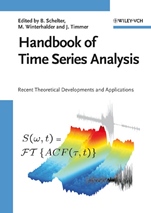
Handbook of Time Series Analysis: Recent Theoretical Developments and Applications
ISBN 9783527406234
Autor: Björn Schelter, Matthias Winterhalder, Jens Timmer
Wydawca: Wiley
Dostępność: 3-6 tygodni
Cena: 1 287,30 zł
Przed złożeniem zamówienia prosimy o kontakt mailowy celem potwierdzenia ceny.
ISBN13: |
9783527406234 |
ISBN10: |
3527406239 |
Autor: |
Björn Schelter, Matthias Winterhalder, Jens Timmer |
Oprawa: |
Hardback |
Rok Wydania: |
2006-10-06 |
Ilość stron: |
514 |
Wymiary: |
248x182 |
Tematy: |
MB |
This handbook provides an up–to–date survey of current research topics and applications of time series analysis methods written by leading experts in their fields. It covers recent developments in linear and non–linear, as well as stochastic and deterministic analysis methods and their cross–fertilization between Mathematics, Physics, and Engineering. Each chapter comprises both methodological aspects and applications to time series from real world complex systems, such as the human brain or Earth′s climate. Covering an exceptionally broad spectrum of topics, beginners, experts and practitioners in time series analysis who seek to understand the latest developments will profit from this handbook.
Spis treści:
Preface.
List of Contributors.
1 Handbook of Time Series Analysis: Introduction and Overview (Björn Schelter, Matthias Winterhalder, and Jens Timmer).
2 Nonlinear Analysis of Time Series Data (Henry D. I. Abarbanel and Ulrich Parlitz).
2.1 Introduction.
2.2 Unfolding the Data: Embedding Theoremin Practice.
2.3 Where are We?
2.4 Lyapunov Exponents: Prediction, Classi.cation, and Chaos.
2.5 Predicting.
2.6 Modeling.
2.7 Conclusion.
References.
3 Local and Cluster Weighted Modeling for Time Series Prediction (David Engster and Ulrich Parlitz).
3.1 Introduction.
3.2 LocalModeling.
3.3 Cluster Weighted Modeling.
3.4 Examples.
3.5 Conclusion.
References.
4 Deterministic and Probabilistic Forecasting in Reconstructed State Spaces (Holger Kantz and Eckehard Olbrich).
4.1 Introduction.
4.2 Determinism and Embedding
4.3 Stochastic Processes.
4.4 Events and Classification Error.
4.5 Conclusions.
References.
5 Dealing with Randomness in Biosignals (Patrick Celka, Rolf Vetter, Elly Gysels, and Trevor J. Hine).
5.1 Introduction.
5.2 How Do Biological Sy
stems Cope with or Use Randomness?
5.2.1 Uncertainty Principle in Biology.
5.3 How Do Scientists and Engineers Cope with Randomness and Noise?
5.4 A Selection of Coping Approaches.
5.5 Applications.
5.6 Conclusions.
References.
6 Robust Detail–Preserving Signal Extraction (Ursula Gather, Roland Fried, and Vivian Lanius).
6.1 Introduction.
6.2 Filters Based on Local Constant Fits.
6.3 Filters Based on Local Linear Fits.
6.4 Modi.cations for Better Preservation of Shifts.
6.5 Conclusions.
References.
7 Coupled Oscillators Approach in Analysis of Bivariate Data (Michael Rosenblum, Laura Cimponeriu, and Arkady Pikovsky).
7.1 Bivariate Data Analysis: Model–Based Versus Nonmodel–Based Approach.
7.2 Reconstruction of PhaseDynamics fromData.
7.3 Characterization of Coupling from Data.
7.4 Conclusions and Discussion.
References.
8 Nonlinear Dynamical Models from Chaotic Time Series: Methods and Applications (Dmitry A. Smirnov and Boris P. Bezruchko).
8.1 Introduction.
8.2 Scheme of theModeling Process.
8.3 “White Box” Problems.
8.4 “Gray Box” Problems.
8.5 “Black Box” Problems.
8.6 Applications of Empirical Models.
8.7 Conclusions.
References.
9 Data–Driven Analysis of Nonstationary Brain Signals (Mario Chavez, Claude Adam, Stefano Boccaletti and Jacques Martinerie).
9.1 Introduction.
9.2 Intrinsic Time–Scale Decomposition.
9.3 Intrinsic Time Scales of Forced Systems.
9.4 Intrinsic Time Scales ofCoupled Systems.
9.5 Intrinsic Time Scales of Epileptic Signals.
9.6 Time–Scale Synchronization of SEEG Data.
9.7 Conclusions.
References.
10 Synchronization Analysis and Recurrence in Complex Systems (Maria Carmen Romano, Marco Thiel, Jürgen Kurths, Martin Rolfs, Ralf Engbert, and Reinhold Kliegl).
10.1 Introduction.
10
.2 Phase Synchronization by Means of Recurrences.
10.3 Generalized Synchronization and Recurrence.
10.4 Transitions to Synchronization.
10.5 Twin Surrogates to Test for PS.
10.6 Application to Fixational Eye Movements.
10.7 Conclusions.
References.
11 Detecting Coupling in the Presence of Noise and Nonlinearity (Theoden I. Neto., Thomas L. Carroll, Louis M. Pecora, and Steven J. Schi. ).
11.1 Introduction.
11.2 Methods of Detecting Coupling.
11.3 Linear and Nonlinear Systems.
11.4 Uncoupled Systems.
11.5 Weakly Coupled Systems.
11.6 Conclusions.
11.7 Discussion.
References.
12 Linear Models for Mutivariate Time Series (Manfred Deistler).
12.1 Introduction.
12.2 Stationary Processes and Linear Systems.
12.3 Multivariable State Space and ARMA(X) Models.
12.4 Factor Models for Time Series.
12.5 Summary and Outlook.
References.
13 Spatio–Temporal Modeling for Biosurveillance (David S. Stoffer and Myron J. Katzo.).
13.1 Introduction.
13.2 Background.
13.3 The State Space Model.
13.4 Spatially Constrained Models.
13.5 Data Analysis.
13.6 Discussion.
References.
14 Graphical Modeling of Dynamic Relationships in Multivariate Time Series (Michael Eichler).
14.1 Introduction.
14.2 Granger Causality in Multivariate Time Series.
14.3 Graphical Representations of Granger Causality.
14.4 Markov Interpretation of Path Diagrams.
14.5 Statistical Inference.
14.6 Applications.
14.7 Conclusion.
References.
15 Multivariate Signal Analysis by Parametric Models (Katarzyna J. Blinowska and Maciej Kamiñski).
15.1 Introduction.
15.2 Parametric Modeling.
15.3 Linear Models.
15.4 Model Estimation.
15.5 Cross Measures.
15.6 Causal Estimators.
15.7 Modeling of Dynamic Processes
15.8 Simulations.
15.9 Multivariate Analysis of Experimental Data.
15.10 Discussion.
15
.11 Acknowledgements.
References.
16 Computer Intensive Testing for the Influence Between Time Series (Luiz A. Baccalá, Daniel Y. Takahashi, and Koichi Sameshima).
16.1 Introduction.
16.2 Basic Resampling Concepts.
16.3 Time Series Resampling.
16.4 Numerical Examples and Applications.
16.5 Discussion.
16.6 Conclusions.
References.
17 Granger Causality: Basic Theory and Application to Neuroscience (Mingzhou Ding, Yonghong Chen, and Steven L. Bressler).
17.1 Introduction.
17.2 Bivariate Time Series and Pairwise Granger Causality.
17.3 TrivariateTime Series and Conditional Granger Causality.
17.4 Estimation of Autoregressive Models.
17.5 Numerical Examples.
17.6 Analysis of a Beta Oscillation Network in Sensorimotor Cortex.
17.7 Summary.
References.
18 Granger Causality on Spatial Manifolds: Applications to Neuroimaging (Pedro A. Valdés–Sosa, Jose Miguel Bornot–Sánchez, Mayrim Vega–Hernández, Lester Melie–García, Agustin Lage–Castellanos, and Erick Canales–Rodríguez).
18.1 Introduction.
18.2 The Continuous Spatial Multivariate Autoregressive Model and its Discretization.
18.3 Testing for Spatial Granger Causality.
18.4 Dimension Reduction Approaches to sMAR Models.
18.5 Penalized sMAR.
18.6 Estimation via the MMAlgorithm.
18.7 Evaluation of Simulated Data.
18.8 Influence Fields for Real Data.
18.9 Possible Extensions and Conclusions.
References.
Index.
Nota biograficzna:
The Editors are members of the research group "Data Analysis and Modeling of Dynamic Processes in the Life Sciences" at the Center for Data Analysis and Modeling of the University of Freiburg, Germany. In interdisciplinary projects, they develop, investigate and apply mathematical methods to elucidate properties of complex systems in the field of neurology based on multivariat
e time series.
Okładka tylna:
This handbook provides an up–to–date survey of current research topics and applications of time series analysis methods written by leading experts in their fields. It covers recent developments in linear and non–linear, as well as stochastic and deterministic analysis methods and their cross–fertilization between Mathematics, Physics, and Engineering. Each chapter comprises both methodological aspects and applications to time series from real world complex systems, such as the human brain or Earth′s climate. Covering an exceptionally broad spectrum of topics, beginners, experts and practitioners in time series analysis who seek to understand the latest developments will profit from this handbook.
Koszyk
Książek w koszyku: 0 szt.
Wartość zakupów: 0,00 zł
Informacje


Kontakt
Gambit
Centrum Oprogramowania
i Szkoleń Sp. z o.o.
Al. Pokoju 29b/22-24
31-564 Kraków
Siedziba Księgarni
ul. Kordylewskiego 1
31-542 Kraków
+48 12 410 5991
+48 12 410 5987
+48 12 410 5989
Subskrypcje
Administratorem danych osobowych jest firma Gambit COiS Sp. z o.o. Na podany adres będzie wysyłany wyłącznie biuletyn informacyjny.
Autoryzacja płatności

Informacje na temat autoryzacji płatności poprzez PayU.

© Copyright 2012: GAMBIT COiS Sp. z o.o. Wszelkie prawa zastrzeżone.
Projekt i wykonanie: Alchemia Studio Reklamy