


Wydawcy
Katalog tematyczny
- Archeologia (109)
- Ekonomia, finanse, business (13704)
- Filozofia (1445)
- Historia (3040)
- Języki i językoznawstwo (2356)
- Lifestyle, hobby i rozrywka (475)
- Medycyna (9704)
- Nauki humanistyczne (4)
- Nauki o Ziemi i środowisku (2638)
- Nauki ścisłe (20412)
- Astronomia (294)
- Biologia (5119)
- Chemia (6540)
- Fizyka (3309)
- Elektryczność i magnetyzm (90)
- Fizyka atomowa i molekularna (110)
- Fizyka cząstek elementarnych (36)
- Fizyka jądra atomowego (36)
- Fizyka kwantowa (210)
- Fizyka matematyczna (121)
- Fizyka relatywistyczna (36)
- Fizyka statystyczna (51)
- Fizyka stosowana (498)
- Mechanika klasyczna (186)
- Optyka i światło (133)
- Stany materii (202)
- Matematyka (4574)
- Nauki ścisłe, ogólnie (503)
- Nauki społeczne (8486)
- Nauki techniczne (13450)
- Prawo (1696)
- Publikacje informacyjne i interdyscyplinarne (1288)
- Religia i wierzenia (917)
- Technika komputerowa (4067)
- Zdrowie, relacje międzyludzkie i rozwój osobisty (657)





Informacje szczegółowe o książce
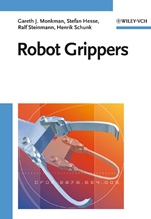
Robot Grippers
ISBN 9783527406197
Autor: Gareth J. Monkman, Stefan Hesse, Ralf Steinmann, Henrik Schunk
Wydawca: Wiley
Dostępność: 3-6 tygodni
Cena: 990,15 zł
Przed złożeniem zamówienia prosimy o kontakt mailowy celem potwierdzenia ceny.
ISBN13: |
9783527406197 |
ISBN10: |
3527406190 |
Autor: |
Gareth J. Monkman, Stefan Hesse, Ralf Steinmann, Henrik Schunk |
Oprawa: |
Hardback |
Rok Wydania: |
2006-11-10 |
Ilość stron: |
463 |
Wymiary: |
242x178 |
Tematy: |
PH |
Since robotic prehension is widely used in all sectors of the manufacturing industry, this book fills the need for a comprehensive, up–to–date treatment of the topic. As such, this is the first text to address both developers and users, dealing as it does with the function, design and use of industrial robot grippers. The book includes both traditional methods and many more recent developments such as micro grippers for the optoelectronics industry. Written by authors from academia, industry and consulting, it begins by covering the four basic categories of robotic prehension before expanding into sections dealing with endeffector design and control, robotic manipulation and kinematics. Later chapters go on to describe how these various gripping techniques can be used for a common industrial aim, with details of related topics such as: kinematics, part separation, sensors, tool exchange and compliance. The whole is rounded off with specific examples and case studies. With more than 570 figures, this practical book is all set to become the standard for advanced students, researchers and manufacturing engineers, as well as designers and project managers seeking practical descriptions of robot endeffectors and their applications.
From the contents:Introduction to Prehension TechnologyAutomatic PrehensionImpactive Mechanical GrippersIngressive GrippersAstrictive PrehensionContigutive PrehensionMiniature Grippers and MicrogrippersSpecial DesignsHand Axes and KinematicsSeparationInstrumentation and ControlTool Exchange and ReconfigurabilityComplianceSelected Case Studies
Spis treści:
Preface.
1 Introduction to Prehension Technology.
1.1 Grippers for Mechanization and Automation.
1.2 Definitions and Conceptual Basics.
1.3 Grasping in Natural Systems.
1.4 Historical Overview of Technical Hands.
2 Automatic Prehension.
2.1 Ac
tive Pair MatingPair Mating.
2.2 Strategy and Procedures.
2.2.1 Prehension Strategy.
Example of a prehension strategy.
2.2.2 Gripping Procedure, Conditions and Force.
2.2.3 Gripper Flexibility.
2.3 Gripper Classification.
2.4 Requirements and Gripper Characteristics.
2.5 Planning and Selection of Grippers.
3 Impactive Mechanical Grippers.
3.1 Gripper DrivesDrives.
3.1.1 Electromechanical Drives.
3.1.2 Pneumatic Drives.
3.1.3 Electrostrictive and Piezoelectric Actuation.
3.2 Design of Impactive Grippers.
3.2.1 Systematics and Kinematics.
3.2.1.1 Parallel Impactive Grippers.
3.2.2 Angular Impactive Grippers.
3.2.3 Radial Impactive Grippers (Centring Grippers).
3.2.4 Internal Grippers.
3.2.5 Gripper with Self–blocking Capability.
3.2.6 Rotatable Jaw Grippers.
3.2.7 Gripper Finger and Jaw Design.
3.2.8 Self Securing Grippers.
3.2.8.1 Securing Through Spring Forces.
3.2.8.2 Securing Through Object Mass.
3.2.9 Three–finger Grippers.
3.2.10 Four–finger Grippers and Four–point Prehension.
4 Ingressive Grippers.
4.1 Flexible Materials.
4.1.1 Pinch Mechanisms.
4.1.2 Intrusive Mechanisms.
4.1.3 Non–Intrusive Mechanisms.
5 Astrictive Prehension.
5.1 Vacuum Suction.
5.1.1 Vacuum Production.
5.1.2 Vacuum Suckers.
5.1.3 Passive Suction Caps.
5.1.4 Air Jet Grippers.
5.2 Magnetoadhesion.
5.2.1 Permanent Magnet Grippers.
5.2.2 Electromagnetic Grippers.
5.2.3 Hybrid Electromagnetic Grippers.
5.4 Electroadhesion.
5.4.1 Electroadhesive Prehension of Electrical Conductors.
5.4.2 Electroadhesive Prehension of Electrical Insulators.
6 Contigutive Prehension.
6.1 Chemoadhesion.
6.2 Thermoadhesion.
7 Miniature Grippers and Microgrippers.
7.1 Impactive Microgrippers.
7.1.1 Electromechanically Driven Impactive Microgrippers.
7.1.2 Thermally Driven Impactive Microgrippers.
7.1.3 Electrostatically Driven Impactive Microgrippers.
7.2 Astrictive Microgrippers.
7.2.1 Vacuum Microgrippers.
7.2.2 Electroadhesive Microgrippers.
7.3 Contigutive Microgrippers.
8 Special Designs.
8.1 Clasping (Embracing) Grippers.
8.2 Anthropomorphic Grippers.
8.2.1 Jointed finger Grippers.
8.2.2 Jointless Finger Grippers.
8.3 Dextrous Hands.
9 Hand Axes and Kinematics.
9.1 Kinematic Necessities and Design.
9.2 Rotary and Pivot Units.
10 Separation.
10.1 Separation of Randomly Mixed Materials.
10.2 Separation of Rigid Three Dimensional Objects.
10.3 Separation of Rigid Sheet Materials.
10.3.1 Gripping of Thin Blanks from a Magazine.
10.3.2 Air Flow Grippers.
10.4 Separation of Non–Rigid Sheet Materials.
10.4.1 Roller Grippers.
11 Instrumentation and Control.
11.1 Gripper Sensor Technology.
11.2 Perception Types.
11.2.1 Tactile Sensors.
11.2.2 Proximity Sensors.
11.2.3 Measurement sensors.
11.2.4 Finger Position Measurement.
11.2.5 Measuring Procedures in the Gripper.
11.3 Sensory Integration.
11.3.1 Discrete and Continuous Sensing.
11.3.2 Software and Hardware Interrupts.
11.3.3 Sensor FusionSensor Fusion.
11.4 Gripper Control.
11.4.1 Control of Pneumatically Driven Grippers.
11.4.2 Control of Electrically Driven Grippers.
12 Tool Exchange and Reconfigurability.
12.1 Multiple Grippers.
12.1.1 Double and Multiple Grippers.
12.1.2 Multiple Gripper Transfer Rails.
12.1.3 Turrets.
12.2 Specialized Grippers.
12.2.1 Composite Grippers.
12.2.2 Reconfigurable Grippers.
12.2.3 Modular Gripper Systems.
12.3 Gripper Exchange Systems.
12.3.1 Tool Exchange.
12.3.2 Task, Functions and Coupling Elements.
12.3.3 Joining Techniques and Process Media Connection.
12.3.4 Manual Exchange Systems.
12.3.5 Automatic Exchange Systems.
12.3.6 Finger Exchange Systems.
12.4 Integrated Proces
sing.
13 Compliance.
13.1 Remote Centre Compliance (RCC).
13.2 Instrumented Remote Centre Compliance (IRCC).
13.3 Near Collet Compliance (NCC).
13.4 Parts Feeding.
13.5 Mechanical Compliance.
13.6 Pneumatic Compliance.
13.6.1 Internal Prehension Through Membrane Expansion.
13.6.2 External Prehension Through Membrane Expansion.
13.7 Shape Adaptive Grippers.
13.7.1 Partially Ccompliant Shape Adaptive Grippers.
13.7.2 Totally Compliant Shape Adaptive Grippers.
13.8 Collision Protection and Safety.
13.8.1 Safety Requirements.
13.8.2 Collision Protection Systems.
13.8.3 Failure Safety.
14 Selected Case Studies.
14.1 Simple Telemanipulation.
14.2 Grippers for Sheet and Plate Components.
14.2.1 Impactive Grippers for Sheet Metal Handling.
14.2.2 Astrictive Grippers for Sheet Metal.
14.2.3 Astrictive Grippers for Glass Sheet.
14.2.4 Astrictive Grippers for Composite Material Handling.
14.3 Prehension of Cuboid Objects.
14.4 Prehension of Cylindrical Objects.
14.4.1 Serial Prehension of Tubes.
14.4.2 Prehension of Wound Coils.
14.4.3 Prehension of Slit Coils.
14.5 Prehension of Objects with Irregular Topology.
14.5.1 Handling of Castings.
14.5.2 Mounting of Dashboards for Automobiles.
14.5.3 Prehension of Water Pumps.
14.5.4 Astrictive Prehension of Irregular Surfaces.
14.6 Multiple Object Prehension.
14.6.1 Packaging of Candies.
14.6.2 Bottle Palletization.
14.6.3 Multiple Irregular Shaped Objects.
14.7 Prehension of Flexible Objects.
14.7.1 Bag and Sack Grippers.
14.7.2 Gripping and Mounting of Outside O–rings.
14.8 Medical Applications.
References.
Subject Index.
Nota biograficzna:
Gareth Monkman is Professor of Robotics and Automation at the Fachhochschule Regensburg in Germany. Besides authoring a large number of academic papers, he also holds numerous patents in the field of gripper t
Koszyk
Książek w koszyku: 0 szt.
Wartość zakupów: 0,00 zł
Informacje


Kontakt
Gambit
Centrum Oprogramowania
i Szkoleń Sp. z o.o.
Al. Pokoju 29b/22-24
31-564 Kraków
Siedziba Księgarni
ul. Kordylewskiego 1
31-542 Kraków
+48 12 410 5991
+48 12 410 5987
+48 12 410 5989
Subskrypcje
Administratorem danych osobowych jest firma Gambit COiS Sp. z o.o. Na podany adres będzie wysyłany wyłącznie biuletyn informacyjny.
Autoryzacja płatności

Informacje na temat autoryzacji płatności poprzez PayU.

© Copyright 2012: GAMBIT COiS Sp. z o.o. Wszelkie prawa zastrzeżone.
Projekt i wykonanie: Alchemia Studio Reklamy