


Wydawcy
Katalog tematyczny
- Archeologia (109)
- Ekonomia, finanse, business (13704)
- Filozofia (1445)
- Historia (3040)
- Języki i językoznawstwo (2356)
- Lifestyle, hobby i rozrywka (475)
- Medycyna (9704)
- Nauki humanistyczne (4)
- Nauki o Ziemi i środowisku (2638)
- Nauki ścisłe (20412)
- Astronomia (294)
- Biologia (5119)
- Chemia (6540)
- Fizyka (3309)
- Elektryczność i magnetyzm (90)
- Fizyka atomowa i molekularna (110)
- Fizyka cząstek elementarnych (36)
- Fizyka jądra atomowego (36)
- Fizyka kwantowa (210)
- Fizyka matematyczna (121)
- Fizyka relatywistyczna (36)
- Fizyka statystyczna (51)
- Fizyka stosowana (498)
- Mechanika klasyczna (186)
- Optyka i światło (133)
- Stany materii (202)
- Matematyka (4574)
- Nauki ścisłe, ogólnie (503)
- Nauki społeczne (8486)
- Nauki techniczne (13450)
- Prawo (1696)
- Publikacje informacyjne i interdyscyplinarne (1288)
- Religia i wierzenia (917)
- Technika komputerowa (4067)
- Zdrowie, relacje międzyludzkie i rozwój osobisty (657)





Informacje szczegółowe o książce
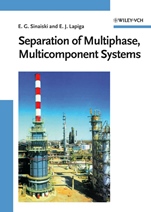
Separation of Multiphase, Multicomponent Systems
ISBN 9783527406128
Autor: Emmanuil G. Sinaiski, Eugeniy J. Lapiga
Wydawca: Wiley
Dostępność: 3-6 tygodni
Cena: 1 551,90 zł
Przed złożeniem zamówienia prosimy o kontakt mailowy celem potwierdzenia ceny.
ISBN13: |
9783527406128 |
ISBN10: |
3527406123 |
Autor: |
Emmanuil G. Sinaiski, Eugeniy J. Lapiga |
Oprawa: |
Hardback |
Rok Wydania: |
2007-06-06 |
Ilość stron: |
810 |
Wymiary: |
243x177 |
Tematy: |
PH |
This highly detailed reference represents an elaborate development of the theory of processing oil and natural gas and its application in the field –– indispensable for graduate engineering students and professionals alike. The renowned expert author, a professor at Moscow State University, has ample experience in both lecturing and publishing, albeit in the Russian language. This book is thus the first to provide a translation compiling his extensive knowledge, much of which remained unpublished due to security restrictions in the former Soviet Union.
Based upon and compiled from Professor Sinaiski′s university lectures, the first chapters treat the technical facilities for preparing and processing natural hydrocarbon substances. The following systematic approach go on to explain the behaviors of fluids, gases and droplets separately for solutions, suspensions and emulsions, as well as for gas–liquid mixtures.
The resulting work is of interest both for senior students as well as for engineers working in this field.
Emmanuil G. Sinaiski graduated from the Lomonossow–State University, Moscow, USSR, where he obtained his PhD in physics and mathematics. He received a doctorate in petroleum engineering from Gubkin–State University of Oil&Gas, Moscow, Russia, where he was later appointed a full professor. He has published numerous books and scientific articles. Professor Sinaiski′s fields of interests are applied mathematics, fluid mechanics, physicochemical hydrodynamics, chemical and petroleum engineering.
Eugeniy J. Lapiga graduated from the Moscow Physico–Technical Institute before obtaining his PhD in physics and mathematics at the Institute of Problems in Mechanics, Academy of Sciences, USSR. From 1969 through 1990 he worked at Gubkin State University of Oil&Gas, in the departments of Applied Mathematics, Automation of Production Processes, and Oil Fields Development. At present he is Assistant Di
rector General of the scientific technical company EITEK. Dr. Lapiga has numerous scientific publications and inventions to his name, in the fields of modeling, optimization and automation of oil extraction, preparation and refining processes.
Spis treści:
Preface.
List of Symbols.
I Technological Fundamentals of Preparation of Natural Hydrocarbons for Transportation.
Introduction.
1 Technological Schemes of Complex Oil, Gas and Condensate Processing Plants.
2 Construction of Typical Apparatuses.
2.1 Separators, Dividers, and Settlers.
2.2 Absorbers.
2.3 Cooling Devices.
3 Basic Processes of Separation of Multi–phase, Multi–component Hydrocarbon Mixtures.
References.
II Physical and Chemical Bases of Technological Processes.
4 The Transfer Phenomena.
4.1 Phenomenological Models.
4.2 Momentum Transfer.
4.3 Thermal Conduction and Heat Transfer.
4.4 Diffusion and Mass Transfer.
4.5 Electro–Conductivity and Charge Transfer.
5 Conservation Laws and Equations of State.
5.1 Isothermal Processes.
5.2 Non–isothermal Processes.
5.3 Multi–Component Mixtures.
5.4 Multi–Phase Mixtures.
5.5 Charged Mixtures.
5.6 The Criteria of Similarity.
5.7 The State Equations.
5.7.1 The State Equation for an Ideal Gas and an Ideal Gas Mixture.
5.7.2 The State Equation for a Real Gas and a Real Gas Mixture.
5.7.3 Methods of Calculation of Liquid–Vapor Equilibrium.
5.8 Balance of Entropy – The Onsager Reciprocal Relations.
References.
III Solutions.
6 Solutions Containing Non–charged Components.
6.1 Diffusion and Kinetics of Chemical Reactions.
6.2 Convective Diffusion.
6.3 Flow in a Channel with a Reacting Wall.
6.4 Reverse Osmosis.
6.5 Diffusion Toward a Particle Moving in a Solution.
6.6 Distribution of Matter Introduced Into a Fluid Flow.
6.7 Diffusion Flux in a Natural Conve
ction.
6.8 Dynamics of the Bubble in a Solution.
6.9 Evaporation of a Multi–component Drop Into an Inert Gas.
6.10 Chromatography.
6.11 The Capillary Model of a Low–permeable Porous Medium.
7 Solutions of Electrolytes.
7.1 Electrolytic Cell.
7.2 Electrodialysis.
7.3 Electric Double Layer.
7.4 Electrokinetic Phenomena.
7.5 Electroosmosis.
References.
IV Suspensions and Colloid Systems.
8 Suspensions Containung Non–charged Particles.
8.1 Microhydrodynamics of Particles.
8.2 Brownian Motion.
8.3 Viscosity of Diluted Suspensions.
8.4 Separation in the Gravitatonial Field.
8.5 Separation in the Field of Centrifugal Forces.
9 Suspensions Containing Charged Particles.
9.1 Electric Charge of Particles.
9.2 Electrophoresis.
9.3 The Motion of a Drop in an Electric Field.
9.4 Sedimentation Potential.
10 Stability of Suspensions, Coagulation of Particles, and Deposition of Particles on Obstacles.
10.1 Stability of Colloid Systems.
10.2 Brownian, Gradient (Shear) and Turbulent Coagulation.
10.2.1 Brownian Coagulation.
10.2.2 Gradient (Shear) Coagulation.
10.2.3 Turbulent Coagulation 272
10.3 Particles’ Deposition on the Obstacles.
10.3.1 Brownian Diffusion.
10.3.2 Particles’ Collisions with an Obstacle.
10.4 The Capture of Particles Due to Surface and Hydrodynamic Forces.
10.5 Inertial Deposition of Particles on the Obstacles.
10.6 The Kinetics of Coagulation.
10.7 The Filtering and a Model of a Highly Permeable Porous Medium with Resistance.
10.8 The Phenomenon of Hydrodynamic Diffusion.
References.
V Emulsions.
11 Behavior of Drops in an Emulsion.
11.1 The Dynamics of Drop Enlargement.
11.2 The Basic Mechanisms of Drop Coalescence.
11.3 Motion of Drops in a Turbulent Flow of Liquid.
11.4 Forces of Hydrodynamic Interaction of Drops.
11.5 Molecular and Electrostatic Interaction Forces Acting on Drops.<
br>11.6 The Conducting Drops in an Electric Field.
11.7 Breakup of Drops.
12 Interaction of Two Conducting Drops in a Uniform External Electric Field.
12.1 Potential of an Electric Field in the Space Around Drops.
12.2 Strength of an Electric Field in the Gap Between Drops.
12.3 Interaction Forces of Two Conducting Spherical Drops.
12.4 Interaction Forces Between Two Far–spaced Drops.
12.5 Interaction of Two Touching Drops.
12.6 Interaction Forces Between Two Closely Spaced Drops.
12.7 Redistribution of Charges.
13 Coalescence of Drops.
13.1 Coalescence of Drops During Gravitational Settling.
13.2 The Kinetics of Drop Coalescence During Gravitational Separation of an Emulsion in an Electric Field.
13.3 Gravitational Sedimentation of a Bidisperse Emulsion in an Electric Field.
13.4 The Effect of Electric Field on Emulsion Separation in a Gravitational Settler.
13.5 Emulsion Flow Through an Electric Filter.
13.6 Coalescence of Drops with Fully Retarded Surfaces in a Turbulent Emulsion Flow.
13.7 Coalescence of Drops with a Mobile Surface in a Turbulent Flow of the Emulsion.
13.7.1 Fast Coagulation.
13.7.2 Slow Coagulation.
13.8 Coalescence of Conducting Emulsion Drops in a Turbulent Flow in the Presence of an External Electric Field.
13.9 Kinetics of Emulsion Drop Coalescence in a Turbulent Flow.
References.
VI Gas–Liquid Mixtures.
14 Formation of a Liquid Phase in a Gas Flow.
14.1 Formation of a Liquid Phase in the Absence of Condensation.
14.2 Formation of a Liqid Phase in the Process of Condensation.
15 Coalescence of Drops in a Turbulent Gas Flow.
15.1 Inertial Mechanism of Coagulation.
15.2 Mechanism of Turbulent Diffusion.
15.3 Coalescence of a Polydisperse Ensemble of Drops.
16 Formation of a Liquid Phase in Devices of Preliminary Condensation.
16.1 Condensation Growth of Drops in a Quiescent Gas–Liquid Mixture.
16.2 Condensation Growth o
f Drops in a Turbulent Flow of a Gas–Liquid Mixture.
16.3 Enlargement of Drops During the Passage of a Gas–Liquid Mixture Through Devices of Preliminary Condensation.
16.4 Formation of a Liquid Phase in a Throttle.
16.5 Fomation of a Liquid Phase in a Heat–Exchanger.
17 Surface Tension.
17.1 Physics of Surface Tension.
17.2 Capillary Motion.
17.3 Moistening Flows.
17.4 Waves at the Surface of a Liquid and Desintegration of Jets.
17.5 Flow Caused by a Surface Tension Gradient – The Marangoni Effect.
17.6 Pulverization of a Liquid and Breakup of Drops in a Gas Flow.
18 Efficiency of Gas–Liquid Separation in Separators.
18.1 The Influence of Non–Uniformity of the Velocity Profile on the Efficiency Coefficient of Gravitational Separators.
18.2 The Efficiency Coefficient of a Horizontal Gravitational Separation.
18.3 The Efficiency Coefficient of Vertical Gravitational Separators.
18.4 The Effect of Phase Transition on the Efficiency Coefficient of a Separator.
18.5 The Influence of Drop Coalescence on the Efficiency Coefficient of a Separator.
18.6 The Effect of Curvature of the Separator Wall on the Efficiency Coefficient.
18.7 The Influence of a Distance Between the Preliminary Condensation Device and the Separator on the Efficiency Coefficient.
19 The Efficiency of Separation of Gas–Liqid Mixtures in Separators with Drop Catcher Orifices.
19.1 The Efficiency Coefficient of Separators with Jalousie Orifices.
19.2 The Efficiency Coefficient of a Separator with Multicyclone Orifices.
19.3 The Efficiency Coefficient of a Separator with String Orifices.
19.4 The Efficiency Coefficient of a Separator with Mesh Orifices.
20 Absorption Extraction of Heavy Hydrocarbons and Water Vapor from Natural Gas.
20.1 Concurrent Absorption of Heavy Hydrocarbons.
20.2 Multistage Concurrent Absorption of Heavy Hydrocarbons.
20.3 Counter–Current Absorption of He
avy Hydrocarbons.
20.4 Gas Dehydration in Concurrent Flow.
20.5 Gas Dehydration in Counter–Current Absorbers with High–Speed Separation–Contact Elements.
21 Prevention of Gas–Hydrate Formation in Natural Gas.
21.1 The Dynamics of Mass Exchange between Hydrate–Inhibitor Drops and Hydrocarbon Gas.
21.2 Evolution of the Spectrum of Hydrate–Inhibitor Drops Injected into a Turbulent Flow.
References.
VII Liquid–Gas Mixtures.
22 Dynamics of Gas Bubbles in a Multi–Component Liquid.
22.1 Motion of a Non–Growing Bubble in a Binary Solution.
22.2 Diffusion Growth of a Motionless Bubble in a Binary Solution.
22.3 The Initial Stage of Bubble Growth in a Multi–Component Solution.
22.4 Bubble Dynamics in a Multi–Componenet Solution.
22.5 The Effect of Surfactants on Bubble Growth.
23 Separation of Liquid–Gas Mixtures.
23.1 Differential Separation of a Binary Mixture.
23.2 Contact Separation of a Binary Mixture.
23.3 Differential Separation of Multi–Componenet Mixtures.
23.4 Separation of a Moving Layer.
24 Separation with Due Regard of Hinderness of Floating Bubbles.
24.1 Separation in the Periodic Pump–out Regime.
24.2 Separation in the Flow Regime.
25 Coagulation of Bubbles in a Viscous Liquid.
25.1 Coagulation of Bubbles in a Laminar Flow.
25.2 Coagulation of Bubbles in a Turbulent Flow.
25.3 Kinetics of Bubble Coagulation.
References.
Author Index.
Subject Index.
Nota biograficzna:
Emmanuil G. Sinaiski graduated from the Lomonossow–State University, Moscow, USSR, where he obtained his PhD in physics and mathematics. He received a doctorate in petroleum engineering from Gubkin–State University of Oil&Gas, Moscow, Russia, where he was later appointed a full professor. He has published numerous books and scientific articles. Professor Sinaiski′s fields of interests ar
e applied mathematics, fluid mechanics, physicochemical hydrodynamics, chemical and petroleum engineering.
Eugeniy J. Lapiga graduated from the Moscow Physico–Technical Institute before obtaining his PhD in physics and mathematics at the Institute of Problems in Mechanics, Academy of Sciences, USSR. From 1969 through 1990 he worked at Gubkin State University of Oil&Gas, in the departments of Applied Mathematics, Automation of Production Processes, and Oil Fields Development. At present he is Assistant Director General of the scientific technical company EITEK. Dr. Lapiga has numerous scientific publications and inventions to his name, in the fields of modeling, optimization and automation of oil extraction, preparation and refining processes.
Okładka tylna:
This highly detailed reference represents an elaborate development of the theory of processing oil and natural gas and its application in the field –– indispensable for graduate engineering students and professionals alike. The renowned expert author, a professor at Moscow State University, has ample experience in both lecturing and publishing, albeit in the Russian language. This book is thus the first to provide a translation compiling his extensive knowledge, much of which remained unpublished due to security restrictions in the former Soviet Union.
Based upon and compiled from Professor Sinaiski′s university lectures, the first chapters treat the technical facilities for preparing and processing natural hydrocarbon substances. The following systematic approach go on to explain the behaviors of fluids, gases and droplets separately for solutions, suspensions and emulsions, as well as for gas–liquid mixtures.
The resulting work is of interest both for senior students as well as for engineers working in this field.
Emmanuil G. Sinaiski graduated from the Lomonossow–State University, Moscow, USSR, where he obtained his PhD in physics and m
athematics. He received a doctorate in petroleum engineering from Gubkin–State University of Oil&Gas, Moscow, Russia, where he was later appointed a full professor. He has published numerous books and scientific articles. Professor Sinaiski′s fields of interests are applied mathematics, fluid mechanics, physicochemical hydrodynamics, chemical and petroleum engineering.
Eugeniy J. Lapiga graduated from the Moscow Physico–Technical Institute before obtaining his PhD in physics and mathematics at the Institute of Problems in Mechanics, Academy of Sciences, USSR. From 1969 through 1990 he worked at Gubkin State University of Oil&Gas, in the departments of Applied Mathematics, Automation of Production Processes, and Oil Fields Development. At present he is Assistant Director General of the scientific technical company EITEK. Dr. Lapiga has numerous scientific publications and inventions to his name, in the fields of modeling, optimization and automation of oil extraction, preparation and refining processes.
Koszyk
Książek w koszyku: 0 szt.
Wartość zakupów: 0,00 zł
Informacje


Kontakt
Gambit
Centrum Oprogramowania
i Szkoleń Sp. z o.o.
Al. Pokoju 29b/22-24
31-564 Kraków
Siedziba Księgarni
ul. Kordylewskiego 1
31-542 Kraków
+48 12 410 5991
+48 12 410 5987
+48 12 410 5989
Subskrypcje
Administratorem danych osobowych jest firma Gambit COiS Sp. z o.o. Na podany adres będzie wysyłany wyłącznie biuletyn informacyjny.
Autoryzacja płatności

Informacje na temat autoryzacji płatności poprzez PayU.

© Copyright 2012: GAMBIT COiS Sp. z o.o. Wszelkie prawa zastrzeżone.
Projekt i wykonanie: Alchemia Studio Reklamy