


Wydawcy
Katalog tematyczny
- Archeologia (109)
- Ekonomia, finanse, business (13704)
- Filozofia (1445)
- Historia (3040)
- Języki i językoznawstwo (2356)
- Lifestyle, hobby i rozrywka (475)
- Medycyna (9704)
- Nauki humanistyczne (4)
- Nauki o Ziemi i środowisku (2638)
- Nauki ścisłe (20412)
- Astronomia (294)
- Biologia (5119)
- Chemia (6540)
- Fizyka (3309)
- Elektryczność i magnetyzm (90)
- Fizyka atomowa i molekularna (110)
- Fizyka cząstek elementarnych (36)
- Fizyka jądra atomowego (36)
- Fizyka kwantowa (210)
- Fizyka matematyczna (121)
- Fizyka relatywistyczna (36)
- Fizyka statystyczna (51)
- Fizyka stosowana (498)
- Mechanika klasyczna (186)
- Optyka i światło (133)
- Stany materii (202)
- Matematyka (4574)
- Nauki ścisłe, ogólnie (503)
- Nauki społeczne (8486)
- Nauki techniczne (13450)
- Prawo (1696)
- Publikacje informacyjne i interdyscyplinarne (1288)
- Religia i wierzenia (917)
- Technika komputerowa (4067)
- Zdrowie, relacje międzyludzkie i rozwój osobisty (657)





Informacje szczegółowe o książce
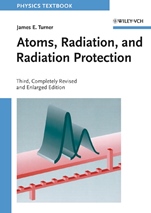
Atoms, Radiation, and Radiation Protection
ISBN 9783527406067
Autor: James E. Turner
Wydawca: Wiley
Dostępność: 3-6 tygodni
Cena: 693,00 zł
Przed złożeniem zamówienia prosimy o kontakt mailowy celem potwierdzenia ceny.
ISBN13: |
9783527406067 |
ISBN10: |
3527406069 |
Autor: |
James E. Turner |
Oprawa: |
Paperback |
Rok Wydania: |
2007-05-11 |
Numer Wydania: |
3rd, Completely Revised and Enlarged Edition |
Ilość stron: |
606 |
Wymiary: |
245x177 |
Tematy: |
PH |
Atoms, Radiation, and Radiation Protection offers professionals and advanced students a comprehensive coverage of the major concepts that underlie the origins and transport of ionizing radiation in matter. Understanding atomic structure and the physical mechanisms of radiation interactions is the foundation on which much of the current practice of radiological health protection is based. The work covers the origin, detection, and measurement of radiation and the statistical interpretation of the data. The procedures that are used to protect man and the environment from the potential harmful effects of radiation are thoroughly described. Basic principles are illustrated with an abundance of worked examples that exemplify practical applications. Chapters include problem sets (with partial answers) and extensive tables and graphs for continued use as a reference work. This expanded Third Edition includes thorough updates of the material, including the latest recommendations of the ICRP and NCRP.
From the contents:
1. About Atomic Physics and Radiation.
2. Atomic Structure and Atomic Radiation.
3. The Nucleus and Nuclear Radiation.
4. Radioactive Decay.
5. Interaction of Heavy Charged Particles with Matter.
6. Interaction of Electrons with Matter.
7. Phenomena Associated with Charged–Particle Tracks.
8. Interaction of Photons with Matter.
9. Neutrons, Fission, and Criticality.
10. Methods of Radiation Detection.
11. Statistics.
12. Radiation Dosimetry.
13. Chemical and Biological Effects of Radiation.
14. Radiation–Protection Criteria and Exposure Limits.
15. External Radiation Protection.
16. Internal Dosimetry and Radiation Protection.
Spis treści:
Preface to the First Edition.
Preface to the Second Edition.
Preface to the Third Edition.
1 About Atomic Physics and Radiation.
1.1 Classical Physics.
1.2 Discovery of X Rays.
1.3 Some
Important Dates in Atomic and Radiation Physics.
1.4 Important Dates in Radiation Protection.
1.5 Sources and Levels of Radiation Exposure.
1.6 Suggested Reading.
2 Atomic Structure and Atomic Radiation.
2.1 The Atomic Nature of Matter (ca. 1900).
2.2 The Rutherford Nuclear Atom.
2.3 Bohr’s Theory of the Hydrogen Atom.
2.4 Semiclassical Mechanics, 1913–1925.
2.5 Quantum Mechanics.
2.6 The Pauli Exclusion Principle.
2.7 Atomic Theory of the Periodic System.
2.8 Molecules.
2.9 Solids and Energy Bands.
2.10 Continuous and Characteristic X Rays.
2.11 Auger Electrons.
2.12 Suggested Reading.
2.13 Problems.
2.14 Answers.
3 The Nucleus and Nuclear Radiation 55
3.1 Nuclear Structure 55
3.2 Nuclear Binding Energies.
3.3 Alpha Decay.
3.4 Beta Decay (β–).
3.5 Gamma–Ray Emission.
3.6 Internal Conversion.
3.7 Orbital Electron Capture.
3.8 Positron Decay (β+).
3.9 Suggested Reading.
3.10 Problems.
3.11 Answers.
4 Radioactive Decay.
4.1 Activity.
4.2 Exponential Decay.
4.3 Specific Activity.
4.4 Serial Radioactive Decay.
4.5 Natural Radioactivity.
4.6 Radon and Radon Daughters.
4.7 Suggested Reading.
4.8 Problems.
4.9 Answers.
5 Interaction of Heavy Charged Particles with Matter.
5.1 Energy–Loss Mechanisms.
5.2 Maximum Energy Transfer in a Single Collision.
5.3 Single–Collision Energy–Loss Spectra.
5.4 Stopping Power.
5.5 Semiclassical Calculation of Stopping Power.
5.6 The Bethe Formula for Stopping Power.
5.7 Mean Excitation Energies.
5.8 Table for Computation of Stopping Powers.
5.9 Stopping Power of Water for Protons.
5.10 Range.
5.11 Slowing–Down Time.
5.12 Limitations of Bethe’s Stopping–Power Formula.
5.13 Suggested Reading.
5.14 Problems.
5.15 Answers.
6 Interaction of
Electrons with Matter.
6.1 Energy–Loss Mechanisms.
6.2 Collisional Stopping Power.
6.3 Radiative Stopping Power.
6.4 Radiation Yield.
6.5 Range.
6.6 Slowing–Down Time.
6.7 Examples of Electron Tracks in Water.
6.8 Suggested Reading.
6.9 Problems.
6.10 answers.
7 Phenomena Associated with Charged–Particle Tracks.
7.1 Delta Rays.
7.2 Restricted Stopping Power.
7.3 Linear Energy Transfer (LET).
7.4 Specific Ionization.
7.5 Energy Straggling.
7.6 Range Straggling.
7.7 Multiple Coulomb Scattering.
7.8 Suggested Reading.
7.9 Problems.
7.10 Answers.
8 Interaction of Photons with Matter.
8.1 Interaction Mechanisms.
8.2 Photoelectric Effect.
8.3 Energy–Momentum Requirements for Photon Absorption by an Electron.
8.4 Compton Effect.
8.5 Pair Production.
8.6 Photonuclear Reactions.
8.7 Attenuation Coef.cients.
8.8 Energy–Transfer and Energy–Absorption Coef.cients.
8.9 Calculation of Energy Absorption and Energy Transfer.
8.10 Suggested Reading.
8.11 Problems.
8.12 Answers.
9 Neutrons, Fission, and Criticality.
9.1 Introduction.
9.2 Neutron Sources.
9.3 Classification of Neutrons.
9.4 Interactions with Matter.
9.5 Elastic Scattering.
9.6 Neutron–Proton Scattering Energy–Loss Spectrum.
9.7 Reactions.
9.8 Energetics of Threshold Reactions.
9.9 Neutron Activation.
9.10 Fission.
9.11 Criticality.
9.12 Suggested Reading.
9.13 Problems.
9.14 Answers.
10 Methods of Radiation Detection.
10.1 Ionization in Gases.
Ionization Current.
10.2 Ionization in Semiconductors.
10.3 Scintillation.
10.4 Photographic Film.
10.5 Thermoluminescence.
10.6 Other Methods.
10.7 Neutron Detection.
10.8 Suggested Reading.
10.9 Problems.
10.10 Answers.
11 Statistics.
11.1 The Statistical World of Atoms and Radiation.
11.2 Radioactive
Disintegration—Exponential Decay.
11.3 Radioactive Disintegration—a Bernoulli Process.
11.4 The Binomial Distribution.
11.5 The Poisson Distribution.
11.6 The Normal Distribution.
11.7 Error and Error Propagation.
11.8 Counting Radioactive Samples.
11.9 Minimum Significant Measured Activity—Type–I Errors.
11.10 Minimum Detectable True Activity—Type–II Errors.
11.11 Criteria for Radiobioassay, HPS Nl3.30–1996.
11.12 Instrument Response.
11.13 Monte Carlo Simulation of Radiation Transport.
11.14 Suggested Reading.
11.15 Problems.
11.16 Answers.
12 Radiation Dosimetry.
12.1 Introduction.
12.2 Quantities and Units.
12.3 Measurement of Exposure.
12.4 Measurement of Absorbed Dose.
12.5 Measurement of X– and Gamma–Ray Dose.
12.6 Neutron Dosimetry.
12.7 Dose Measurements for Charged–Particle Beams.
12.8 Determination of LET.
12.9 Dose Calculations.
12.10 Other Dosimetric Concepts and Quantities.
12.11 Suggested Reading.
12.12 Problems.
12.13 Answers.
13 Chemical and Biological Effects of Radiation.
13.1 Time Frame for Radiation Effects.
13.2 Physical and Prechemical Chances in Irradiated Water.
13.3 Chemical Stage.
13.4 Examples of Calculated Charged–Particle Tracks in Water.
13.5 Chemical Yields in Water.
13.6 Biological Effects.
13.7 Sources of Human Data.
13.8 The Acute Radiation Syndrome.
13.9 Delayed Somatic Effects.
13.10 Irradiation of Mammalian Embryo and Fetus.
13.11 Genetic Effects.
13.12 Radiation Biology.
13.13 Dose–Response Relationships.
13.14 Factors Affecting Dose Response.
13.15 Suggested Reading.
13.16 Problems.
13.17 Answers.
14 Radiation–Protection Criteria and Exposure Limits.
14.1 Objective of Radiation Protection.
14.2 Elements of Radiation–Protection Programs.
14.3 The NCRP and ICRP.
14.4 NCRP/I
Koszyk
Książek w koszyku: 0 szt.
Wartość zakupów: 0,00 zł
Informacje


Kontakt
Gambit
Centrum Oprogramowania
i Szkoleń Sp. z o.o.
Al. Pokoju 29b/22-24
31-564 Kraków
Siedziba Księgarni
ul. Kordylewskiego 1
31-542 Kraków
+48 12 410 5991
+48 12 410 5987
+48 12 410 5989
Subskrypcje
Administratorem danych osobowych jest firma Gambit COiS Sp. z o.o. Na podany adres będzie wysyłany wyłącznie biuletyn informacyjny.
Autoryzacja płatności

Informacje na temat autoryzacji płatności poprzez PayU.

© Copyright 2012: GAMBIT COiS Sp. z o.o. Wszelkie prawa zastrzeżone.
Projekt i wykonanie: Alchemia Studio Reklamy