


Wydawcy
Katalog tematyczny
- Archeologia (109)
- Ekonomia, finanse, business (13704)
- Filozofia (1445)
- Historia (3040)
- Języki i językoznawstwo (2356)
- Lifestyle, hobby i rozrywka (475)
- Medycyna (9704)
- Nauki humanistyczne (4)
- Nauki o Ziemi i środowisku (2638)
- Nauki ścisłe (20412)
- Astronomia (294)
- Biologia (5119)
- Chemia (6540)
- Fizyka (3309)
- Elektryczność i magnetyzm (90)
- Fizyka atomowa i molekularna (110)
- Fizyka cząstek elementarnych (36)
- Fizyka jądra atomowego (36)
- Fizyka kwantowa (210)
- Fizyka matematyczna (121)
- Fizyka relatywistyczna (36)
- Fizyka statystyczna (51)
- Fizyka stosowana (498)
- Mechanika klasyczna (186)
- Optyka i światło (133)
- Stany materii (202)
- Matematyka (4574)
- Nauki ścisłe, ogólnie (503)
- Nauki społeczne (8486)
- Nauki techniczne (13450)
- Prawo (1696)
- Publikacje informacyjne i interdyscyplinarne (1288)
- Religia i wierzenia (917)
- Technika komputerowa (4067)
- Zdrowie, relacje międzyludzkie i rozwój osobisty (657)





Informacje szczegółowe o książce
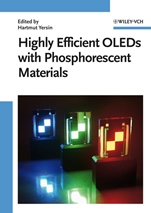
Highly Efficient OLEDs with Phosphorescent Materials
ISBN 9783527405947
Autor: Hartmut Yersin
Wydawca: Wiley
Dostępność: 3-6 tygodni
Cena: 1 085,70 zł
Przed złożeniem zamówienia prosimy o kontakt mailowy celem potwierdzenia ceny.
ISBN13: |
9783527405947 |
ISBN10: |
3527405941 |
Autor: |
Hartmut Yersin |
Oprawa: |
Hardback |
Rok Wydania: |
2007-10-17 |
Ilość stron: |
458 |
Wymiary: |
243x173 |
Tematy: |
PH |
This brand–new monograph on organic light emitting diodes, edited by a pioneer, and written by front–line researchers from academia and industry, provides access to the latest findings in this rapidly growing field. More than ten contributions cover all areas –– from theory and basic principles, to different emitter materials and applications in production.
Spis treści:
Preface.
Contributors.
1 Triplet Emitters for Organic Light–Emitting Diodes: Basic Properties (Hartmut Yersin and Walter J. Finkenzeller).
1.1 Introduction.
1.2 Electro–Luminescence and the Population of Excited States.
1.3 Electronic Excitations and Excited States.
1.4 Zero–Field Splitting (ZFS) of the Emitting Triplet, Photophysical Trends, and Ordering Scheme for Organo–Transition Metal Compounds.
1.5 Characterization of the Lowest Triplet State Based on High–Resolution Spectroscopy: Application to Pt(thpy)2.
1.6 Characterization of the Lowest Triplet State Based on Decay Time Measurements: Application to Ir(ppy)3.
1.7 Phosphorescence Dynamics and Spin–Lattice Relaxation: Background and Case Study Applied to Pt(thpy)2.
1.8 The Triplet State Under Application of High Magnetic Fields: Properties of Ir(btp)2(acac).
1.9 Vibrational Satellite Structures: Case Studies Applied to Pt(thpy)2 and Ir(btp)2(acac).
1.10 Environmental Effects on Triplet State Properties: Case Studies Applied to Ir(btp)2(acac).
1.11 Emission Linewidths and Spectral Broadening Effects.
1.12 Conclusions.
2 Spin Correlations in Organic Light–Emitting Diodes (Manfred J. Walter and John M. Lupton).
2.1 Introduction.
2.2 Spin–Dependent Recombination of Charge Carriers and Spin–Lattice Relaxation.
2.3 Studying Spin States using Electric Field Modulated Fluorescence a
nd Phosphorescence.
2.4 Summary and Outlook.
3 Cyclometallated Organoiridium Complexes as Emitters in Electrophosphorescent Devices (Peter I. Djurovich and Mark E. Thompson).
3.1 Organic Light–Emitting Devices.
3.2 Phosphorescent Materials as Emitters in OLEDs.
3.3 Organometallic Complexes as Phosphorescent Emitters in OLEDs.
3.4 Confi ning Triplet Excitons and Carriers in Phosphor–Doped OLEDs.
3.5 Cyclometallated Complexes for OLEDs.
3.6 Conclusion.
4 Highly Effi cient Red–Phosphorescent Iridium Complexes (Akira Tsuboyama, Shinjiro Okada, and Kazunori Ueno).
4.1 Introduction.
4.2 Issues of Red–Emissive Materials.
4.3 Red–Phosphorescent Iridium Complexes.
4.4 OLED Device.
4.5 Summary.
5 Pyridyl Azolate Based Luminescent Complexes: Strategic Design, Photophysics, and Applications (Yun Chi and Pi–Tai Chou).
5.1 Introduction.
5.2 Ligand Synthesis.
5.3 Phosphorescent OLED Applications.
5.4 Concluding Remarks.
6 Physical Processes in Polymer–Based Electrophosphorescent Devices (Xiao–Hui Yang, Frank Jaiser, and Dieter Neher).
6.1 Introduction.
6.2 Phosphorescent Devices Based on PVK.
6.3 Devices with PtOEP Doped into Conjugated Polymer Matrices.
6.4 Conclusion and Outlook.
7 Phosphorescent Platinum(II) Materials for OLED Applications (Hai–Feng Xiang, Siu–Wai Lai, P. T. Lai, and Chi–Ming Che).
7.1 Introduction.
7.2 Device Fabrication and Electroluminescence Measurements.
7.3 Platinum(II) α–Diimine Arylacetylide Complexes.
7.4 Tridentate Pt(II) Complexes.
7.5 Tetradentate Pt(II) Complexes.
7.6 Concluding Remarks.
8 Energy–Transfer Processes between Phosphorescent Guest and Fluorescent Host Molecules in Phosphorescent OLEDs (Isao Tanaka and Shizuo Tokito).
8.1 Introduction.
8.2 Electronic Structure an
d Energy Transfer in Guest–Host Systems.
8.3 Luminescence Properties of Phosphorescent and Fluorescent Materials.
8.4 Energy Transfer of Blue Phosphorescent Molecules in Guest–Host Systems.
8.5 Energy Transfer Between Ir(ppy)3 and Alq3: Enhancement of Phosphorescence from Alq3.
8.6 Energy Transfer Between Ir(ppy)3 and BAlq: Observation of Thermal Equilibrium of Triplet Excited States.
8.7 Conclusion.
9 High–Effi ciency Phosphorescent Polymer LEDs (Addy van Dijken, Klemens Brunner, Herbert Börner, and Bea M.W. Langeveld).
9.1 Introduction.
9.2 The Route Toward High–Effi ciency OLEDs.
9.3 Singlet and Triplet Excited States.
9.4 Phosphorescent Emitters.
9.5 Host Materials for Phosphorescent Emitters.
9.6 Outlook.
10 Electroluminescence from Metal–Containing Polymers and Metal Complexes with Functional Ligands (Chris Shuk Kwan Mak, and Wai Kin Chan).
10.1 Introduction.
10.2 Traditional Materials Used in OLEDs.
10.3 Development of Phosphorescent Materials for OLEDS.
10.4 Ruthenium Containing Polymers.
10.5 Summary.
11 Molecular Engineering of Iridium Complexes and their Application in Organic Light Emitting Devices (Mohammad K. Nazeeruddin, Cedric Klein, Michael Grätzel, Libero Zuppiroli, and Detlef Berner).
11.1 Introduction.
11.2 Phosphorescent Iridium Complexes.
11.3 Application of Iridium Complexes in Organic Light–Emitting Devices (OLEDs).
12 Progress in Electroluminescence Based on Lanthanide Complexes (Zu–Qiang Bian and Chun–Hui Huang).
12.1 Introduction.
12.2 The Device Construction and Operating Principles.
12.3 The Red Electroluminescence Based on Europium Complexes.
12.4 The Green Electroluminescence Based on Terbium Complexes.
12.5 The Near Infrared Electroluminescence Based on Neodymium, Erbium, or Ytterbium Complexes.
12.6 The Ligand Emission Electroluminesce
nce Based on Yttrium, Lanthanum, Gadolinium, or Lutetium Complexes.
12.7 Conclusion.
Index.
Nota biograficzna:
Hartmut Yersin is Professor at the University in Regensburg, the city which also hosts the headquarter of OSRAM, one of the two leading illumination companies. Various research stays brought him in contact with leading workgroups in East and West. Now his research activities focus upon characterization of emitter materials, transition metal complexes, and theory and development of electroluminescent devices. His projects are awarded large fundings from the German Research Foundation, the Volkswagen Foundation as well as the Federal Ministry of Education and Research.
His close relationships with various institutions have enabled him to recruit a set of pioneering researchers from both industry and universities to cover a broad spectrum of topics ranging from theory to application.
Koszyk
Książek w koszyku: 0 szt.
Wartość zakupów: 0,00 zł
Informacje


Kontakt
Gambit
Centrum Oprogramowania
i Szkoleń Sp. z o.o.
Al. Pokoju 29b/22-24
31-564 Kraków
Siedziba Księgarni
ul. Kordylewskiego 1
31-542 Kraków
+48 12 410 5991
+48 12 410 5987
+48 12 410 5989
Subskrypcje
Administratorem danych osobowych jest firma Gambit COiS Sp. z o.o. Na podany adres będzie wysyłany wyłącznie biuletyn informacyjny.
Autoryzacja płatności

Informacje na temat autoryzacji płatności poprzez PayU.

© Copyright 2012: GAMBIT COiS Sp. z o.o. Wszelkie prawa zastrzeżone.
Projekt i wykonanie: Alchemia Studio Reklamy