


Wydawcy
Katalog tematyczny
- Archeologia (109)
- Ekonomia, finanse, business (13704)
- Filozofia (1445)
- Historia (3040)
- Języki i językoznawstwo (2356)
- Lifestyle, hobby i rozrywka (475)
- Medycyna (9704)
- Nauki humanistyczne (4)
- Nauki o Ziemi i środowisku (2638)
- Nauki ścisłe (20412)
- Astronomia (294)
- Biologia (5119)
- Chemia (6540)
- Fizyka (3309)
- Elektryczność i magnetyzm (90)
- Fizyka atomowa i molekularna (110)
- Fizyka cząstek elementarnych (36)
- Fizyka jądra atomowego (36)
- Fizyka kwantowa (210)
- Fizyka matematyczna (121)
- Fizyka relatywistyczna (36)
- Fizyka statystyczna (51)
- Fizyka stosowana (498)
- Mechanika klasyczna (186)
- Optyka i światło (133)
- Stany materii (202)
- Matematyka (4574)
- Nauki ścisłe, ogólnie (503)
- Nauki społeczne (8486)
- Nauki techniczne (13450)
- Prawo (1696)
- Publikacje informacyjne i interdyscyplinarne (1288)
- Religia i wierzenia (917)
- Technika komputerowa (4067)
- Zdrowie, relacje międzyludzkie i rozwój osobisty (657)





Informacje szczegółowe o książce
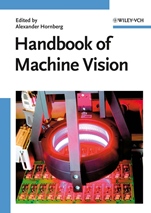
Handbook of Machine Vision
ISBN 9783527405848
Autor: Alexander Hornberg
Wydawca: Wiley
Dostępność: 3-6 tygodni
Cena: 1 071,00 zł
Przed złożeniem zamówienia prosimy o kontakt mailowy celem potwierdzenia ceny.
ISBN13: |
9783527405848 |
ISBN10: |
3527405844 |
Autor: |
Alexander Hornberg |
Oprawa: |
Hardback |
Rok Wydania: |
2006-07-21 |
Ilość stron: |
821 |
Wymiary: |
247x181 |
Tematy: |
PH |
With the demands made of quality management and process control within an industrial environment, machine vision is becoming an increasingly important issue. Written by experts from leading companies operating in the field, this handbook covers all aspects of image acquisition and image processing.
The authors approach the subject in terms of industrial applications, elucidating such topics as illumination and camera calibration. Throughout, they concentrate on all hardware aspects, ranging from lenses and camera systems to camera–computer interfaces, as well as discussing the necessary software in equal detail.
Equipped with this handbook, readers will not only be able to understand the latest systems for machine vision but will also be qualified to plan and evaluate such technology.
Spis treści:
1 Processing of Information in the Human Visual System (Prof. Dr. F. Schaeffel, University of Tübingen).
1.1 Preface.
1.2 Design and Structure of the Eye.
1.3 Optical Aberrations and Consequences for Visual Performance.
1.4 Chromatic Aberration.
1.5 Neural Adaptation to Monochromatic Aberrations.
1.6 Optimizing Retinal Processing with Limited Cell Numbers, Space and Energy.
1.7 Adaptation to Different Light Levels.
1.8 Rod and Cone Responses.
1.9 Spiking and Coding.
1.10 Temporal and Spatial Performance.
1.11 ON/OFF Structure, Division of theWhole Illuminance Amplitude in Two Segments.
1.12 Consequences of the Rod and Cone Diversity on Retinal Wiring.
1.13 Motion Sensitivity in the Retina.
1.14 Visual Information Processing in Higher Centers.
1.15 Effects of Attention.
1.16 Color Vision, Color Constancy, and Color Contrast.
1.17 Depth Perception.
1.18 Adaptation in the Visual System to Color, Spatial, and Temporal Contrast.
1.19 Conclusions.
References.
2 Introduction to Building a Machine Vision Inspection (Axel Telljohann, Consulting Team Machine
Vision (CTMV)).
2.1 Preface.
2.2 Specifying a Machine Vision System.
2.3 Designing a Machine Vision System.
2.4 Costs.
2.5 Words on Project Realization.
2.6 Examples.
3 Lighting in Machine Vision (I. Jahr, Vision & Control GmbH).
3.1 Introduction.
3.2 Demands on Machine Vision lighting.
3.3 Light used in Machine Vision.
3.4 Interaction of Test Object and Light.
3.5 Basic Rules and Laws of Light Distribution.
3.6 Light Filters.
3.7 Lighting Techniques and Their Use.
3.8 Lighting Control.
3.9 Lighting Perspectives for the Future.
References.
4 Optical Systems in Machine Vision (Dr. Karl Lenhardt, Jos. Schneider OptischeWerke GmbH).
4.1 A Look on the Foundations of Geometrical Optics.
4.2 Gaussian Optics.
4.3 The Wave Nature of Light.
4.4 Information Theoretical Treatment of Image Transfer and Storage.
4.5 Criteria for Image Quality.
4.6 Practical Aspects.
References.
5 Camera Calibration (R. Godding, AICON 3D Systems GmbH).
5.1 Introduction.
5.2 Terminology.
5.3 Physical Effects.
5.4 Mathematical Calibration Model.
5.5 Calibration and Orientation Techniques.
5.6 Verification of Calibration Results.
5.7 Applications.
References.
6 Camera Systems in Machine Vision (Horst Mattfeldt, Allied Vision Technologies GmbH).
6.1 Camera Technology.
6.2 Sensor Technologies.
6.3 CCD Image Artifacts.
6.4 CMOS Image Sensor.
6.5 Block Diagrams and their Description.
6.6 Digital Cameras.
6.7 Controlling Image Capture.
6.8 Configuration of the Camera.
6.9 Camera Noise1.
6.10 Digital Interfaces.
References.
7 Camera Computer Interfaces (Tony Iglesias, Anita Salmon, Johann Scholtz, Robert Hedegore, Julianna Borgendale, Brent Runnels, Nathan McKimpson, National Instruments).
7.1 Overview.
7.2 Analog Camera Buses.
7.3 Parallel Digital Camera Buses.
7.4 Standa
rd PC Buses.
7.5 Choosing a Camera Bus.
7.6 Computer Buses.
7.7 Choosing a Computer Bus.
7.8 Driver Software.
7.9 Features of a Machine Vision System.
8 Machine Vision Algorithms (Dr. Carsten Steger, MVTec Software GmbH).
8.1 Fundamental Data Structures.
8.2 Image Enhancement.
8.3 Geometric Transformations.
8.4 Image Segmentation.
8.5 Feature Extraction.
8.6 Morphology.
8.7 Edge Extraction.
8.8 Segmentation and Fitting of Geometric Primitives.
8.9 Template Matching.
8.10 Stereo Reconstruction.
8.11 Optical Character Recognition.
References.
9 Machine Vision in Manufacturing (Dr.–Ing. Peter Waszkewitz, Robert Bosch GmbH).
9.1 Introduction.
9.2 Application Categories.
9.3 System Categories.
9.4 Integration and Interfaces.
9.5 Mechanical Interfaces.
9.6 Electrical Interfaces.
9.7 Information Interfaces.
9.8 Temporal Interfaces.
9.9 Human–Machine Interfaces.
9.10 Industrial Case Studies.
9.11 Constraints and Conditions.
References.
Index.
Nota biograficzna:
Alexander Hornberg is Professor for Physics and Photonics at the University of Applied Sciences Esslingen, Germany. He holds a degree in physics and a doctorate in mathematics from the University of Karlsruhe. He started his professional career as development and software engineer for a major industry manufacturer (DUNLOP) in 1989. In 1992 he returned to higher education at the University of Applied Sciences Ulm. Since 1997 he has been working in the field of machine vision at the Technical University of Applied Sciences Esslingen.
Okładka tylna:
With the demands made of quality management and process control within an industrial environment, machine vision is becoming an increasingly important issue. Written by experts from leading companies operating in the field, this handbook covers all aspects of image acquisition and
image processing.
The authors approach the subject in terms of industrial applications, elucidating such topics as illumination and camera calibration. Throughout, they concentrate on all hardware aspects, ranging from lenses and camera systems to camera–computer interfaces, as well as discussing the necessary software in equal detail.
Equipped with this handbook, readers will not only be able to understand the latest systems for machine vision but will also be qualified to plan and evaluate such technology.
Koszyk
Książek w koszyku: 0 szt.
Wartość zakupów: 0,00 zł
Informacje


Kontakt
Gambit
Centrum Oprogramowania
i Szkoleń Sp. z o.o.
Al. Pokoju 29b/22-24
31-564 Kraków
Siedziba Księgarni
ul. Kordylewskiego 1
31-542 Kraków
+48 12 410 5991
+48 12 410 5987
+48 12 410 5989
Subskrypcje
Administratorem danych osobowych jest firma Gambit COiS Sp. z o.o. Na podany adres będzie wysyłany wyłącznie biuletyn informacyjny.
Autoryzacja płatności

Informacje na temat autoryzacji płatności poprzez PayU.

© Copyright 2012: GAMBIT COiS Sp. z o.o. Wszelkie prawa zastrzeżone.
Projekt i wykonanie: Alchemia Studio Reklamy