


Wydawcy
Katalog tematyczny
- Archeologia (109)
- Ekonomia, finanse, business (13704)
- Filozofia (1445)
- Historia (3040)
- Języki i językoznawstwo (2356)
- Lifestyle, hobby i rozrywka (475)
- Medycyna (9704)
- Nauki humanistyczne (4)
- Nauki o Ziemi i środowisku (2638)
- Nauki ścisłe (20412)
- Astronomia (294)
- Biologia (5119)
- Chemia (6540)
- Fizyka (3309)
- Elektryczność i magnetyzm (90)
- Fizyka atomowa i molekularna (110)
- Fizyka cząstek elementarnych (36)
- Fizyka jądra atomowego (36)
- Fizyka kwantowa (210)
- Fizyka matematyczna (121)
- Fizyka relatywistyczna (36)
- Fizyka statystyczna (51)
- Fizyka stosowana (498)
- Mechanika klasyczna (186)
- Optyka i światło (133)
- Stany materii (202)
- Matematyka (4574)
- Nauki ścisłe, ogólnie (503)
- Nauki społeczne (8486)
- Nauki techniczne (13450)
- Prawo (1696)
- Publikacje informacyjne i interdyscyplinarne (1288)
- Religia i wierzenia (917)
- Technika komputerowa (4067)
- Zdrowie, relacje międzyludzkie i rozwój osobisty (657)





Informacje szczegółowe o książce
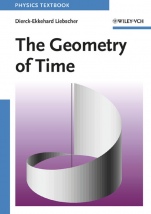
The Geometry of Time
ISBN 9783527405671
Autor: Dierck–Ekkehard Liebscher
Wydawca: Wiley
Dostępność: 3-6 tygodni
Cena: 619,50 zł
Przed złożeniem zamówienia prosimy o kontakt mailowy celem potwierdzenia ceny.
ISBN13: |
9783527405671 |
ISBN10: |
3527405674 |
Autor: |
Dierck–Ekkehard Liebscher |
Oprawa: |
Paperback |
Rok Wydania: |
2005-03-08 |
Ilość stron: |
253 |
Wymiary: |
218x166 |
Tematy: |
PH |
A description of the geometry of space–time, in particular the theory of special relativity, with all the questions and issues explained without relying solely on formulas. The author shows that the geometry of space–time is indeed geometry, using actual constructions with which we are familiar from Euclidean geometry, and which admit exact demonstrations and proofs. He also uses the relation to projective geometry to illustrate the starting points of general relativity.
This is not intended as a textbook aimed at introducing readers to the theory of relativity so they may calculate formally, but rather its aim is to show the connection with synthetic geometry –– a first in books on special relativity.
The book is written at an introductory (undergraduate) level, with the formal mathematics behind the constructions provided in the appendices. The novel presentation allows teaching staff to learn from it, too.
Spis treści:
Foreword.
The structure of the book.
Notation.
1 Introduction.
2 The World of Space and Time.
2.1 Timetable.
2.2 Surveying Space–Time.
2.3 Physical Prerequisites of Geometry.
3 Reflection and Collision.
3.1 Geometry and Reflection.
3.2 The Reflection of Mechanical Motion.
4 The Relativity Principle of Mechanics and Wave Propagation.
5 Relativity Theory and its Paradoxes.
5.1 Pseudo–Euclidean Geometry.
5.2 Einstein’s Mechanics.
5.3 Energy.
5.4 Kinematic Peculiarities.
5.5 Aberration and Fresnel’s Paradox.
5.6 The Net.
5.7 Faster than Light.
6 The Circle Disguised as Hyperbola.
7 Curvature.
7.1 Spheres and Hyperbolic Shells.
7.2 The Universe.
8 The Projective Origin of the Geometries of the Plane.
9 The Nine Geometries of the Plane.
10 General Remarks.
10.1 The Theory of Relativity.
10.2 Geometry and Physics.
Appendic
es.
A Reflections.
B Transformations.
B.1 Coordinates.
B.2 Inertial Reference Systems.
B.3 Riemannian Spaces, Einstein Worlds.
C Projective Geometry.
C.1 Algebra.
C.2 Projective Maps.
C.3 Conic Sections.
D The Transition from the Projective to the Metrical Plane.
D.1 Polarity.
D.2 Reflection.
D.3 Velocity Space.
D.4 Circles and Peripheries.
D.5 Two Examples.
E The Metrical Plane.
E.1 Classification.
E.2 The Metric.
Exercises.
Glossary.
References.
Nota biograficzna:
Dierck–Eckehard Liebscher studied physics at the Humboldt University, Berlin, and received two PhDs in 1966 and 1973, both on topics of general relativity. From 1967 to 1991, he worked at the Central Institute for Astrophysics of the former GDR. In 1992, he accepted a post as senior scientist at the Astrophysical Institute, Potsdam, where he still works. Professor Liebscher is the author of several books and numerous papers.
Okładka tylna:
A description of the geometry of space–time, in particular the theory of special relativity, with all the questions and issues explained without relying solely on formulas. The author shows that the geometry of space–time is indeed geometry, using actual constructions with which we are familiar from Euclidean geometry, and which admit exact demonstrations and proofs. He also uses the relation to projective geometry to illustrate the starting points of general relativity.
This is not intended as a textbook aimed at introducing readers to the theory of relativity so they may calculate formally, but rather its aim is to show the connection with synthetic geometry –– a first in books on special relativity.
The book is written at an introductory (undergraduate) level, with the formal mathematics behind the constructions provided in the appendices. The novel presentation allows teaching staff
to learn from it, too.
Koszyk
Książek w koszyku: 0 szt.
Wartość zakupów: 0,00 zł
Informacje


Kontakt
Gambit
Centrum Oprogramowania
i Szkoleń Sp. z o.o.
Al. Pokoju 29b/22-24
31-564 Kraków
Siedziba Księgarni
ul. Kordylewskiego 1
31-542 Kraków
+48 12 410 5991
+48 12 410 5987
+48 12 410 5989
Subskrypcje
Administratorem danych osobowych jest firma Gambit COiS Sp. z o.o. Na podany adres będzie wysyłany wyłącznie biuletyn informacyjny.
Autoryzacja płatności

Informacje na temat autoryzacji płatności poprzez PayU.

© Copyright 2012: GAMBIT COiS Sp. z o.o. Wszelkie prawa zastrzeżone.
Projekt i wykonanie: Alchemia Studio Reklamy