


Wydawcy
Katalog tematyczny
- Ekonomia, finanse, business (11664)
- Języki i językoznawstwo (2311)
- Lifestyle, hobby i rozrywka (411)
- Medycyna (5054)
- Nauki o Ziemi i środowisku (1033)
- Nauki ścisłe (10005)
- Astronomia (12)
- Biologia (1261)
- Chemia (5074)
- Fizyka (1553)
- Elektryczność i magnetyzm (14)
- Fizyka atomowa i molekularna (13)
- Fizyka cząstek elementarnych (1)
- Fizyka jądra atomowego (1)
- Fizyka relatywistyczna (1)
- Fizyka stosowana (39)
- Mechanika klasyczna (18)
- Optyka i światło (14)
- Stany materii (20)
- Matematyka (1875)
- Nauki ścisłe, ogólnie (177)
- Nauki społeczne (6049)
- Nauki techniczne (5313)
- Prawo (160)
- Publikacje informacyjne i interdyscyplinarne (706)
- Technika komputerowa (2101)
- Zdrowie, relacje międzyludzkie i rozwój osobisty (632)





Informacje szczegółowe o książce
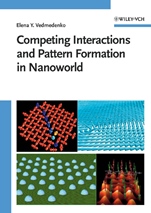
Competing Interactions and Pattern Formation in Nanoworld
ISBN 9783527404841
Autor: Elena Vedmedenko
Wydawca: Wiley
Dostępność: 3-6 tygodni
Cena: 962,85 zł
Przed złożeniem zamówienia prosimy o kontakt mailowy celem potwierdzenia ceny.
ISBN13: |
9783527404841 |
ISBN10: |
3527404848 |
Autor: |
Elena Vedmedenko |
Oprawa: |
Hardback |
Rok Wydania: |
2007-01-26 |
Ilość stron: |
215 |
Wymiary: |
249x179 |
Tematy: |
PH |
Systems displaying competing interactions of some kind are widespread – much more, in fact, as commonly anticipated (magnetic and Ising–type interactions or the dynamics of DNA molecules being only two popular examples).
Written for researchers in the field with different professional backgrounds, this volume classifies phenomena not by system but rather by the type of competing interactions involved. This allows for a straightforward presentation of the underlying principles and the universal laws governing the behaviour of different systems.
Starting with a historical overview, the author proceeds by describing self–competitions of various types of interactions (such as diploar or multipolar interactions), competitions between a short–range and a long–range interaction (as in Ising systems or DNA models) or between a long–range interaction and an anisotropy (as in ultrathin magnetic films or magnetic nanoparticles) and finally competitions between interactions of the same range (as in spin glasses).
Each chapter contains a few problems with solutions which provide suitable material for lecturers of mathematics and physics as well as biology courses.
A vast body of references to the original literature make the volume self–contained and ideally suited to master this interdisciplinary field.
Spis treści:
Preface.
1 Introduction.
1.1 How the Story Began.
1.1.1 Structure Periodicity and Modulated Phases.
1.1.2 Ferromagnetic and Ferroelectric Domains.
1.2 First Theoretical Approaches for Competing Interactions.
1.2.1 Frenkel–Kontorova Model.
1.2.2 Theoretical Models of the Magnetic/Ferroelectric Domains.
1.2.2.1 Phenomenology of the Dipolar Interaction.
1.2.2.2 Phenomenology of the Exchange and Exchange–Like Interactions.
1.2.2.3 Mechanism of the Domain Formation.
1.3 Summary.
1.4 Exercises.
References.
2 Self–Competi
tion: or How to Choose the Best from the Worst.
2.1 Frustration: The World is not Perfect.
2.2 Why is an Understanding of Frustration Phenomena Important for Nanosystems?
2.3 Ising, XY, and Heisenberg Statistical Models.
2.4 Order–Disorder Phenomena.
2.4.1 Phase Transitions and their Characterization.
2.4.2 Order Below a Critical Temperature.
2.4.3 Measure of Frustration: Local Energy Parameter.
2.5 Self–Competition of the Short–Range Interactions.
2.5.1 Ising Antiferromagnet on a Lattice.
2.5.1.1 Triangular Lattice.
2.5.1.2 Kagome Lattice.
2.5.1.3 Ising Antiferromagnet on Aperiodic Tilings.
2.5.2 Heisenberg Antiferromagnet on a Lattice.
2.5.2.1 Triangular and Kagome Lattices.
2.5.2.2 Aperiodic Tilings.
2.5.3 Three–Dimensional Spin Structure on a Periodic Two–Dimensional Lattice: Itinerant Systems.
2.5.4 Frustration Squeezed Out.
2.6 Self–Competition of the Long–Range Interactions.
2.6.1 Dipolar Interactions.
2.6.1.1 Localized Ising Moments on a Periodic Lattice.
2.6.1.2 Localized Vector Moments on a Periodic Lattice.
2.6.1.3 Localized Vector Moments on Aperiodic Tilings.
2.6.1.4 Delocalized Moments with Given Orientation: Two–Dimensional Electron Wigner Crystal.
2.6.2 Multipolar Interactions: Why Might that be Interesting?
2.6.2.1 Multipolar Moments of Molecular Systems and Bose–Einstein Condensates.
2.6.2.2 Multipolar Moments of Nanomagnetic Particles.
2.6.2.3 Multipole–Multipole Interactions.
2.6.2.4 Ground States for Multipoles of Even Symmetry: Quadrupolar and Hexadecapolar Patterns.
2.6.2.5 Ground States for Multipoles of Odd Symmetry: Octopolar and Dotriacontapolar Patterns.
2.7 Summary.
2.8 Exercises.
References.
3 Competition Between a Short– and a Long–Range Interaction.
3.1 Localized Particles.
3.1.1 Competition Between the Ferromagnetic Exchange and the Dipolar Interac
tion: Ising Spins.
3.1.1.1 Stripes or Checkerboard?
3.1.1.2 Scaling Theory.
3.1.1.3 Stripes in an External Magnetic Field: Bubbles.
3.1.2 Competition Between the Ferromagnetic Exchange and the Dipolar Interaction: Vector Spins.
3.1.2.1 Films: Dominating Exchange Interaction.
3.1.2.2 Films: Dominating Dipolar Interaction.
3.1.2.3 Nanoparticles with Periodic Atomic Structure.
3.1.2.4 Nanoparticles with Aperiodic Atomic Structure.
3.1.3 Competition Between the Antiferromagnetic Exchange and the Dipolar Interaction.
3.1.3.1 Periodic Lattices.
3.1.3.2 Aperiodic Lattices.
3.1.4 Neural Networks.
3.2 Delocalized Particles.
3.2.1 Self–Assembled Domain Structures on a Solid Surface: Dipolar Lattice Gas Model.
3.2.2 Self–Organization in Langmuir Monolayers.
3.2.3 Self–Organization in Block Copolymer Systems.
3.2.4 Self–Organization in Colloidal Systems.
3.2.4.1 Planar Colloidal Crystals.
3.2.4.2 Patterns in Ferrofluids.
3.2.4.3 Systems of Magnetic Holes.
3.2.5 Two–Dimensional Electron Systems.
3.2.6 Patterns in Animal Colors.
3.3 Exercises.
References.
4 Competition Between Interactions on a Similar Length Scale.
4.1 Two Short– or Mid–Range Interactions.
4.1.1 Super–Exchange and Indirect Exchange Interactions.
4.1.2 Spin Glass.
4.1.3 Non–Collinear Magnetism at Surfaces.
4.1.3.1 Competing Heisenberg Exchange Interactions (Hexagonal Lattice).
4.1.3.2 Competing Heisenberg Exchange Couplings (Square Lattice).
4.1.3.3 Antiferromagnetic Domain Wall as a Spin Spiral.
4.1.3.4 Spin Spiral State in the Presence of Dipolar Interactions.
4.1.4 Two Short–Range Repulsive Interactions.
4.2 Two Long–Range Interactions.
4.2.1 Systems with Dipolar and Quadrupolar Interactions.
4.2.2 Systems with Dipolar and Octopolar Interactions.
4.2.2.1 Combined Multipoles in Nanomagnetic Arrays.
4.2.2.2 Magnetization Rev
ersal in Nanomagnetic Arrays.
4.3 Summary.
4.4 Exercises.
References.
5 Interplay Between Anisotropies and Interparticle Interactions 145
5.1 Interplay Between the Structural Anisotropy and the Short–Range Repulsion/Attraction: Liquid Crystals.
5.1.1 Liquid Crystal Phases.
5.1.2 Liquid Crystal Patterns: Textures and Disclinations.
5.1.3 The Lattice Model of Liquid Crystals.
5.2 Competition Between the Spin–Orbit Coupling and the Long–Range Dipolar Energy: Ultrathin Magnetic Films.
5.2.1 Shape Anisotropy from Dipolar Interactions.
5.2.2 Perpendicular Magnetic Anisotropy.
5.2.3 Anisotropy Phase Diagram.
5.2.4 Magnetic Structure of the Spin Reorientation Transition (SRT).
5.2.4.1 Regimes of Vertical and Planar Magnetization.
5.2.4.2 SRT via the Twisted Phase.
5.2.4.3 SRT via the State of Canted Magnetization.
5.2.4.4 SRT via the State of Coexisting Phases.
5.3 Magnetic Nanoplatelets.
5.3.1 Size–Dependence of Shape Anisotropy in Discrete Atomic Approximation.
5.3.2 Multiplicative Separation of Discrete and Continuum Contributions.
5.3.3 Size–Dependent Spin Reorientation Transition.
5.3.4 Size–Dependence of Crystallographic Anisotropy.
5.4 Summary.
5.5 Exercises.
References.
6 Dynamic Self–Organization.
6.1 Diffusion–Limited Aggregation.
6.1.1 Computer Model.
6.1.2 Diffusion–Limited Aggregation Altered by Interactions.
6.2 Dynamic Wave Patterns.
6.2.1 Pattern Dynamics of Spin Waves.
6.2.2 Liquid Crystals in a Rotating Magnetic Field.
6.2.3 Standing Waves in Two–Dimensional Electron Gas: Quantum Mirages.
6.3 Summary.
References.
Subject Index.
Koszyk
Książek w koszyku: 0 szt.
Wartość zakupów: 0,00 zł
Informacje


Kontakt
Gambit
Centrum Oprogramowania
i Szkoleń Sp. z o.o.
Al. Pokoju 29b/22-24
31-564 Kraków
Siedziba Księgarni
ul. Kordylewskiego 1
31-542 Kraków
+48 12 410 5991
+48 12 410 5987
+48 12 410 5989
Subskrypcje
Administratorem danych osobowych jest firma Gambit COiS Sp. z o.o. Na podany adres będzie wysyłany wyłącznie biuletyn informacyjny.
Autoryzacja płatności

Informacje na temat autoryzacji płatności poprzez PayU.

© Copyright 2012: GAMBIT COiS Sp. z o.o. Wszelkie prawa zastrzeżone.
Projekt i wykonanie: Alchemia Studio Reklamy