


Wydawcy
Katalog tematyczny
- Archeologia (109)
- Ekonomia, finanse, business (13704)
- Filozofia (1445)
- Historia (3040)
- Języki i językoznawstwo (2356)
- Lifestyle, hobby i rozrywka (475)
- Medycyna (9704)
- Nauki humanistyczne (4)
- Nauki o Ziemi i środowisku (2638)
- Nauki ścisłe (20412)
- Astronomia (294)
- Biologia (5119)
- Chemia (6540)
- Fizyka (3309)
- Elektryczność i magnetyzm (90)
- Fizyka atomowa i molekularna (110)
- Fizyka cząstek elementarnych (36)
- Fizyka jądra atomowego (36)
- Fizyka kwantowa (210)
- Fizyka matematyczna (121)
- Fizyka relatywistyczna (36)
- Fizyka statystyczna (51)
- Fizyka stosowana (498)
- Mechanika klasyczna (186)
- Optyka i światło (133)
- Stany materii (202)
- Matematyka (4574)
- Nauki ścisłe, ogólnie (503)
- Nauki społeczne (8486)
- Nauki techniczne (13450)
- Prawo (1696)
- Publikacje informacyjne i interdyscyplinarne (1288)
- Religia i wierzenia (917)
- Technika komputerowa (4067)
- Zdrowie, relacje międzyludzkie i rozwój osobisty (657)





Informacje szczegółowe o książce
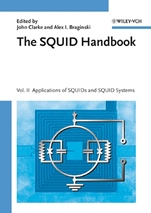
The SQUID Handbook: Applications of SQUIDs and SQUID Systems
ISBN 9783527404087
Autor: John Clarke, Alex I. Braginski
Wydawca: Wiley
Dostępność: 3-6 tygodni
Cena: 1 314,60 zł
Przed złożeniem zamówienia prosimy o kontakt mailowy celem potwierdzenia ceny.
ISBN13: |
9783527404087 |
ISBN10: |
3527404082 |
Autor: |
John Clarke, Alex I. Braginski |
Oprawa: |
Hardback |
Rok Wydania: |
2006-08-18 |
Ilość stron: |
653 |
Wymiary: |
246x186 |
Tematy: |
PH |
This two–volume handbook offers a comprehensive, coordinated presentation of Superconducting QUantum Interference Devices (SQUIDs), including their fundamentals, design, technology, system issues and applications. The handbook bridges the gap between fundamentals and applications, and will be a valuable textbook reference for graduate students and professionals engaged in SQUID research and engineering as well as for specialists in fields in which SQUIDs are used, including fundamental science, detection of signals from the brain and heart for both clinical and research purposes, non–destructive evaluation of metal structures and semiconductor packaging, detection of nuclear magnetic resonance, and prospecting for oil and minerals.
Spis treści:
Volume I.
Preface.
1 Introduction.
1.1 The Beginning.
1.2 Subsequent Developments.
1.3 The dc SQUID: A First Look.
1.4 The rf SQUID: A First Look.
1.5 Cryogenics and Systems.
1.6 Instruments: Amplifiers, Magnetometers and Gradiometers.
1.7 Applications.
1.8 Challenges and Perspectives.
1.9 Acknowledgment.
2 SQUID Theory.
2.1 Josephson Junctions.
2.2 Theory of the dc SQUID.
2.3 Theory of the rf SQUID.
3 SQUID Fabrication Technology.
3.1 Junction Electrode Materials and Tunnel Barriers.
3.2 Low–temperature SQUID Devices.
3.3 High–temperature SQUID Devices.
3.4 Future Trends.
4 SQUID Electronics.
4.1 General.
4.2 Basic Principle of a Flux–locked Loop.
4.3 The dc SQUID Readout.
4.4 The rf SQUID Readout.
4.5 Trends in SQUID Electronics.
5 Practical DC SQUIDS: Configuration and Performance.
5.1 Introduction.
5.2 Basic dc SQUID Design.
5.3 Magnetometers.
5.4 Gradiometers.
5.5 1/f Noise and Operation in Ambient Field.
5.6 Other Performance Degrading Effects.
6 Practical RF SQUIDs: Configuration and Performance.
6.1 Introduc
tion.
6.2 Rf SQUID Magnetometers.
6.3 Rf SQUID Gradiometers.
6.4 Low–Frequency Excess Noise in rf SQUIDs.
6.5 Response of rf SQUIDs to High–frequency Electromagnetic Interference.
6.6 Characterization and Adjustment of rf SQUIDs.
6.7 The rf SQUID versus the dc SQUID.
6.8 Concluding Remarks and Outlook.
7 SQUID System Issues.
7.1 Introduction.
7.2 Cryogenics.
7.3 Cabling and Electronics.
7.4 Data Acquisition and Rudimentary Signal Processing.
7.5 Characterization, Calibration and Testing.
7.6 Conditions Imposed on SQUID Systems by the Environment and Applications.
7.7 Noise Suppression.
7.8 Signal and Noise Implications forthe SQUID System Design.
7.9 Concluding Remarks and System Trends.
Appendix 1: Basic Properties of Superconductivity.
Appendix 2: Abbreviations, Constants and Symbols.
Index.
Volume II.
Preface.
List of Contributors.
8 SQUID Voltmetersand Amplifiers (J. Clarke, A. T. Lee, M. Mck and P. L. Richards).
8.1 Introduction.
8.2 Voltmeters.
8.3 The SQUID as a Radiofrequency Amplifier.
8.4 Microstrip SQUID Amplifier.
8.5 SQUID Readout of Thermal Detectors.
8.6 NuclearM agnetic and Quadrupole Resonance and Magnetic Resonance Imaging.
8.7 The Axion Detector.
9 SQUIDsfor Standardsand Metrology (J. Gallop and F. Piquemal).
9.1 Introduction.
9.2 SQUIDs in Voltage Metrology.
9.3 Cryogenic Current Comparator (CCC).
9.4 Other Current Metrological Applications of SQUIDs.
9.5 Future Trends and Conclusion.
10 The Magnetic Inverse Problem (E. A. Lima, A. Irimia and J. P. Wikswo).
10.1 The Peculiarities of the Magnetic Inverse Problem.
10.2 The Magnetic Forward Problem.
10.3 The Magnetic Inverse Problem.
10.4 Conclusions.
11 Biomagnetism (J. Vrba, J. Nenonen and L. Trahms).
11.1 Introduction.
11.2 Magnetoencephalography.
11.3 Magnetocardiography.
11.4 Quasi
static Field Magnetometry.
11.5 Magnetoneurography.
11.6 LiverS usceptometry.
11.7 Gastromagnetometry.
11.8 Magnetic Relaxation Immunoassays.
12 Measurements of Magnetism and Magnetic Properties of Matter (R. C. Black and F. C. Wellstood).
12.1 Introduction.
12.2 The SQUID Magnetometer–Susceptometer.
12.3 Scanning SQUID Microscopy.
13 Nondestructive Evaluation of Materials and Structuresus ing SQUIDs (H.–J. Krause and G. Donaldson).
13.1 Introduction.
13.2 Detection of Magnetic Moments.
13.3 Magnetic Flux Leakage Technique.
13.4 Static Current Distribution Mapping.
13.5 Eddy Current Technique.
13.6 Alternative Excitation Techniques.
13.7 Conclusion and Prospects.
14 SQUIDsfor Geophysical Survey and Magnetic Anomaly Detection (T. R. Clem, C. P. Foley, M. N. Keene).
14.1 Introduction.
14.2 Magnetic Measurements in the Earth’s Field.
14.3 Operation of SQUIDs in Real World Environments.
14.4 Data Acquisition and Signal Processing.
14.5 Geophysical Applications of SQUIDs.
14.6 Magnetic Anomaly Detection Systems using SQUIDs.
14.7 Future Prospects.
15 Gravity and Motion Sensors (Ho J. Paik).
15.1 Introduction.
15.2 The Superconducting Accelerometer.
15.3 Superconducting Transducer for Gravitational–Wave Detectors.
15.4 Superconducting Gravity Gradiometers (SGGs).
15.5 Applications of the SGG Technology.
15.6 Outlook.
Appendix: Physical Constants, Abbreviations and Symbols.
Index.
Nota biograficzna:
John Clarke is the world leading authority on SQUIDs and Alex Braginski contributed significantly to the development of high–temperature SQUIDs. They have assembled a team of co–authors who are the pre–eminent specialists in virtually all aspects of SQUIDs and SQUID applications.
Okładka tylna:
This two–volume handbook offers a comprehensi
ve, coordinated presentation of Superconducting QUantum Interference Devices (SQUIDs), including their fundamentals, design, technology, system issues and applications. The handbook bridges the gap between fundamentals and applications, and will be a valuable textbook reference for graduate students and professionals engaged in SQUID research and engineering as well as for specialists in fields in which SQUIDs are used, including fundamental science, detection of signals from the brain and heart for both clinical and research purposes, non–destructive evaluation of metal structures and semiconductor packaging, detection of nuclear magnetic resonance, and prospecting for oil and minerals.
Koszyk
Książek w koszyku: 0 szt.
Wartość zakupów: 0,00 zł
Informacje


Kontakt
Gambit
Centrum Oprogramowania
i Szkoleń Sp. z o.o.
Al. Pokoju 29b/22-24
31-564 Kraków
Siedziba Księgarni
ul. Kordylewskiego 1
31-542 Kraków
+48 12 410 5991
+48 12 410 5987
+48 12 410 5989
Subskrypcje
Administratorem danych osobowych jest firma Gambit COiS Sp. z o.o. Na podany adres będzie wysyłany wyłącznie biuletyn informacyjny.
Autoryzacja płatności

Informacje na temat autoryzacji płatności poprzez PayU.

© Copyright 2012: GAMBIT COiS Sp. z o.o. Wszelkie prawa zastrzeżone.
Projekt i wykonanie: Alchemia Studio Reklamy