


Wydawcy
Katalog tematyczny
- Archeologia (109)
- Ekonomia, finanse, business (13704)
- Filozofia (1445)
- Historia (3040)
- Języki i językoznawstwo (2356)
- Lifestyle, hobby i rozrywka (475)
- Medycyna (9704)
- Nauki humanistyczne (4)
- Nauki o Ziemi i środowisku (2638)
- Nauki ścisłe (20412)
- Astronomia (294)
- Biologia (5119)
- Chemia (6540)
- Fizyka (3309)
- Elektryczność i magnetyzm (90)
- Fizyka atomowa i molekularna (110)
- Fizyka cząstek elementarnych (36)
- Fizyka jądra atomowego (36)
- Fizyka kwantowa (210)
- Fizyka matematyczna (121)
- Fizyka relatywistyczna (36)
- Fizyka statystyczna (51)
- Fizyka stosowana (498)
- Mechanika klasyczna (186)
- Optyka i światło (133)
- Stany materii (202)
- Matematyka (4574)
- Nauki ścisłe, ogólnie (503)
- Nauki społeczne (8486)
- Nauki techniczne (13450)
- Prawo (1696)
- Publikacje informacyjne i interdyscyplinarne (1288)
- Religia i wierzenia (917)
- Technika komputerowa (4067)
- Zdrowie, relacje międzyludzkie i rozwój osobisty (657)





Informacje szczegółowe o książce
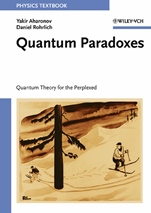
Quantum Paradoxes: Quantum Theory for the Perplexed
ISBN 9783527403912
Autor: Yakir Aharonov, Daniel Rohrlich
Wydawca: Wiley
Dostępność: 3-6 tygodni
Cena: 530,25 zł
Przed złożeniem zamówienia prosimy o kontakt mailowy celem potwierdzenia ceny.
ISBN13: |
9783527403912 |
ISBN10: |
3527403914 |
Autor: |
Yakir Aharonov, Daniel Rohrlich |
Oprawa: |
Paperback |
Rok Wydania: |
2005-03-08 |
Ilość stron: |
299 |
Wymiary: |
233x175 |
Tematy: |
PH |
Yakir Aharonov is one of the pioneers in measuring theory, the nature of quantum correlations, superselection rules, and geometric phases and, as such, has made monumental contributions to theoretical physics. Together with Daniel Rohrlich of the Weizmann Institute, Israel, he has written here a groundbreaking work on the remaining mysteries of quantum mechanics. With both students as well as researchers in mind, the authors provide an insight into that part of the field that led Feynman to declare "nobody understands quantum mechanics".
Spis treści:
1 The Uses of Paradox.
1.1 Paradox in Physics.
1.2 Errors.
1.3 Gaps.
1.4 Contradictions.
1.5 Overview of the Book.
References.
2 How to Weigh a Quantum.
2.1 Why does the Color of the Light Change?
2.2 Quanta.
2.3 Uncertainty Relations.
2.4 The Clock–in–the–Box Paradox.
2.5 From Inconsistency to Incompleteness.
References.
3 Is Quantum Theory Complete?
3.1 The Einstein–Podolsky–Rosen Paradox.
3.2 Polarized Photons.
3.3 Quantum States and Observables.
3.4 Bell’s Inequality.
3.5 Paradox and Beyond.
References.
4 Phases and Gauges.
4.1 Two Paradoxical Procedures.
4.2 Classical and Quantum Phases.
4.3 Phase Meets Gauge.
4.4 The Aharonov–Bohm Effect.
4.5 Quantum Consistency and the Aharonov–Bohm Effect.
4.6 Flux Quantization.
4.7 Magnetoresistance.
4.8 Non–Abelian Phases.
References.
5 Modular Variables.
5.1 A Lattice of Solenoids.
5.2 Non–overlapping Wave Packets.
5.3 Modular Momentum.
5.4 The xmod, pmod Representation.
5.5 Intimations of Nonlocality.
References.
6 Nonlocality and Causality.
6.1 Causality and a Piston.
6.2 Quantum Effects Without Classical Analogues.
6.3 Modular Energy.
6.4 Reconciling the Irreconcilable.References.
7 Quantum Measurements.
7.1 The Velocity Paradox.
7.2 A Quantum Measurement Paradigm.
7.3 Quantum Measurements and Uncertainty Relations.
7.4 Paradox Lost.
References.
8 Measurement and Compensation.
8.1 Paradox Regained.
8.2 Compensating Forces.
8.3 Quantum Measurements of Noncanonical Observables.
8.4 Measuring the Electric Field.
8.5 Energy and Time.
References.
9 Quantum Cats.
9.1 Schr¨odinger’s Cat.
9.2 A Quantum Catalyst.
9.3 Quantum Concatenations.
9.4 A Quantum Catalog.
References.
10 A Quantum Arrow of Time?
10.1 A Quantum Card Trick.
10.2 Time Reversal.
10.3 The Aharonov–Bergmann–Lebowitz Formula.
10.4 The Arrow of Time Revisited.
10.5 Boundary Conditions on the Universe.
References.
11 Superselection Rules.
11.1 Superselection Rule for Angular Momentum?
11.2 T and Spin.
11.3 The Wick–Wightman–Wigner Argument.
11.4 Everything is Relative.
11.5 Superposing Charge States.
References.
12 Quantum Slow Dance.
12.1 A Watched Pot Never Boils.
12.2 The Adiabatic Approximation.
12.3 Feynman Paths.
12.4 Classical Analogues.
References.
13 Charges and Fluxons.
13.1 Hidden Momentum?
13.2 Duality of the Aharonov–Bohm Effect.
13.3 The Aharonov–Bohm Effect and Berry’s Phase.
13.4 The Aharonov–Casher Effect.
References.
14 Quantum Measurements and Relativity.
14.1 Collapse and Relativity.
14.2 Relativistic Constraints on Measurements.
14.3 Nonlocal Measurements.
14.4 Which Nonlocal Operators are Measurable?
14.5 Measuring a Nonlocal Operator.
14.6 Collapse and Relativity Revisited.
References.
15 How to Observe a Quantum Wave.
15.1 Dipole Paradox.
15.2 How not to Observe a Quantum Wave.
15.3 Protective Measurements.
15.4 Galilean Dialogue.
15.
5 Protective Measurements and Causality.
15.6 Towards Quantum Field Theory.
References.
16 Weak Values.
16.1 A Weak Measurement.
16.2 A Paradox of Errors.
16.3 Pre– and Postselected Ensembles.
16.4 Weak Measurements and Weak Values.
16.5 A Quantum Shell Game.
16.6 The Quantum Walk.
16.7 Faster than Light.
16.8 Galilean Dialogue.
References.
17 Weak Values and Entanglement.
17.1 Interaction–free Paradox.
17.2 A Grin Without a Cat.
17.3 Alice and Bob in Wonderland.
17.4 Galilean Dialogue.
17.5 Complex Weak Values.
References.
18 The Quantum World.
18.1 Weak Measurements and Interference.
18.2 From Amplitudes to Probabilities.
18.3 The Fate of the Universe.
18.4 The Role of h.
18.5 Causality and Nonlocality as Axioms.
18.6 Causality, Nonlocality and Scaling.
18.7 What is the Quantum World?
References.
Index.
Nota biograficzna:
Professor Yakir Aharonov, born in 1932, studied physics at Technion in Haifa, Israel, and Bristol University, England, where he received his PhD in 1960. He currently works as Professor of Physics at the University of Tel Aviv and the University of South Carolina. Professor Aharonov′s research interests are nonlocal and topological effects in quantum mechanics, relativistic quantum field theories, and interpretations of quantum mechanics. Professor Aharonov is an elected member of the U.S. National Academy of Sciences.
Dr. Daniel Rohrlich, born in 1954, received his Ph.D. in physics from the State University of New York at Stony Brook in 1986. He currently works as a research scientist at the Weizmann Institute in Rehovot, Israel. His research interests lie in the fields of quantum information, fundamental aspects of quantum mechanics, path integrals, and experimental mesoscopic physics.
Okładka tylna:
Yakir Aharonov is one of the pioneers in measuring theory, the na
ture of quantum correlations, superselection rules, and geometric phases and, as such, has made monumental contributions to theoretical physics. Together with Daniel Rohrlich of the Weizmann Institute, Israel, he has written here a groundbreaking work on the remaining mysteries of quantum mechanics. With both students as well as researchers in mind, the authors provide an insight into that part of the field that led Feynman to declare "nobody understands quantum mechanics".
Koszyk
Książek w koszyku: 0 szt.
Wartość zakupów: 0,00 zł
Informacje


Kontakt
Gambit
Centrum Oprogramowania
i Szkoleń Sp. z o.o.
Al. Pokoju 29b/22-24
31-564 Kraków
Siedziba Księgarni
ul. Kordylewskiego 1
31-542 Kraków
+48 12 410 5991
+48 12 410 5987
+48 12 410 5989
Subskrypcje
Administratorem danych osobowych jest firma Gambit COiS Sp. z o.o. Na podany adres będzie wysyłany wyłącznie biuletyn informacyjny.
Autoryzacja płatności

Informacje na temat autoryzacji płatności poprzez PayU.

© Copyright 2012: GAMBIT COiS Sp. z o.o. Wszelkie prawa zastrzeżone.
Projekt i wykonanie: Alchemia Studio Reklamy