


Wydawcy
Katalog tematyczny
- Archeologia (109)
- Ekonomia, finanse, business (13704)
- Filozofia (1445)
- Historia (3040)
- Języki i językoznawstwo (2356)
- Lifestyle, hobby i rozrywka (475)
- Medycyna (9704)
- Nauki humanistyczne (4)
- Nauki o Ziemi i środowisku (2638)
- Nauki ścisłe (20412)
- Astronomia (294)
- Biologia (5119)
- Chemia (6540)
- Fizyka (3309)
- Elektryczność i magnetyzm (90)
- Fizyka atomowa i molekularna (110)
- Fizyka cząstek elementarnych (36)
- Fizyka jądra atomowego (36)
- Fizyka kwantowa (210)
- Fizyka matematyczna (121)
- Fizyka relatywistyczna (36)
- Fizyka statystyczna (51)
- Fizyka stosowana (498)
- Mechanika klasyczna (186)
- Optyka i światło (133)
- Stany materii (202)
- Matematyka (4574)
- Nauki ścisłe, ogólnie (503)
- Nauki społeczne (8486)
- Nauki techniczne (13450)
- Prawo (1696)
- Publikacje informacyjne i interdyscyplinarne (1288)
- Religia i wierzenia (917)
- Technika komputerowa (4067)
- Zdrowie, relacje międzyludzkie i rozwój osobisty (657)





Informacje szczegółowe o książce
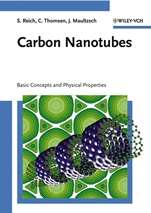
Carbon Nanotubes: Basic Concepts and Physical Properties
ISBN 9783527403868
Autor: Stephanie Reich, Christian Thomsen, Janina Maultzsch
Wydawca: Wiley
Dostępność: 3-6 tygodni
Cena: 962,85 zł
Przed złożeniem zamówienia prosimy o kontakt mailowy celem potwierdzenia ceny.
ISBN13: |
9783527403868 |
ISBN10: |
3527403868 |
Autor: |
Stephanie Reich, Christian Thomsen, Janina Maultzsch |
Oprawa: |
Hardback |
Rok Wydania: |
2004-02-06 |
Ilość stron: |
224 |
Wymiary: |
245x176 |
Tematy: |
PH |
Carbon nanotubes are exceptionally interesting from a fundamental research point of view. Many concepts of one–dimensional physics have been verified experimentally such as electron and phonon confinement or the one–dimensional singularities in the density of states; other ID signatures are still under debate, such as Luttinger–liquid behavior. Carbon nanotubes are chemically stable, mechanically very strong, and conduct electricity. For this reason, they open up new perspectives for various applications, such as nano–transistors in circuits, field–emission displays, artificial muscles, or added reinforcements in alloys.
This text is an introduction to the physical concepts needed for investigating carbon nanotubes and other one–dimensional solid–state systems. Written for a wide scientific readership, each chapter consists of an instructive approach to the topic and sustainable ideas for solutions. The former is generally comprehensible for physicists and chemists, while the latter enables the reader to work towards the state of the art in that area. The book gives for the first time a combined theoretical and experimental description of topics like luminescence of carbon nanotubes. Raman scattering, or transport measurements. The theoretical concepts discussed range from the right–binding approximation, which can be followed by pencil and paper, to first–principles simulations. The authors emphasize a comprehensive theoretical and experimental understanding of carbon nanotubes includinggeneral concepts for one–dimensional systemsan introduction to the symmetry of nanotubestextbook models of nanotubes as narrow cylindersa combination of ab–initio calculations and experimentsluminescence excitation spectroscopy linked to Raman spectroscopyan introduction to the ID–transport properties of nanotubeseffects of bundling on the electronic and vibrational pro
perties andresonance Raman scattering in nanotubes
Spis treści:
Preface.
1 Introduction.
2 Structure and Symmetry.
2.1 Structure of Carbon Nanotubes.
2.2 Experiments.
2.3 Symmetry of Single–walled Carbon Nanotubes.
2.3.1 Symmetry Operations.
2.3.2 Symmetry–based Quantum Numbers.
2.3.3 Irreducible representations.
2.3.4 Projection Operators.
2.3.5 Phonon Symmetries in Carbon Nanotubes.
2.4 Summary.
3 Electronic Properties of Carbon Nanotubes.
3.1 Graphene.
3.1.1 Tight–binding Description of Graphene.
3.2 Zone–folding Approximation.
3.3 Electronic Density of States.
3.3.1 Experimental Verifications of the DOS.
3.4 Beyond Zone Folding — Curvature Effects.
3.4.1 Secondary Gaps in Metallic Nanotubes.
3.4.2 Rehybridization of the σ and π States.
3.5 Nanotube Bundles.
3.5.1 Low–energy Properties.
3.5.2 Visible Energy Range.
3.6 Summary.
4 Optical P roperties.
4.1 Absorption and Emission.
4.1.1 Selection Rules and Depolarization.
4.2 Spectra of Isolated Tubes.
4.3 Photoluminescence Excitation — (n1, n2) Assignment.
4.4 4–Å–diameter Nanotubes.
4.5 Bundles of Nanotubes.
4.6 Excited–state Carrier Dynamics.
4.7 Summary.
5 Electronic Transport.
5.1 Room–temperature Conductance of Nanotubes.
5.2 Electron Scattering.
5.3 Coulomb Blockade.
5.4 Luttinger Liquid.
5.5 Summary.
6 Elastic Properties.
6.1 Continuum Model of Isolated Nanotubes.
6.1.1 Ab–initio, Tight–binding, and Force–constants Calculations.
6.2 Pressure Dependence of the Phonon Frequencies.
6.3 Micro–mechanical Manipulations.
6.4 Summary.
7 Raman Scattering.
7.1 Raman Basics and Selection Rules.
7.2 Tensor Invariants.
7.2.1 Polarized Measurements.
7.3 Raman Measurements at Large Phonon q.
7.4 Double Resonant Raman Scattering.
7.5 Summary.
8 Vibrational Properties.
8.1 Introduction.
8.2 Radial Breathing Mode.
8.2.1 The RBM in Isolated and Bundled Nanotubes.
8.2.2 Double–walled Nanotubes.
8.3 The Defect–induced D Mode.
8.3.1 The D Mode in Graphite.
8.3.2 The D Mode in Carbon Nanotubes.
8.4 Symmetry of the Raman Modes.
8.5 High–energy Vibrations.
8.5.1 Raman and Infrared Spectroscopy.
8.5.2 Metallic Nanotubes.
8.5.3 Single– and Double–resonance Interpretation.
8.6 Summary.
8.7 What we Can Learn from the Raman Spectra of Single–walled Carbon Nanotubes.
Appendix A: Character and Correlation Tables of Graphene.
Appendix B: Raman Intensities in Unoriented Systems.
Appendix C: Fundamental Constants.
Bibliography.
Index.
Nota biograficzna:
Stephanie Reich graduated in 2001 from the Technische Universität Berlin, Germany, and, after a year at the Institut de Ciéncia de Materials de Barcelona, Spain, she is now an Oppenheimer Fellow at the University of Cambridge, UK. Her scientific focus is combining experimental and ab–initio techniques in nanotube research.
Christian Thomsen researches and teaches as professor of physics at the Technische Universität Berlin. His work concentrates on the physical properties of solid–state systems investigated with optical spectroscopy.
Janina Maultzsch is in the final state of completing her doctoral thesis at the Technische Universität Berlin. Her main scientific interests are the symmetry properties of one–dimensional systems and resonant Raman processes in nanotubes.
Okładka tylna:
Carbon nanotubes are exceptionally interesting from a fundamental research point of view. Many concepts of one–dimensional physics have been verified experimentally s
uch as electron and phonon confinement or the one–dimensional singularities in the density of states; other ID signatures are still under debate, such as Luttinger–liquid behavior. Carbon nanotubes are chemically stable, mechanically very strong, and conduct electricity. For this reason, they open up new perspectives for various applications, such as nano–transistors in circuits, field–emission displays, artificial muscles, or added reinforcements in alloys.
This text is an introduction to the physical concepts needed for investigating carbon nanotubes and other one–dimensional solid–state systems. Written for a wide scientific readership, each chapter consists of an instructive approach to the topic and sustainable ideas for solutions. The former is generally comprehensible for physicists and chemists, while the latter enables the reader to work towards the state of the art in that area. The book gives for the first time a combined theoretical and experimental description of topics like luminescence of carbon nanotubes. Raman scattering, or transport measurements. The theoretical concepts discussed range from the right–binding approximation, which can be followed by pencil and paper, to first–principles simulations. The authors emphasize a comprehensive theoretical and experimental understanding of carbon nanotubes includinggeneral concepts for one–dimensional systemsan introduction to the symmetry of nanotubestextbook models of nanotubes as narrow cylindersa combination of ab–initio calculations and experimentsluminescence excitation spectroscopy linked to Raman spectroscopyan introduction to the ID–transport properties of nanotubeseffects of bundling on the electronic and vibrational properties andresonance Raman scattering in nanotubes
Koszyk
Książek w koszyku: 0 szt.
Wartość zakupów: 0,00 zł
Informacje


Kontakt
Gambit
Centrum Oprogramowania
i Szkoleń Sp. z o.o.
Al. Pokoju 29b/22-24
31-564 Kraków
Siedziba Księgarni
ul. Kordylewskiego 1
31-542 Kraków
+48 12 410 5991
+48 12 410 5987
+48 12 410 5989
Subskrypcje
Administratorem danych osobowych jest firma Gambit COiS Sp. z o.o. Na podany adres będzie wysyłany wyłącznie biuletyn informacyjny.
Autoryzacja płatności

Informacje na temat autoryzacji płatności poprzez PayU.

© Copyright 2012: GAMBIT COiS Sp. z o.o. Wszelkie prawa zastrzeżone.
Projekt i wykonanie: Alchemia Studio Reklamy