


Wydawcy
Katalog tematyczny
- Archeologia (109)
- Ekonomia, finanse, business (13704)
- Filozofia (1445)
- Historia (3040)
- Języki i językoznawstwo (2356)
- Lifestyle, hobby i rozrywka (475)
- Medycyna (9704)
- Nauki humanistyczne (4)
- Nauki o Ziemi i środowisku (2638)
- Nauki ścisłe (20412)
- Astronomia (294)
- Biologia (5119)
- Chemia (6540)
- Fizyka (3309)
- Elektryczność i magnetyzm (90)
- Fizyka atomowa i molekularna (110)
- Fizyka cząstek elementarnych (36)
- Fizyka jądra atomowego (36)
- Fizyka kwantowa (210)
- Fizyka matematyczna (121)
- Fizyka relatywistyczna (36)
- Fizyka statystyczna (51)
- Fizyka stosowana (498)
- Mechanika klasyczna (186)
- Optyka i światło (133)
- Stany materii (202)
- Matematyka (4574)
- Nauki ścisłe, ogólnie (503)
- Nauki społeczne (8486)
- Nauki techniczne (13450)
- Prawo (1696)
- Publikacje informacyjne i interdyscyplinarne (1288)
- Religia i wierzenia (917)
- Technika komputerowa (4067)
- Zdrowie, relacje międzyludzkie i rozwój osobisty (657)





Informacje szczegółowe o książce
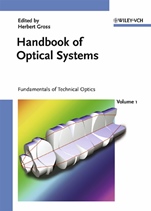
Handbook of Optical Systems, Volume 1: Fundamentals of Technical Optics
ISBN 9783527403776
Autor: Herbert Gross
Wydawca: Wiley
Dostępność: 3-6 tygodni
Cena: 2 098,95 zł
Przed złożeniem zamówienia prosimy o kontakt mailowy celem potwierdzenia ceny.
ISBN13: |
9783527403776 |
ISBN10: |
3527403779 |
Autor: |
Herbert Gross |
Oprawa: |
Hardback |
Rok Wydania: |
2005-02-25 |
Ilość stron: |
848 |
Wymiary: |
251x179 |
Tematy: |
PH |
The state–of–the–art full–colored handbook gives in six volumes a comprehensive introduction to the principles and the practice of calculation, layout and understanding of optical systems and lens design. Written by reputed industrial experts in the field the user is introduced to the basic properties of optical systems, aberration theory, classification and characterization of systems, advanced simulation models, measuring of system quality and manufacturing issues. More than 3,000 full–colored illustrations and images support the reader and supply an easy understanding of complex optical systems and optical modeling.Vol.1 Fundamentals of Technical OpticsVol.2 Physical Image FormationVol.3 Aberration Theory and Correction of Optical SystemsVol.4 Survey of Optical InstrumentsVol.5 Metrology of Optical Components and SystemsVol.6 Advances Physical OpticsIn this volume
Volume 1 gives a general introduction to the field of technical optics. Although part of the series, it acts as a fully selfstanding textbook. With more than 700 full color graphs and it is a intuitive introduction for the beginner and a comprehensive reference for the professional.
1 Introduction
2 Paraxial optics
3 Dielectric interfaces
4 Materials
5 Raytracing
6 Photometry
7 Lightsources
8 Sensors and receivers
9 Theory of color
10 Optical systems
11 Aberrations
12 Waveoptics
13 Plates and prisms
14 Gratings
15 Special components
16 Testing
Spis treści:
Preface.
1 Introduction.
2 Paraxial Imaging.
2.1 General Remarks.
2.2 Single Surface.
2.3 Single Lens.
2.4 Multiple–component Systems.
2.5 Invariants.
2.6 Matrix Calculus.
2.7 Matrices Describing a More General Geometry.
2.8 Literature.
3 Interfaces.
3.1 Basics.
3.2 The Fresnel Equations.
3.3 Polarization Effects at Interfaces.
3.4 Evanescent Wav
es.
3.5 Non–geometrical Effects at Reflection.
3.6 Absorbing Media.
3.7 Literature.
4 Materials.
4.1 Basics.
4.2 Dispersion.
4.3 Relative Partial Dispersion.
4.4 Transmission.
4.5 Glasses.
4.6 Crystals and Special Materials.
4.7 Plastics.
4.8 Gases.
4.9 Liquids and Cements.
4.10 Metals.
4.11 Literature.
5 Raytracing.
5.1 The Meaning of Raytracing.
5.2 Raytracing Scheme.
5.3 Raytracing Formula Sets.
5.4 Raytracing in Optical Systems.
5.5 Special Components.
5.6 Differential Rays.
5.7 Non–sequential Raytracing.
5.8 Literature.
6 Radiometry.
6.1 Introduction.
6.2 Lambertian Radiator.
6.3 Radiation Transfer.
6.4 Radiometry of Optical Systems.
6.5 Description of Radiation Transport in the Phase Space.
6.6 Literature.
7 Light Sources.
7.1 Introduction.
7.2 Thermal Radiators.
7.3 Classical Lamps.
7.4 Diodes.
7.5 Laser Light Sources.
7.6 Model Descriptions of Radiation Sources.
7.7 Literature.
8 Sensor Technology and Signal Processing.
8.1 Introduction.
8.2 Sensor Characteristics.
8.3 Special Types of Sensor.
8.4 Sampling.
8.5 Signal Processing.
8.6 Noise.
8.7 Special Methods of Detection.
8.8 Literature.
9 Theory of Color Vision.
9.1 Introduction.
9.2 Color Vision of the Human Eye.
9.3 Phenomenologcal Theory of Color Vision.
9.4 Colorimetry.
9.5 Color Triangle.
9.6 Alternative Basic Systems.
9.7 Literature.
10 Optical Systems.
10.1 Special Properties of Lenses.
10.2 Special Rays in Optical Systems.
10.3 Pupils.
10.4 Delano Diagram.
10.5 Special Aspects.
10.6 Literature.
11 Aberrations.
11.1 General Considerations.
11.2 Description of Aberrations.
11.3 Ray Aberrations.
11.4 The Sine Condition.
11.5 Wave Aberrations.
11.6 Spherical Aberration.
11.7 Astigmatism.
11.8 Field Curvature.
11.9 Coma
.
11.10 Distortion.
11.11 Chromatic Longitudinal Aberrations.
11.12 Chromatic Transverse Aberrations.
11.13 Literature.
12 Wave Optics.
12.1 Basic Principles.
12.2 Point–spread Function.
12.3 Fourier Theory of Image Formation.
12.4 Transfer Functions.
12.5 Literature.
13 Plano–optical Components.
13.1 Plane–parallel plates.
13.2 Dispersion Prisms.
13.3 Reflection Prisms.
13.4 Construction Designs for Reflection Prisms.
13.5 Prism Systems.
13.6 Filters.
13.7 Literature.
14 Gratings.
14.1 Diffraction by a Slit.
14.2 Diffraction Gratings.
14.3 Blazed Gratings.
14.4 Fourier Theory of the Grating Diffraction.
14.5 Transmission Gratings.
14.6 Types of Grating.
14.7 Gratings in Image Formation Systems.
14.8 Diffraction by a Grating in the General Case.
14.9 Literature.
15 Special Components.
15.1 Aspherical Devices.
15.2 Gradient–index Lenses.
15.3 Diffusing Disks.
15.4 Cylinder Lenses.
15.5 Simple Cylinder Lenses.
15.6 Dynamic Light Modulators.
15.7 Fresnel Lenses.
15.8 Light Pipes.
15.9 Axicons.
15.10 Literature.
16 Optical Measurement and Testing Techniques.
16.1 Overview.
16.2 Measurement of the Focal Length.
16.3 Measurement of Angles.
16.4 Centering.
16.5 Measuring the Index of Refraction.
16.6 Surface–shape Measurement.
16.7 Testing of Surface Radii and Shapes.
16.8 Measuring Wavefronts.
16.9 Measurement of the Optical Transfer Function.
16.10 Beam–quality Measurement.
16.11 Coherence Measurement.
16.12 Polarization Measurement.
16.13 Stray–light Measurement.
16.14 Color Measurement.
16.15 Literature. Index.
Nota biograficzna:
Herbert Gross was born in 1955. He studied Physics at the University of Stuttgart and joined Carl Zeiss in 1982. Since then he has been working in the department of optical design.
His special areas of interest are the development of simulation methods, optical design software and algorithms, the modelling of laser systems and the simulation of problems in physical optics, and the tolerancing and measurement of optical systems. Since 1995, he has been heading the central optical design department at Zeiss. Dr. Gross served as a lecturer at the University of Applied Sciences at Aalen and at the University of Lausanne, and gave seminars for the Photonics Net of Baden Württemberg as well as several internal company courses. In 1995, he received his PhD from the University of Stuttgart for a work on the modelling of laser beam propagation in the partial coherent region. He has published several papers and has given many talks at conferences.
Okładka tylna:
The state–of–the–art full–colored handbook gives in six volumes a comprehensive introduction to the principles and the practice of calculation, layout and understanding of optical systems and lens design. Written by reputed industrial experts in the field the user is introduced to the basic properties of optical systems, aberration theory, classification and characterization of systems, advanced simulation models, measuring of system quality and manufacturing issues. More than 3,000 full–colored illustrations and images support the reader and supply an easy understanding of complex optical systems and optical modeling.Vol.1 Fundamentals of Technical OpticsVol.2 Physical Image FormationVol.3 Aberration Theory and Correction of Optical SystemsVol.4 Survey of Optical InstrumentsVol.5 Metrology of Optical Components and SystemsVol.6 Advances Physical OpticsIn this volume
Volume 1 gives a general introduction to the field of technical optics. Although part of the series, it acts as a fully selfstanding textbook. With more than 700 full color graphs and it is a intuitive introduction for the beginner
Koszyk
Książek w koszyku: 0 szt.
Wartość zakupów: 0,00 zł
Informacje


Kontakt
Gambit
Centrum Oprogramowania
i Szkoleń Sp. z o.o.
Al. Pokoju 29b/22-24
31-564 Kraków
Siedziba Księgarni
ul. Kordylewskiego 1
31-542 Kraków
+48 12 410 5991
+48 12 410 5987
+48 12 410 5989
Subskrypcje
Administratorem danych osobowych jest firma Gambit COiS Sp. z o.o. Na podany adres będzie wysyłany wyłącznie biuletyn informacyjny.
Autoryzacja płatności

Informacje na temat autoryzacji płatności poprzez PayU.

© Copyright 2012: GAMBIT COiS Sp. z o.o. Wszelkie prawa zastrzeżone.
Projekt i wykonanie: Alchemia Studio Reklamy