


Wydawcy
Katalog tematyczny
- Archeologia (109)
- Ekonomia, finanse, business (13704)
- Filozofia (1445)
- Historia (3040)
- Języki i językoznawstwo (2356)
- Lifestyle, hobby i rozrywka (475)
- Medycyna (9704)
- Nauki humanistyczne (4)
- Nauki o Ziemi i środowisku (2638)
- Nauki ścisłe (20412)
- Astronomia (294)
- Biologia (5119)
- Chemia (6540)
- Fizyka (3309)
- Elektryczność i magnetyzm (90)
- Fizyka atomowa i molekularna (110)
- Fizyka cząstek elementarnych (36)
- Fizyka jądra atomowego (36)
- Fizyka kwantowa (210)
- Fizyka matematyczna (121)
- Fizyka relatywistyczna (36)
- Fizyka statystyczna (51)
- Fizyka stosowana (498)
- Mechanika klasyczna (186)
- Optyka i światło (133)
- Stany materii (202)
- Matematyka (4574)
- Nauki ścisłe, ogólnie (503)
- Nauki społeczne (8486)
- Nauki techniczne (13450)
- Prawo (1696)
- Publikacje informacyjne i interdyscyplinarne (1288)
- Religia i wierzenia (917)
- Technika komputerowa (4067)
- Zdrowie, relacje międzyludzkie i rozwój osobisty (657)





Informacje szczegółowe o książce
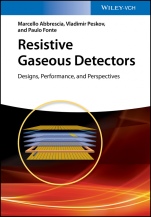
Resistive Gaseous Detectors: Designs, Performance, and Perspectives
ISBN 9783527340767
Autor: Marcello Abbrescia, Vladimir Peskov, Paulo Fonte
Wydawca: Wiley
Dostępność: 3-6 tygodni
Cena: 719,25 zł
Przed złożeniem zamówienia prosimy o kontakt mailowy celem potwierdzenia ceny.
ISBN13: |
9783527340767 |
ISBN10: |
3527340769 |
Autor: |
Marcello Abbrescia, Vladimir Peskov, Paulo Fonte |
Oprawa: |
Hardback |
Rok Wydania: |
2018-04-18 |
Ilość stron: |
400 |
Wymiary: |
249x180 |
Tematy: |
PH |
This first book to critically summarize the latest achievements and emerging applications within this interdisciplinary topic focuses on one of the most important types of detectors for elementary particles and photons: resistive plate chambers (RPCs).
In the first part, the outstanding, international team of authors comprehensively describes and presents the features and design of single and double–layer RPCs before covering more advanced multi–layer RPCs. The second part then focuses on the application of RPCs in high energy physics, materials science, medicine and security.
Throughout, the experienced authors adopt a didactic approach, with each subject presented in a simple way, increasing in complexity step by step.
Preface
Introduction
"Classical" Gaseous Detectors and Their Limits
Historical Developments Leading to Modern Resistive Gaseous Detectors
Basics of Resistive Plate Chambers
Further Developments in Resistive Plate Chambers
Resistive Plate Chambers in High Energy Physics Experiments
Materials and Aging in Resistive Plate Chambers
Advanced Designs: High–Rate, High–Spatial Resolution Resistive Plate Chambers
New Developments in the Family of Gaseous Detectors: Micropattern Detectors with Resistive Electrodes
Applications beyond High Energy Physics and Current Trends
Conclusions and Perspectives
Appendix: Some Guidelines for RPC Fabrication
Marcello Abbrescia is professor at the Bari University, Italy, and associate researcher for the Italian Institute of Nuclear Physics. Since the beginning of his scientific career he has been working on gaseous detectors and specifically Resistive Plate Chambers. He is member of the CMS collaboration at CERN, where he contributed to design and build the CMS/RPC system, being also responsible for its upgrade toward the High Luminosity phase of LHC. He developed one of the first models describing RPC behavior, and lead researches on RPC for applications in humanitarian demining. He is also coordinator of the Extreme Energy Events collaboration, and author or co–author of more than 700 papers on particle physics or instrumentation for particle physics.
Vladimir Peskov is chief scientist at the Institute for Chemical Physics Russian Academy of Sciences (RAS). Having obtained his academic degrees from the Institute of Physical Problems RAS in Moscow, he worked in the Physics Laboratory RAS led by P.L. Kapitza where he discovered and studied a new type of plasma instability. In 1986 he obtained an Associate Scientist position at CERN in G. Charpak′s group and later spent most of his career working at various Scientific Institutions (CERN, Fermi National Laboratory, NASA and the Royal Institute of Technology, Sweden) on the instrumentation for high energy physics, astrophysics and medicine. He is author or co–author of more than 200 publications, three scientific books and twelve international patents.
Paulo Fonte is professor at the Institute of Engineering of the Polytechnic Institute of Coimbra and senior researcher at the Laboratory for Instrumentation and High Energy Particle Physics, Portugal. Made his doctoral work at CERN in G. Charpak′s group, collaborating closely since then with V. Peskov in many detector–related themes. He has been deeply involved in the original development of timing Resistive Plate Chambers and his group has pursued the extension of this technology towards new capabilities and applications, being responsible for the RPC TOF wall of the HADES experiment. He is member of the HADES and RD51 international collaborations. With a special interest in detector physics, he authored or co–authored about 180 publications.
Koszyk
Książek w koszyku: 0 szt.
Wartość zakupów: 0,00 zł
Informacje


Kontakt
Gambit
Centrum Oprogramowania
i Szkoleń Sp. z o.o.
Al. Pokoju 29b/22-24
31-564 Kraków
Siedziba Księgarni
ul. Kordylewskiego 1
31-542 Kraków
+48 12 410 5991
+48 12 410 5987
+48 12 410 5989
Subskrypcje
Administratorem danych osobowych jest firma Gambit COiS Sp. z o.o. Na podany adres będzie wysyłany wyłącznie biuletyn informacyjny.
Autoryzacja płatności

Informacje na temat autoryzacji płatności poprzez PayU.

© Copyright 2012: GAMBIT COiS Sp. z o.o. Wszelkie prawa zastrzeżone.
Projekt i wykonanie: Alchemia Studio Reklamy