


Wydawcy
Katalog tematyczny
- Archeologia (109)
- Ekonomia, finanse, business (13704)
- Filozofia (1445)
- Historia (3040)
- Języki i językoznawstwo (2356)
- Lifestyle, hobby i rozrywka (475)
- Medycyna (9704)
- Chirurgia (272)
- Inne gałęzie medycyny (1871)
- Medycyna kliniczna (4187)
- Choroby wewnętrzne (514)
- Dermatologia (51)
- Diagnostyka medyczna (3)
- Endokrynologia (144)
- Gastroenterologia (27)
- Geriatria (50)
- Ginekologia i położnictwo (134)
- Hematologia (46)
- Hepatologia (10)
- Kardiologia (71)
- Laryngologia (12)
- Nefrologia (10)
- Neurologia (500)
- Oftalmologia (50)
- Pediatria (33)
- Pulmunologia (32)
- Reumatologia (14)
- Terapia genowa (1)
- Układ mięśniowo-szkieletowy (1)
- Urologia (14)
- Medycyna niekonwencjonalna (14)
- Medycyna przedkliniczna (269)
- Medycyna, ogólnie (1740)
- Medyczne służby pomocnicze (745)
- Studia medyczne (16)
- Weterynaria (548)
- Nauki humanistyczne (4)
- Nauki o Ziemi i środowisku (2638)
- Nauki ścisłe (20412)
- Nauki społeczne (8486)
- Nauki techniczne (13450)
- Prawo (1696)
- Publikacje informacyjne i interdyscyplinarne (1288)
- Religia i wierzenia (917)
- Technika komputerowa (4067)
- Zdrowie, relacje międzyludzkie i rozwój osobisty (657)





Informacje szczegółowe o książce
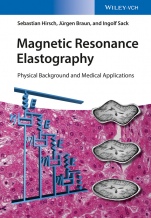
Magnetic Resonance Elastography: Physical Background and Medical Applications
ISBN 9783527340088
Autor: Sebastian Hirsch, Jurgen Braun, Ingolf Sack
Wydawca: Wiley
Dostępność: 3-6 tygodni
Cena: 719,25 zł
Przed złożeniem zamówienia prosimy o kontakt mailowy celem potwierdzenia ceny.
ISBN13: |
9783527340088 |
ISBN10: |
3527340084 |
Autor: |
Sebastian Hirsch, Jurgen Braun, Ingolf Sack |
Oprawa: |
Hardback |
Rok Wydania: |
2017-01-11 |
Ilość stron: |
456 |
Wymiary: |
249x173 |
Tematy: |
MJ |
Magnetic resonance elastography (MRE) is a medical imaging technique that combines magnetic resonance imaging (MRI) with mechanical vibrations to generate maps of viscoelastic properties of biological tissue. It serves as a non–invasive tool to detect and quantify mechanical changes in tissue structure, which can be symptoms or causes of various diseases. Clinical and research applications of MRE include staging of liver fibrosis, assessment of tumor stiffness and investigation of neurodegenerative diseases.
The first part of this book is dedicated to the physical and technological principles underlying MRE, with an introduction to MRI physics, viscoelasticity theory and classical waves, as well as vibration generation, image acquisition and viscoelastic parameter reconstruction.
The second part of the book focuses on clinical applications of MRE to various organs. Each section starts with a discussion of the specific properties of the organ, followed by an extensive overview of clinical and preclinical studies that have been performed, tabulating reference values from published literature. The book is completed by a chapter discussing technical aspects of elastography methods based on ultrasound.
Foreword
Preface
Introduction
PART I. Magnetic Resonance Imaging
NUCLEAR MAGNETIC RESONANCE
Protons in a Magnetic Field
Precession of Magnetization
Relaxation
Bloch Equations
Echoes
Magnetic Resonance Imaging
IMAGING CONCEPTS
k–Space
k–Space Sampling Strategies
MOTION ENCODING AND MRE SEQUENCES
Motion Encoding
Intra–Voxel Phase Dispersion
Diffusion–Weighted MRE
MRE Sequences
PART II. Elasticity
VISCOELASTIC THEORY
Strain
Stress
Invariants
Hooke′s Law
Strain–Energy Function
Symmetries
Engineering Constants
Viscoelastic Models
Dynamic Deformation
Waves in Anisotropic Media
Energy Density and Flux
Shear Wave Scattering from Interfaces and Inclusions
POROELASTICITY
Navier Equations for Biphasic Media
Poroelastic Signal Equation
PART III. Technical Aspects and Data Processing
MRE HARDWARE
MRI Systems
Actuators
MRE PROTOCOLS
NUMERICAL METHODS AND POST–PROCESSING
Noise and Denoising in MRE
Directional Filters
Numerical Filters
Finite Differences
PHASE UNWRAPPING
Flynn′s Minimum Discontinuity Algorithm
Gradient Unwrapping
Laplacian Unwrapping
VISCOELASTIC PARAMETER RECONSTRUCTION METHODS
Discretization and Noise
Phase Gradient
Algebraic Helmholtz Inversion
Local Frequency Estimation
Multifrequency Inversion
k–MDEV
Finite Element Method
Direct Inversion for a Transverse Isotropic Medium
Waveguide Elastography
MULTI–COMPONENT ACQUISITION
ULTRASOUND ELASTOGRAPHY
Strain Imaging (SI)
Strain–Rate Imaging (SRI)
Acoustic Radiation Force Impulse (ARFI) Imaging
Vibro–Acoustography (VA)
Vibration–Amplitude Sonoelastography (VA Sono)
Cardiac Time–Harmonic Elastography (cardiac THE)
Vibration Phase Gradient (PG) Sonoelastography
Time–Harmonic Elastography (1D/2D THE)
Crawling Waves (CW) Sonoelastography
Electromechanical Wave Imaging (EWI)
Pulse Wave Imaging (PWI)
Transient Elastography (TE)
Point Shear Wave Elastography (pSWE)
Shear Wave Elasticity Imaging (SWEI)
Comb–Push Ultrasound Shear Elastography (CUSE)
Supersonic Shear Imaging (SSI)
Spatially Modulated Ultrasound Radiation Force (SMURF)
Shear Wave Dispersion Ultrasound Vibrometry (SDUV)
Harmonic Motion Imaging (HMI)
PART IV. Clinical Applications
MRE OF THE HEART
Normal Heart Physiology
Clinical Motivation for Cardiac MRE
Cardiac Elastography
MRE OF THE BRAIN
General Aspects of Brain MRE
Technical Aspects of Brain MRE
Findings
MRE OF ABDOMEN, PELVIS AND INTERVERTEBRAL DISC
Liver
Spleen
Pancreas
Kidneys
Uterus
Prostate
Intervertebral Disc
MRE OF SKELETAL MUSCLE
In Vivo MRE of Healthy Muscles
MRE in Muscle Diseases
ELASTOGRAPHY OF TUMORS
Micromechanical Properties of Tumors
Ultrasound Elastography of Tumors
MRE of Tumors
PART V. Outlook
APPENDICES
Simulating the Bloch Equations
Proof that eq. (3.8) is Sinusoidal
Proof for eq. (4.1)
Wave Intensity Distributions
Ingolf Sack is professor for Experimental Radiology and Elastography at Charite – Universitatsmedizin Berlin, Germany. He received a PhD in Chemistry at Freie Universitat Berlin, Germany, for the development of methods in NMR spectroscopy. He worked at the Weizmann Institute in Rehovot, Israel, and at the Sunnybrook Hospital Toronto, Canada. Since 2003 he leads an interdisciplinary team of physicists, engineers, chemists and physicians which has pioneered pivotal developments in time–harmonic elastography of both MRI and ultrasound for many medical applications.
Sebastian Hirsch is a postdoctoral fellow in the Department of Radiology at the Charite – Universitatsmedizin Berlin, Germany. After studying physics at the University of Mainz, Germany, he joined Charite, where he works on pressure–sensitive MRE and the development of data acquisition strategies.
Jurgen Braun is an assistant professor at the Charite – Universitatsmedizin Berlin, Germany. He received his PhD degree in physical chemistry from Albert–Ludwigs–University in Freiburg, Germany, for the elucidation of reaction kinetics with liquid and solid state NMR. He possesses long standing professional experience in elastography, medical engineering, and image processing.
Koszyk
Książek w koszyku: 0 szt.
Wartość zakupów: 0,00 zł
Informacje


Kontakt
Gambit
Centrum Oprogramowania
i Szkoleń Sp. z o.o.
Al. Pokoju 29b/22-24
31-564 Kraków
Siedziba Księgarni
ul. Kordylewskiego 1
31-542 Kraków
+48 12 410 5991
+48 12 410 5987
+48 12 410 5989
Subskrypcje
Administratorem danych osobowych jest firma Gambit COiS Sp. z o.o. Na podany adres będzie wysyłany wyłącznie biuletyn informacyjny.
Autoryzacja płatności

Informacje na temat autoryzacji płatności poprzez PayU.

© Copyright 2012: GAMBIT COiS Sp. z o.o. Wszelkie prawa zastrzeżone.
Projekt i wykonanie: Alchemia Studio Reklamy