


Wydawcy
Katalog tematyczny
- Archeologia (109)
- Ekonomia, finanse, business (13704)
- Filozofia (1445)
- Historia (3040)
- Języki i językoznawstwo (2356)
- Lifestyle, hobby i rozrywka (475)
- Medycyna (9704)
- Nauki humanistyczne (4)
- Nauki o Ziemi i środowisku (2638)
- Nauki ścisłe (20412)
- Astronomia (294)
- Biologia (5119)
- Chemia (6540)
- Chemia analityczna (361)
- Chemia fizyczna (346)
- Chemia nieorganiczna (137)
- Chemia organiczna (535)
- Krystalografia (27)
- Minerologia (46)
- Fizyka (3309)
- Matematyka (4574)
- Nauki ścisłe, ogólnie (503)
- Nauki społeczne (8486)
- Nauki techniczne (13450)
- Prawo (1696)
- Publikacje informacyjne i interdyscyplinarne (1288)
- Religia i wierzenia (917)
- Technika komputerowa (4067)
- Zdrowie, relacje międzyludzkie i rozwój osobisty (657)





Informacje szczegółowe o książce
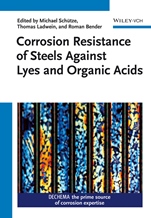
Corrosion Resistance of Steels against Lyes and Organic Acids
ISBN 9783527336791
Autor: Michael Schütze, Thomas L. Ladwein, Roman Bender
Wydawca: Wiley
Dostępność: 3-6 tygodni
Cena: 935,55 zł
Przed złożeniem zamówienia prosimy o kontakt mailowy celem potwierdzenia ceny.
ISBN13: |
9783527336791 |
ISBN10: |
3527336796 |
Autor: |
Michael Schütze, Thomas L. Ladwein, Roman Bender |
Oprawa: |
Hardback |
Rok Wydania: |
2013-10-09 |
Ilość stron: |
438 |
Wymiary: |
252x178 |
Tematy: |
PN |
This handbook provides recent data on corrosion protection and prevention for steels, one of the most widely used construction and manufacturing materials. It provides comprehensive information derived from the DECHEMA Corrosion Handbook, including numerous tabulated data and references, on the corrosion properties of virtually all types of steels and other iron–based alloys, such as chromium steels, chromium–nickel steels and chromium–nickel–molybdenum steels. The following corrosive media are considered: • Acetic acid • Alkanecarboxylic acids • Carbonic acid • Formic acid • Sulfonic acids • Alkaline earth hydroxides • Ammonia and ammonium hydroxide • Lithium hydroxide • Potassium hydroxide • Sodium hydroxide The large body of information contained in this book is key knowledge for all mechanical, civil and chemical engineers, materials scientists and chemists working with steels exposed to corrosive media.
Preface IX How to use the Handbook XI Warranty disclaimer 1 Acetic Acid 3 Unalloyed steels and cast steel 3 Unalloyed cast iron 12 High–alloy cast iron, high–silicon cast iron 13 Structural steels with up to 12% chromium 19 Ferritic chromium steels with more than 12% chromium 19 Ferritic–austenitic steels with more than 12% chromium 19 Austenitic chromium–nickel steels 32 Austenitic chromium–nickel–molybdenum steels 51 Austenitic chromium–nickel steels with special alloying additions 68 Special iron–based alloys 73 Bibliography 77 Alkanecarboxylic Acids 95 Unalloyed steels and cast steel 95 Unalloyed cast iron 95 Austenitic chromium–nickel–molybdenum steels 100 Austenitic chromium–nickel steels with special alloying additions 100 Special iron–based alloys 100 High–alloy cast iron, high–silicon cast iron 101 Structural steels with up to 12% chromium 102 Ferritic chromium steels with more than 12% chromium 103 Ferritic–austenitic steels with more than 12% chromium 103 Austenitic chromium–nickel steels 104 Austenitic chromium–nickel–molybdenum steels 107 Austenitic chromium–nickel steels with special alloying additions 107 Special iron–based alloys 107 Bibliography 116 Carbonic Acid 119 Unalloyed and low–alloy steels/cast steel 119 Unalloyed cast iron and low–alloy cast iron 119 Ferritic chrome steels with < 13% Cr 146 Ferritic chromium steels with ≥ 13% Cr 147 High–alloy multiphase steels 147 Ferritic/perlitic–martensitic steels 147 Austenitic chromium–nickel steels 151 Austenitic CrNiMo(N) steels 169 Austenitic CrNiMoCu(N) steels 169 Bibliography 172 Formic Acid 175 Unalloyed steels and cast steel 175 Unalloyed cast iron 175 High–alloy cast iron, high–silicon cast iron 175 Structural steels with up to 12% chromium 176 Ferritic chromium steels with more than 12% chromium 176 Ferritic–austenitic steels with more than 12% chromium 179 Austenitic chromium–nickel steels 180 Austenitic chromium–nickel–molybdenum steels 180 Austenitic chromium–nickel steels with special alloying additions 180 Special iron–based alloys 183 Bibliography 185 Sulfonic Acids 187 Unalloyed steels and cast steel 187 High–alloy cast iron, high–silicon cast iron 191 Ferritic chromium steels with more than 12% chromium 191 Austenitic chromium–nickel steels 191 Austenitic chromium–nickel–molybdenum steels 194 Austenitic chromium–nickel steels with special alloying additions 196 Bibliography 197 Alkaline Earth Hydroxides 199 Unalloyed steels and cast steel 199 Unalloyed cast iron 218 High–alloy cast iron, high–silicon cast iron 218 Structural steels with up to 12% chromium 219 Ferritic chromium steels with more than 12% chromium 219 Ferritic–austenitic steels with more than 12% chromium 219 Austenitic chromium–nickel steels 219 Austenitic chromium–nickel–molybdenum steels 219 Austenitic chromium–nickel steels with special alloying additions 219 Bibliography 220 Ammonia and Ammonium Hydroxide 223 Unalloyed and low–alloy steels/cast steel 223 Unalloyed and low–alloyed cast iron 223 Highly alloyed cast iron 244 Cast ferrosilicon 244 Austenitic cast iron (amongst others) 244 Ferritic chrome steels with < 13% Cr 244 Ferritic chrome steels with ≥ 13% Cr 244 Ferritic/perlitic–martensitic steels 244 Ferritic–austenitic steels/duplex steels 244 Austenitic chromium–nickel steels 244 Austenitic chromium–nickel–molybdenum(N) steels and CrNiMoCu(N) steels 244 Bibliography 247 Lithium Hydroxide 251 Unalloyed steels and cast steel 251 Unalloyed cast iron 257 High–alloy cast iron, high–silicon cast iron 257 Ferritic chromium steel with more than 12% chromium 257 Austenitic chromium–nickel steels 258 Austenitic chromium–nickel–molybdenum steels 258 Bibliography 261 Potassium Hydroxide 263 Unalloyed steels and low–alloy steels/cast steel 263 Unalloyed cast iron and low–alloy cast iron 269 High–alloy cast iron 269 Cast ferrosilicon 269 Austenitic cast iron (among other things) 269 Ferritic chrome steels with < 13% Cr 270 Ferritic chrome steels with ≥ 13% Cr 271 Ferritic/Perlitic–martensitic steels 271 Ferritic–austenitic steels/duplex steels 271 Austenitic chromium–nickel steels 274 Austenitic CrNiMo(N) steels and CrNiMoCu(N) steels 277 Bibliography 286 Sodium Hydroxide 293 Unalloyed and low–alloy steels/cast steel 293 Unalloyed cast iron and low–alloy cast iron 316 High–alloy cast iron 319 Silicon cast iron 319 Austenitic cast iron (etc.) 319 Ferritic chromium steels with < 13% Cr 319 Ferritic chromium steels with ≥ 13% Cr 329 High–alloy multiphase steels 334 Ferritic/perlitic–martensitic steels 334 Ferritic–austenitic steels/duplex steels 334 Austenitic chromium–nickel steels 342 Austenitic chromium–nickel–molybdenum(N) steels 349 Austenitic CrNiMoCu(N) steels 361 Special iron–based alloys 362 Bibliography 363 Key to materials compositions 371 Index of materials 411 Subject index 421
Michael Schütze , born in 1952, studied materials sciences at the University of Erlangen–Nürnberg from 1972 to 1978, then joined the Karl Winnacker Institute of the DECHEMA as a research associate. He received his doctorate in engineering sciences from the RWTH (Technical University) in Aachen in 1983, completed his habilitation in 1991, becoming a member of the external teaching staff of the RWTH. Since 1998, he holds a professorship there. He was appointed director of the Karl Winnacker Institute in 1996 and Chairman of the executive board of DECHEMA–Forschungsinstitut in 2012. He is recipient of the Friedrich–Wilhelm–Prize, the Rahmel–Schwenk medal and the Cavallaro medal, past Chairman of the Gordon Research Conference on Corrosion, editor of the journal Materials and Corrosion, Past–President of the European Federation of Corrosion, Past– President of the World Corrosion Organization and Chairman of the Working Party Corrosion by Hot Gases and Combustion Products of the European Federation of Corrosion. Thomas L. Ladwein, born in 1955, studied chemistry and metallurgy at the Universities of Saarbrücken and Münster, and graduated with a Diploma in Chemistry in 1980 and a PhD in Sciences in 1984. After that he worked as a R&D and application engineer for a chemical fabricator specialized in refractory metals. In 1987 he joined the stainless steel divison of Thyssen AG (later ThyssenKrupp AG) and worked there in several positions in R&D, application engineering and technical marketing. Since 2003 he is full time professor for electrochemistry, corrosion and tribology at Aalen University of Applied Science. He works in various committees and working parties of DECHEMA, GfKORR (German Corrosion Society), VDEh (German Iron and Steel Institute) and NACE International. He is current chair of the NACE committee “STG 39: Process Industries – Materials Applications and Experiences” and chairman of the NACE European Area. In 2011 he received the Herbert H. Uhlig Award from NACE International. Roman Bender , born in 1971, studied chemistry at the Justus Liebig University of Giessen from 1992 to 1997. After he received his diploma he joined the Karl Winnacker Institute of the DECHEMA in Frankfurt (Main) as a research associate. Since 2000 he is head of the group materials and corrosion at the DECHEMA and editor in chief of the world’s largest corrosion data collection, the DECHEMA Werkstofftabelle, and the Corrosion Handbook. In 2001 he received his doctorate in natural sciences from the Technical University of Aachen (RWTH Aachen). In 2008 Dr. Bender was appointed chief executive offi cer of the GfKORR – The Society for Corrosion Protection.
Koszyk
Książek w koszyku: 0 szt.
Wartość zakupów: 0,00 zł
Informacje


Kontakt
Gambit
Centrum Oprogramowania
i Szkoleń Sp. z o.o.
Al. Pokoju 29b/22-24
31-564 Kraków
Siedziba Księgarni
ul. Kordylewskiego 1
31-542 Kraków
+48 12 410 5991
+48 12 410 5987
+48 12 410 5989
Subskrypcje
Administratorem danych osobowych jest firma Gambit COiS Sp. z o.o. Na podany adres będzie wysyłany wyłącznie biuletyn informacyjny.
Autoryzacja płatności

Informacje na temat autoryzacji płatności poprzez PayU.

© Copyright 2012: GAMBIT COiS Sp. z o.o. Wszelkie prawa zastrzeżone.
Projekt i wykonanie: Alchemia Studio Reklamy