


Wydawcy
Katalog tematyczny
- Archeologia (109)
- Ekonomia, finanse, business (13704)
- Filozofia (1445)
- Historia (3040)
- Języki i językoznawstwo (2356)
- Lifestyle, hobby i rozrywka (475)
- Medycyna (9704)
- Nauki humanistyczne (4)
- Nauki o Ziemi i środowisku (2638)
- Nauki ścisłe (20412)
- Astronomia (294)
- Biologia (5119)
- Chemia (6540)
- Chemia analityczna (361)
- Chemia fizyczna (346)
- Chemia nieorganiczna (137)
- Chemia organiczna (535)
- Krystalografia (27)
- Minerologia (46)
- Fizyka (3309)
- Matematyka (4574)
- Nauki ścisłe, ogólnie (503)
- Nauki społeczne (8486)
- Nauki techniczne (13450)
- Prawo (1696)
- Publikacje informacyjne i interdyscyplinarne (1288)
- Religia i wierzenia (917)
- Technika komputerowa (4067)
- Zdrowie, relacje międzyludzkie i rozwój osobisty (657)





Informacje szczegółowe o książce
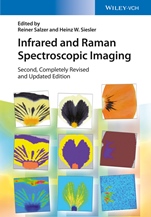
Infrared and Raman Spectroscopic Imaging
ISBN 9783527336524
Autor: Reiner Salzer, Heinz W. Siesler
Wydawca: Wiley
Dostępność: 3-6 tygodni
Cena: 801,15 zł
Przed złożeniem zamówienia prosimy o kontakt mailowy celem potwierdzenia ceny.
ISBN13: |
9783527336524 |
ISBN10: |
3527336524 |
Autor: |
Reiner Salzer, Heinz W. Siesler |
Oprawa: |
Hardback |
Rok Wydania: |
2014-09-03 |
Numer Wydania: |
2nd, Completely Revised and Updated Edition |
Ilość stron: |
656 |
Wymiary: |
248x181 |
Tematy: |
PN |
This second edition of the successful reference work has been updated and revised with approximately 30% new content to reflect the numerous instrumental developments and improvements, as well as the significant expansion of this rapidly developing field. For example, the combination of IR imaging with AFM has enhanced the achievable lateral resolution by an order of magnitude down to a few hundred nanometers, thus launching a multiplicity of new applications in material science. Furthermore, Raman and IR spectroscopic imaging have become key technologies for the life sciences and today contribute tremendously to a better and more detailed understanding of numerous biological and medical research topics. The topical structure of this new edition is now subdivided into four parts. The first treats the fundamentals of the instrumentation for infrared and Raman imaging and mapping and an overview on the chemometric tools for image analysis. The second part describes a wide variety of applications ranging from biomedical via food, agriculture and plants to polymers and pharmaceuticals. This is followed by a description of imaging techniques operating beyond the diffraction limit, while the final part covers special methodical developments and their utility in specific fields. With its many valuable practical tips, this is a must–have overview for researchers in academic and industrial laboratories wishing to obtain reliable results with this method.
Preface XVII List of Contributors XIX Part I Basic Methodology 1 1 Infrared and Raman Instrumentation for Mapping and Imaging 3 Peter R. Griffiths and Ellen V.Miseo 1.1 Introduction to Mapping and Imaging 3 1.2 Mid–Infrared Microspectroscopy and Mapping 4 1.2.1 Diffraction–Limited Microscopy 4 1.2.2 Microscopes and Sampling Techniques 6 1.2.3 Detectors for Mid–Infrared Microspectroscopy 9 1.2.4 Sources for Mid–Infrared Microspectroscopy 11 1.2.5 Spatial Resolution 14 1.2.6 Transmission Microspectroscopy 18 1.2.7 Attenuated Total Reflection Microspectroscopy 19 1.3 Raman Microspectroscopy and Mapping 20 1.3.1 Introduction to Raman Microspectroscopy 20 1.3.2 CCD Detectors 24 1.3.3 Spatial Resolution 26 1.3.4 Tip–Enhanced Raman Spectroscopy 29 1.4 Near–Infrared Hyperspectral Imaging 30 1.5 Raman Hyperspectral Imaging 35 1.6 Mid–Infrared Hyperspectral Imaging 37 1.6.1 Spectrometers Based on 2D Array Detectors 37 1.6.2 Spectrometers Based on Hybrid Linear Array Detectors 43 1.6.3 Sampling 45 1.7 Mapping with Pulsed Terahertz Radiation 48 1.8 Summary 52 Acknowledgments 54 References 54 2 Chemometric Tools for Image Analysis 57 Anna de Juan, Sara Piqueras, Marcel Maeder, Thomas Hancewicz, Ludovic Duponchel, and Romà Tauler 2.1 Introduction 57 2.2 Hyperspectral Images:The Measurement 58 2.2.1 The Data Set and the UnderlyingModel 58 2.3 Image Preprocessing 60 2.3.1 Signal Preprocessing 61 2.3.2 Data Pretreatments 63 2.3.3 Image Compression 64 2.4 Exploratory Image Analysis 65 2.4.1 Classical Image Representations: Limitations 65 2.4.2 Multivariate Image Analysis (MIA) and Principal Component Analysis (PCA) 66 2.5 Quantitative Image Information: Multivariate Image Regression (MIR) 70 2.6 Image Segmentation 73 2.6.1 Unsupervised and Supervised Segmentation Methods 74 2.6.2 Hard and Fuzzy Segmentation Approaches 78 2.6.3 Including Spatial Information in Image Segmentation 79 2.7 Image Resolution 80 2.7.1 The Image Resolution Concept 80 2.7.2 Spatial and Spectral Exploration 81 2.7.3 The Resolution Process: Initial Estimates and Constraints 86 2.7.4 Image Multiset Analysis 91 2.7.5 Resolution Postprocessing: Compound Identification, Quantitative Analysis, and Superresolution 95 2.8 Future Trends 106 References 106 Part II Biomedical Applications 111 3 Vibrational Spectroscopic Imaging of Soft Tissue 113 Christoph Krafft and Jürgen Popp 3.1 Introduction 113 3.1.1 Epithelium 114 3.1.2 Connective Tissue and Extracellular Matrix 115 3.1.3 Muscle Tissue 116 3.1.4 Nervous Tissue 117 3.2 Preparation of Soft Tissue for Vibrational Spectroscopic Imaging 118 3.2.1 General Preparation Strategies 118 3.2.2 Vibrational Spectra of Reference Material 120 3.2.3 Preparation for FT–IR Imaging 121 3.2.4 Preparation for Raman Imaging 123 3.3 Applications to Soft Tissue 125 3.3.1 Colon Tissue 125 3.3.2 Brain Tissue and Brain Tumors 130 3.3.3 Cervix Uteri and Squamous Cell Carcinoma 139 3.3.4 Atherosclerosis 143 3.4 Conclusions 145 References 147 4 Vibrational Spectroscopic Analysis of Hard Tissues 153 Sonja Gamsjaeger, Richard Mendelsohn, Klaus Klaushofer, and Eleftherios P. Paschalis 4.1 Introduction 153 4.1.1 Hard Tissue Composition and Organization 153 4.1.2 Elements of Hard Tissues, Detectable by Vibrational Spectroscopy 153 4.2 Importance of Tissue Age versus Specimen Age 155 4.2.1 Biologically Important Questions That May Be Answered by This Type of Analysis 155 4.3 FT–IR Spectroscopy 156 4.3.1 Specimen Preparation and Typical FT–IR Spectrum 156 4.3.2 Examples from Published Literature 158 4.4 Raman Spectroscopy 160 4.4.1 Instrumental Choices, Specimen Preparation, and Typical Raman Spectra 160 4.4.2 Bone: Typical Raman Bands and Parameters 161 4.4.3 Examples from Published Literature 163 4.5 Clinical Applications of Raman Spectroscopy 165 References 166 5 Medical Applications of Infrared Spectral Imaging of Individual Cells 181 Max Diem, Jennifer Schubert,Miloš Miljkovic, Kostas Papamarkakis, Antonella I. Mazur, Ellen Marcsisin, Jennifer Fore, Benjamin Bird, Kathleen Lenau, Douglas Townsend, Nora Laver, and Max Almond 5.1 Introduction 181 5.2 Methods 183 5.2.1 Cell Collection and Culturing Methods 183 5.2.2 Sample Preparation 184 5.2.3 Data Acquisition 185 5.2.4 Methods of Data Analysis 188 5.3 Results and Discussion 191 5.3.1 General Aspects of SCP 191 5.3.2 Fixation Studies 194 5.3.3 Spectral Cytopathology: Distinction of Cell Types and Disease in Human Urine–Borne Cells and Oral, Cervical, and Esophageal Cells 200 5.3.4 SCP of Live Cells in Aqueous Environment 216 5.4 Future Potential of SCP/Conclusions 218 Acknowledgment 219 References 220 Part III Agriculture, Plants, and Food 225 6 Infrared and Raman Spectroscopic Mapping and Imaging of Plant Materials 227 Hartwig Schulz, Andrea Krähmer, Annette Naumann, and Gennadi Gudi 6.1 Introduction, Background, and Perspective 227 6.2 Application of Mapping and Imaging to Horticultural Crops 229 6.2.1 Carotenoids 229 6.2.2 Polyacetylenes 232 6.2.3 Flavonoids 234 6.2.4 Essential Oils 236 6.2.5 Tissue Constituents 241 6.2.6 Environmental Interactions and Processing 242 6.3 Application of Mapping and Imaging to Agricultural Crops 244 6.3.1 Tissue–Specific Functional–Group Analysis 245 6.3.2 CellWall Microstructure 246 6.3.3 Environmental Impact and Processing 251 6.3.4 Uptake and Fate of Environmental Contaminants/Crop Protection Products 253 6.4 Mapping and Imaging ofWild Plants and Trees 254 6.4.1 Mapping and Imaging of Trees 256 6.4.2 Mapping and Imaging of Arabidopsis thaliana 261 6.4.3 Mapping and Imaging ofWild Plants 262 6.5 Application of Mapping and Imaging to Algae 264 6.5.1 Taxonomic Differentiation and Classification of Algae 265 6.5.2 CellWall Composition and Compound Distribution 266 6.5.3 Environmental Influences on Algae Metabolism 268 6.5.4 Chemometrical and Instrumental Developments 271 6.6 Interaction Between Plant Tissue and Plant Pathogens 273 6.6.1 Bacterial Plant Pathogens 274 6.6.2 Fungal Plant Pathogens 275 6.6.3 Fungal Degradation of Plant Material 279 6.6.4 Interaction with Nonwoody Plants 282 References 282 7 NIR Hyperspectral Imaging for Food and Agricultural Products 295 Véronique Bellon–Maurel and Nathalie Gorretta 7.1 Introduction 295 7.1.1 A Brief History of NIR Spectral Imagers 295 7.1.2 When is NIR Hyperspectral Imaging Used for Food and Agricultural Products? 297 7.2 HSI as a “Super” NIR Analyzer 298 7.2.1 Assessment and Quantification of Physicochemical or Sensory Properties of Food and Agricultural Products 298 7.2.2 Chemical Mapping 300 7.2.3 Analysis of the Physical Properties of the Food/Agricultural Items 308 7.3 NIR HS Imager as a “Super” Vision System 310 7.3.1 Why HS Imaging May Replace RGB Cameras for Sorting or Mixture Characterization 310 7.3.2 External Contamination (Foreign Bodies, Adulteration) 312 7.3.3 Surface and Subsurface Defects 317 7.3.4 Detection of Internal Defects by Candling 320 7.3.5 Classification of Biological Objects 323 7.3.6 Conclusion 325 7.4 Conclusion 326 7.4.1 When is NIR ImagingWorth Using in Online Settings? 326 References 328 Part IV Polymers and Pharmaceuticals 339 8 FT–IR and NIR Spectroscopic Imaging: Principles, Practical Aspects, and Applications in Material and Pharmaceutical Science 341 Elke Grotheer, Christian Vogel, Olga Kolomiets, Uwe Hoffmann, Miriam Unger, and Heinz W. Siesler 8.1 Introduction 341 8.2 Instrumentation for NIR and FT–IR Imaging 343 8.2.1 NIR Imaging in Diffuse Reflection 343 8.2.2 NIR Imaging in Transmission 345 8.2.3 FT–IR Imaging 345 8.3 Applications of FT–IR and FT–NIR Imaging for Polymer Characterization 361 8.3.1 Investigation of Phase Separation in Biopolymer Blends 361 8.3.2 Imaging Anisotropic Materials with Polarized Radiation 364 8.3.3 Applications of FT–NIR Imaging for Diffusion Studies 370 8.3.4 Conclusions 378 8.4 NIR Imaging Spectroscopy for Quality Control of Pharmaceutical Drug Formulations 378 8.4.1 Quantitative Determination of Active Ingredients in a Pharmaceutical Drug Formulation 379 8.4.2 Spatial Distribution of the Active Ingredients in a Pharmaceutical Drug Formulation 381 8.4.3 Conclusions 386 8.5 FT–IR Spectroscopic Imaging of Inorganic Materials 387 8.5.1 Introduction 387 8.5.2 Experimental 388 8.5.3 Determination of P–Fertilizer–Soil Reactions 388 8.5.4 Determination of Mineral Phases in Soils 392 8.5.5 Conclusion 393 References 394 9 FT–IR Imaging in ATR and Transmission Modes: Practical Considerations and Emerging Applications 397 Jennifer Andrew Dougan, K. L. Andrew Chan, and Sergei G. Kazarian 9.1 FT–IR Imaging: Introduction 397 9.1.1 ATR FT–IR Imaging 398 9.1.2 Transmission FT–IR Imaging 400 9.2 FT–IR Imaging: Technical Considerations 401 9.2.1 Transmission FT–IR Imaging: Mapping Versus FPA 401 9.2.2 ATR FT–IR Imaging: Mapping Versus FPA 401 9.2.3 ATR FT–IR Imaging: Field of View 402 9.2.4 ATR FT–IR Imaging: Depth of Penetration 407 9.2.5 ATR FT–IR Imaging: Quantitation 408 9.3 Practical Applications 410 9.3.1 Materials Characterization of Polymer Interfaces and Blends 410 9.3.2 Pharmaceuticals: Studying Tablets, Dissolution, Drug Diffusion, and Biopharmaceuticals 413 9.3.3 Forensics Applications 424 9.3.4 Imaging of Live Cells 427 9.3.5 High–Throughput Studies with ATR FT–IR Imaging 430 9.4 Conclusion and Outlook 436 Acknowledgment 437 References 438 10 Terahertz Imaging of Drug Products 445 Michel Ulmschneider 10.1 Introduction 445 10.2 LowWavenumber Region in the Infrared Spectrum 446 10.2.1 Far–Infrared Spectroscopy 446 10.2.2 THz Spectroscopy 448 10.3 THz–TDS Technology and Applications 448 10.3.1 THz Pulse Generation and Detection 448 10.3.2 Current Applications of THz Spectroscopy 450 10.3.3 Concise Description of THz Imaging 451 10.4 THz Imaging in the Pharmaceutical Industry 452 10.4.1 Introduction 452 10.4.2 Imaging of Solid Dosage Forms 453 10.4.3 Investigating Pharmaceutical Samples by Means of THz Imaging 455 10.4.4 Experimental Setup to Measure Solid Dosage Forms 458 10.4.5 Typical Applications to Solid Dosage Forms 460 10.4.6 Discussion 468 10.5 Going Forward 470 10.6 Competition versus Cost: A Challenge for the Future 471 10.7 Conclusion 472 Acknowledgments 472 References 473 Part V Imaging Beyond the Diffraction Limit 477 11 Spectroscopic Imaging of Biological Samples Using Near–Field Methods 479 Lucas Langelüddecke, Tanja Deckert–Gaudig, and Volker Deckert 11.1 Tip–Enhanced Raman Scattering (TERS) 479 11.1.1 From SERS to TERS 479 11.1.2 Investigation of Nonbiological Samples with TERS 480 11.1.3 Technical Considerations of TERS 481 11.2 Detection of Biomolecules 483 11.2.1 Differentiation/Identification of Single Biomolecules 484 11.2.2 Detection of Structural/Chemical Changes on a Molecular Level 491 11.3 Biopolymers 494 11.3.1 DNA/RNA Strands 495 11.3.2 Proteins and Fibrils 496 11.4 Membranes, Viruses, and Bacteria 500 11.5 Conclusion 505 References 505 12 Infrared Mapping below the Diffraction Limit 513 Peter R. Griffiths and Ellen V.Miseo 12.1 Introduction and Description of EarlyWork 513 12.1.1 Near–Field Microscopy with Small Apertures 513 12.1.2 Scanning Photothermal Microscopy and Microspectroscopy 515 12.1.3 First Description of AFM/FT–IR 518 12.2 Near–Field Microscopy by Elastic Scattering from a Tip 519 12.3 Combination of AFM and Photothermal FT–IR Spectroscopy 529 References 538 Part VI Developments in Methodology 541 13 Subsurface Raman Spectroscopy in TurbidMedia 543 Pavel Matousek 13.1 Introduction 543 13.2 Techniques for Deep Noninvasive Raman Spectroscopy 544 13.2.1 Spatially Offset Raman Spectroscopy (SORS) 544 13.2.2 Inverse SORS 547 13.2.3 Transmission Raman Spectroscopy 548 13.2.4 Raman Tomography 549 13.2.5 SESORS 549 13.3 Examples of Application Areas 550 13.3.1 Probing of Bones through Skin for Disease Diagnosis 550 13.3.2 Chemical Identification of Calcifications in Breast Cancer Lesions 554 13.3.3 Probing of Pharmaceutical Tablets and Capsules in Quality Control 556 13.3.4 Forensic and Security Applications 556 13.4 Conclusions 558 References 558 14 Nonlinear Vibrational SpectroscopicMicroscopy of Cells and Tissue 561 Roberta Galli and Gerald Steiner 14.1 Introduction 561 14.2 Principles of Nonlinear Optical Imaging 562 14.2.1 Important Processes for Nonlinear Optical Imaging 562 14.2.2 Coherent Anti–Stokes Raman Scattering 563 14.2.3 CARS Microscopy 567 14.3 Instrumentation for Multimodal Nonlinear Microscopy 568 14.3.1 Laser Sources 568 14.3.2 Optics 570 14.3.3 Scanning Microscope 571 14.4 Applications 572 14.4.1 Identification of Tumor Tissue 572 14.4.2 Brain Structures and Brain Tumors 574 14.4.3 Normal and Injured Spinal Cord 576 References 580 15 Widefield FT–IR 2D and 3D Imaging at theMicroscale Using Synchrotron Radiation 585 Eric C. Mattson,Miriam Unger, Julia Sedlmair,Michael Nasse, Ebrahim Aboualizadeh, Zahrasadat Alavi, and Carol J. Hirschmugl 15.1 Introduction 585 15.1.1 Synchrotron IR Radiation Sources 585 15.1.2 Synchrotron–Based Infrared Raster–Scanned (IR SR) Spectromicroscopy 586 15.1.3 Synchrotron–Based InfraredWidefield Spectromicroscopy 586 15.1.4 Synchrotron–Based Infrared Spectromicrotomography 588 15.2 Optical Evaluation 588 15.2.1 Microscopy Optics and Diffraction–Limited Resolution 588 15.2.2 Experimental and Simulated Point Spread Functions 589 15.3 Mathematical Evaluation of Hyperspectral Cubes 590 15.3.1 Hyperspectral Deconvolution 590 15.3.2 3D Spectromicrotomographic Reconstruction 593 15.4 Widefield versus Raster Scanning Geometries 595 15.4.1 Effects of Numerical Aperture, Spatial Oversampling, and Deconvolution on Spatial Resolution 595 15.4.2 Signal–to–Noise Ratio Comparisons 597 15.4.3 Time–Area Trade–Off 598 15.4.4 New Directions: Spectromicrotomography 600 15.5 Examples 600 15.5.1 General Applications 600 15.5.2 Influence of Deconvolution 604 15.5.3 Time–Dependent Infrared Imaging 609 15.5.4 Infrared Spectromicrotomography 611 15.6 Conclusions 615 References 616 Index 619
Reiner Salzer is Professor Emeritus of Analytical Chemistry at the Technical University of Dresden (Germany). He has authored more than 250 journal publications and serves on various national and international scientific boards. Professor Salzer is a member of the Norwegian Academy of Science and a recipient of the Emich Plaque of the Austrian Society of Analytical Chemistry. Recently he also received the Clemens Winkler Medal of the GDCh (German Chemical Society) and the Hanus Medal of the Czech Chemical Society. Professor Salzer served as President of the Division Analytical Chemistry of the GDCh and is National Delegate to the Division Analytical Chemistry of EuCheMS, where he is Head of the Study Group Education. He was elected as a member of the ECTNA Label Committee for the Chemistry Eurobachelor and Chemistry Euromaster. Heinz W. Siesler is a Professor of Physical Chemistry at the University of Duisburg–Essen (Germany). After receiving his PhD in chemistry from the University of Vienna (Austria), he worked as a postdoctoral fellow at the University of Cologne (Germany) and at the Witwatersrand University (South Africa). Prior to his present position, he gained industrial experience as section head in molecular spectroscopy and thermal analysis in the Corporate R&D Department of Bayer AG (Germany). Between 1992 and 2008 he held guest professorships in France, Japan, and Austria. Professor Siesler is a recipient of the EAS Award, the Tomas Hirschfeld Award and the Buechi Award in near–infrared spectroscopy. His main research focuses on the application of vibrational spectroscopy to chemical and polymer research, analysis and quality control, and he has written more than 190 publications in this field.
Koszyk
Książek w koszyku: 0 szt.
Wartość zakupów: 0,00 zł
Informacje


Kontakt
Gambit
Centrum Oprogramowania
i Szkoleń Sp. z o.o.
Al. Pokoju 29b/22-24
31-564 Kraków
Siedziba Księgarni
ul. Kordylewskiego 1
31-542 Kraków
+48 12 410 5991
+48 12 410 5987
+48 12 410 5989
Subskrypcje
Administratorem danych osobowych jest firma Gambit COiS Sp. z o.o. Na podany adres będzie wysyłany wyłącznie biuletyn informacyjny.
Autoryzacja płatności

Informacje na temat autoryzacji płatności poprzez PayU.

© Copyright 2012: GAMBIT COiS Sp. z o.o. Wszelkie prawa zastrzeżone.
Projekt i wykonanie: Alchemia Studio Reklamy