


Wydawcy
Katalog tematyczny
- Archeologia (4)
- Ekonomia, finanse, business (1246)
- Filozofia (13)
- Historia (6)
- Języki i językoznawstwo (40)
- Lifestyle, hobby i rozrywka (31)
- Medycyna (2489)
- Nauki o Ziemi i środowisku (853)
- Nauki ścisłe (6237)
- Astronomia (18)
- Biologia (3162)
- Chemia (1365)
- Fizyka (873)
- Elektryczność i magnetyzm (62)
- Fizyka atomowa i molekularna (77)
- Fizyka cząstek elementarnych (2)
- Fizyka jądra atomowego (26)
- Fizyka kwantowa (96)
- Fizyka matematyczna (2)
- Fizyka relatywistyczna (5)
- Fizyka statystyczna (11)
- Fizyka stosowana (243)
- Mechanika klasyczna (76)
- Optyka i światło (66)
- Stany materii (101)
- Matematyka (703)
- Nauki ścisłe, ogólnie (113)
- Nauki społeczne (1088)
- Nauki techniczne (6567)
- Prawo (84)
- Publikacje informacyjne i interdyscyplinarne (514)
- Religia i wierzenia (1)
- Technika komputerowa (1558)
- Zdrowie, relacje międzyludzkie i rozwój osobisty (18)





Informacje szczegółowe o książce
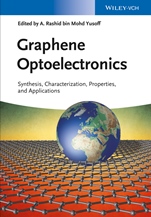
Graphene Optoelectronics: Synthesis, Characterization, Properties, and Applications
ISBN 9783527336340
Autor: Abdul Rashid bin M. Yusoff
Wydawca: Wiley
Dostępność: 3-6 tygodni
Cena: 746,55 zł
Przed złożeniem zamówienia prosimy o kontakt mailowy celem potwierdzenia ceny.
ISBN13: |
9783527336340 |
ISBN10: |
3527336346 |
Autor: |
Abdul Rashid bin M. Yusoff |
Oprawa: |
Hardback |
Rok Wydania: |
2014-10-01 |
Ilość stron: |
288 |
Wymiary: |
251x173 |
Tematy: |
PH |
This first book on emerging applications for this innovative material gives an up–to date account of the many opportunities graphene offers high–end optoelectronics. The text focuses on potential as well as already realized applications, discussing metallic and passive components, such as transparent conductors and smart windows, as well as high–frequency devices, spintronics, photonics, and terahertz devices. Also included are sections on the fundamental properties, synthesis, and characterization of graphene. With its unique coverage, this book will be welcomed by materials scientists, solid–state chemists and solid–state physicists alike.
List of Contributors XIII Preface XIX 1 Electronic Transport and Optical Properties of Graphene 1 Klaus Ziegler, Antonio Hill, and Andreas Sinner 1.1 Introduction 1 1.2 Basic Experimental Facts 3 1.3 Models for Transport in Graphene 5 1.4 DC Conductivity 6 1.5 AC Conductivity for Very Weak Scattering and Thermal Fluctuations 9 1.6 Plasmons 11 1.7 Discussion 13 References 14 2 Synthesis and Modification of Graphene 17 Ding Zhou, Yi Cui, and Bao–Hang Han 2.1 Synthesis of Graphene 17 2.1.1 “Top–Down” Approach 17 2.1.1.1 Micromechanical Cleavage 17 2.1.1.2 Liquid–Phase Exfoliation 18 2.1.1.3 Oxidation and Reduction 19 2.1.1.4 Exfoliation of Graphite Intercalation Compounds 21 2.1.2 “Bottom–Up” Approach 22 2.1.2.1 Chemical Vapor Deposition 22 2.1.2.2 Epitaxial Growth 24 2.1.2.3 Chemical Synthesis 25 2.2 Modification and Functionalization of Graphene 26 2.2.1 Noncovalent Modification 27 2.2.2 Covalent Modification 28 2.2.2.1 Cycloaddition 28 2.2.2.2 Free–Radical Addition 30 2.2.2.3 Substitution 31 2.2.3 Covalent Modification Based on Oxygen–Containing Groups 32 2.3 Concluding Remarks and Perspectives 33 References 34 3 Graphene for the Elaboration of Nanocomposite Films for Optoelectronic Applications 41 Mohammed Khenfouch,Mimouna Baitoul, and Malik Maaza 3.1 Introduction 41 3.2 Synthesis and Optical Characterization of Few–layered Graphene Oxide (FGO) 41 3.2.1 FGO Synthesis 42 3.2.2 Optical Characterization of FGO 42 3.2.2.1 UV–Visible Spectroscopy 42 3.2.2.2 Raman Spectroscopy 43 3.2.2.3 Photoluminescence 43 3.3 Graphene as Seed Layer for Synthesis of DLC Free–Standing Films for Ultrahigh–Intensity Laser–Based Electron/Proton Acceleration Applications 44 3.3.1 Free–Standing DLC Films Synthesis 45 3.3.2 Vibrational and Optical Characterization 47 3.3.2.1 Raman Spectroscopy 47 3.3.2.2 Optical Characterization 49 3.4 ZnO/Graphene Nanorod Composites for LED Application 51 3.4.1 ZnO/Graphene Nanocomposite Synthesis 52 3.4.2 Optical Characteristics 52 3.4.2.1 UV–Visible Spectroscopy 53 3.4.2.2 Raman Spectroscopy 53 3.4.2.3 Photoluminescence 55 3.5 Conclusions 56 Acknowledgments 57 References 57 4 Metallic and Passive Components 63 Mohd Asri bin Mat Teridi and A. Rashid bin Mohd Yusoff 4.1 Introduction 63 4.2 History of Graphene 64 4.3 Applications 65 4.3.1 Transparent, Conductive, and Flexible Electronics 65 4.3.2 Flexible SmartWindows and Bistable Displays 73 4.3.3 Light–Emitting Devices 77 4.3.4 Touch Panels 79 4.3.5 Photovoltaic Devices 82 4.3.5.1 Heterojunction Solar Cells 82 4.3.5.2 Dye–Sensitized Solar Cells 89 4.3.5.3 Tandem Cells 93 4.3.5.4 Quantum–Dot Solar Cells 96 References 101 5 High–Frequency Devices 111 Seong C. Jun 5.1 Graphene Transistor 111 5.1.1 Introduction 111 5.1.2 The Energy Bandgap of Graphene 112 5.1.3 Graphene FET 113 5.1.4 Graphene Nanoribbon FET 116 5.1.5 Graphene High–Frequency Transistor 116 5.2 Functional Circuits 119 5.2.1 Introduction 119 5.2.2 Applications 120 5.2.2.1 Graphene Inverter (GI) 120 5.2.2.2 Graphene Amplifier (GA) 122 5.2.2.3 Graphene Frequency Multiplier (GFM) 125 5.2.2.4 Graphene Mixer (GM) 126 5.2.2.5 Graphene Logic Circuit 129 5.2.3 Conclusions and Prospects 131 5.3 Self–Aligned Electrode 131 5.3.1 Introduction 131 5.3.2 History 132 5.3.3 Development of the Electrode 133 5.3.4 Manufacturing Process 134 5.3.5 Applications 135 5.3.5.1 The MOSFET Electrode Fabrication 135 5.3.5.2 Inkjet Printing of Electrode 136 5.3.5.3 Self–Aligned Graphene and CNTFET Electrode 136 5.4 Dielectrophoresis 138 5.4.1 Introduction 138 5.4.2 Dipole Force 139 5.4.3 Torque on a Dipole 139 5.4.4 Dipole Force in the Solvent 140 5.4.5 Applications of Dielectrophoresis 141 5.4.6 Graphene Oxide Interconnector 142 References 145 6 Bandgap Engineering in Graphene 149 Kai–Tak Lam and Jing Guo 6.1 Introduction 149 6.2 Bandgap Engineering in Bilayer and Multilayer Graphene 150 6.3 Bandgap Engineering in Graphene Nanoribbon 155 6.4 Bandgap Engineering by Strain 159 6.5 Summary 162 References 162 7 Graphene Spintronics: Spin Generation and Manipulation in Graphene 167 Lei Shen,Minggang Zeng, QingyunWu, Zhaoqiang Bai, and Yuan P. Feng 7.1 Background and Challenges 167 7.2 Spin Generation in Graphene 169 7.2.1 Making Magnetic Graphene 169 7.2.1.1 Two–Dimensional Graphene Sheet 170 7.2.1.2 One–Dimensional Graphene Nanoribbon 170 7.2.1.3 Zero–Dimensional Graphene Fragment 171 7.2.2 Driving Spins into Graphene 172 7.2.2.1 By Magnetic Field 172 7.2.2.2 By Tunneling 172 7.2.2.3 By Heat 174 7.3 Spin Manipulation in Graphene 178 7.3.1 Rectification of Spin Current by Spin Diodes 178 7.3.2 Amplification of Spin Current by Spin Transistors 180 7.3.3 Functionalization of Spin Current by Spin Logics 181 7.4 Conclusion 183 References 183 8 Magnetism and Spintronics in Graphenes: Spin Hall Effect and Edge–Derived Spin Phenomena 189 Junji Haruyama 8.1 Introduction 189 8.2 Magnetism and Spintronic Phenomena Arising from Pore Edge Spins in Graphene Nanomeshes 192 8.2.1 Ferromagnetism Derived from Hydrogenated Zigzag–Type Pore Edges 192 8.2.1.1 Non–lithographic Fabrication of GNMs with Zigzag Pore Edges 192 8.2.1.2 Magnetism Depending on Pore Edge Termination by Different Foreign Atoms 194 8.2.1.3 Defect–Dependent TwoTheoretical Models: GNR Model and Lieb’s Theorem 196 8.2.2 Spin–Related Phenomena in MR Measurements of Few–Layer GNMs with Large Interpore Spacing 198 8.3 Recent Advances in Experiments of Spin–Based Phenomena in Graphenes 202 8.4 Conclusions 205 Acknowledgments 206 References 206 9 Graphene: Manipulate Terahertz Waves 209 Yixuan Zhou, Xinlong Xu, Haiming Fan,Mei Qi, Jiayuan Li, Jintao Bai, and Zhaoyu Ren 9.1 Introduction 209 9.2 THz Properties of Graphene 210 9.2.1 Intraband–Transition–Dependent THz Conductivity 210 9.2.2 THz Spectroscopy and THz Imaging for Probing Graphene Properties 212 9.2.3 THz Spectroscopy of Multilayer Graphene 214 9.2.4 Magnetooptic Property of Graphene in the THz Region 216 9.2.5 THz Responses of Other Graphene–Based Materials 218 9.3 Proof–of–Concept Graphene Devices 220 9.3.1 Electrooptic Modulation 221 9.3.2 Magnetooptic Modulation 222 9.3.3 All–Optic Modulation 224 9.4 Advanced THzWave Manipulation: Graphene Plasmons and Metamaterials 225 9.4.1 Graphene THz Plasmons 225 9.4.2 Graphene Coupling to THz Metamaterials 228 9.5 Conclusions and Perspective 229 Acknowledgments 230 References 230 10 Chemical and Biosensors Based on Graphene Materials 235 Perry T. Yin, Tae–Hyung Kim, Jeong–Woo Choi, and Ki–Bum Lee 10.1 Introduction 235 10.2 Graphene–Based Electronic Sensors 236 10.2.1 Electronic Chemical Sensors 237 10.2.2 Electronic Biosensors 241 10.3 Graphene–Based Electrochemical Sensors 243 10.3.1 Electrochemical Chemical Sensors 244 10.3.2 Electrochemical Biosensors 247 10.4 Graphene–Based Optical Sensors 250 10.4.1 Optical Chemical Sensors 251 10.4.2 Optical Biosensors 252 10.5 Conclusion 254 Acknowledgments 255 Abbreviations 255 References 256 Index 261
A.Rashid bin Mohd Yusoff is Assistant Research Professor at Kyung Hee University since 2012. He received his BA in physics from the University Putra Malaysia and his MS in applied physics from the University Malaya. For his PhD studies he went on to Brazil, where he graduated at the University of Parana in 2011. Afterwards, he joined the Department of Information Display at the Kyung Hee University as a post–doctoral fellow studying organic photovoltaics (OPV) and organic light emitting diodes (OLEDs). In 2012, he became group leader for the development of a high efficiency OPV joint program between South Korea and Japan and he was appointed group leader for OLED R&D activities for DNA active matrix OLEDs (AMOLEDs) between Kyung Hee University and the University of Cincinnati (duration 2012–2015). His research interests include electronic properties of organic semiconductor thin films, charge transport properties, device physics, organic and inorganic–based light emitting devices, organic photovoltaics, and organic transistors.
Koszyk
Książek w koszyku: 0 szt.
Wartość zakupów: 0,00 zł
Informacje


Kontakt
Gambit
Centrum Oprogramowania
i Szkoleń Sp. z o.o.
Al. Pokoju 29b/22-24
31-564 Kraków
Siedziba Księgarni
ul. Kordylewskiego 1
31-542 Kraków
+48 12 410 5991
+48 12 410 5987
+48 12 410 5989
Subskrypcje
Administratorem danych osobowych jest firma Gambit COiS Sp. z o.o. Na podany adres będzie wysyłany wyłącznie biuletyn informacyjny.
Autoryzacja płatności

Informacje na temat autoryzacji płatności poprzez PayU.

© Copyright 2012: GAMBIT COiS Sp. z o.o. Wszelkie prawa zastrzeżone.
Projekt i wykonanie: Alchemia Studio Reklamy