


Wydawcy
Katalog tematyczny
- Archeologia (109)
- Ekonomia, finanse, business (13704)
- Filozofia (1445)
- Historia (3040)
- Języki i językoznawstwo (2356)
- Lifestyle, hobby i rozrywka (475)
- Medycyna (9704)
- Nauki humanistyczne (4)
- Nauki o Ziemi i środowisku (2638)
- Nauki ścisłe (20412)
- Astronomia (294)
- Biologia (5119)
- Chemia (6540)
- Chemia analityczna (361)
- Chemia fizyczna (346)
- Chemia nieorganiczna (137)
- Chemia organiczna (535)
- Krystalografia (27)
- Minerologia (46)
- Fizyka (3309)
- Matematyka (4574)
- Nauki ścisłe, ogólnie (503)
- Nauki społeczne (8486)
- Nauki techniczne (13450)
- Prawo (1696)
- Publikacje informacyjne i interdyscyplinarne (1288)
- Religia i wierzenia (917)
- Technika komputerowa (4067)
- Zdrowie, relacje międzyludzkie i rozwój osobisty (657)





Informacje szczegółowe o książce
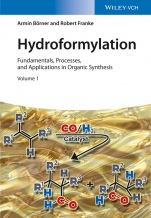
Hydroformylation: Fundamentals, Processes, and Applications in Organic Synthesis
ISBN 9783527335527
Autor: Armin Börner, Robert Franke
Wydawca: Wiley
Dostępność: 3-6 tygodni
Cena: 1 450,05 zł
Przed złożeniem zamówienia prosimy o kontakt mailowy celem potwierdzenia ceny.
ISBN13: |
9783527335527 |
ISBN10: |
3527335528 |
Autor: |
Armin Börner, Robert Franke |
Oprawa: |
Hardback |
Rok Wydania: |
2016-03-16 |
Numer Wydania: |
2 Volumes |
Ilość stron: |
736 |
Wymiary: |
249x172 |
Tematy: |
PN |
One of the largest industrial applications of homogeneous catalysis, hydroformylation is the process whereby alkenes react with carbon monoxide and hydrogen at high temperatures in the presence of a transition metal catalyst to yield aldehydes. The resulting products are valuable intermediates in the synthesis of alcohols, esters, amines, and olefins, used in pharmaceutical chemistry and the manufacture of fragrances. This reaction was discovered around 70 years ago, and nowadays some ten million metric tons of aldehydes are produced each year.
This up–to–date reference is unique in its comprehensive coverage from fundamentals to applications, summarizing the latest advances and developments in hydroformylation reactions. The two authors are at the forefront of catalysis research, and unite their expertise in synthetic and applied catalysis, as well as theoretical and analytical chemistry.
As such, they provide a detailed account of the catalytic systems employed, catalyst stability and recovery, mechanistic investigations, substrate scope, and technical implementation. Chapters on multiphase hydroformylation procedures, tandem hydroformylations and other industrially applied reactions using syngas and carbon monoxide are also included.
A must–have reference not only for synthetic chemists working in academic and industrial research, but also for theoreticians and analytical chemists.
INTRODUCTION
HOMOGENEOUSLY CATALYZED HYDROFORMYLATION
The Catalytic System
TECHNICAL IMPLEMENTATION OF HYDROFORMYLATION REACTIONS
Vessels and Conditions for Small Scale Reactions
Technical Set–Ups for Large Scale Reactions
Safety Issues
Influence of Metals, Ligands and Reaction Conditions on Activity and Regioselectivity
Solvents
Other Influences and Supporting Measurements (Microwaves, Irradiation)
Recovery of Homogeneous Catalysts and Separation of the Product
CATALYST DECOMPOSITION, ENEMIES OF LIGANDS AND CATALYSTS AND MEASURE AGAINST IT
General Aspects (Poison, Formation of Clusters)
Dormant Sites in the Catalytic Cycle (Sulfur Compounds, Enones, Butadienes, Alkynes)
Decomposition of Phosphines (Pathways, Products, Examples)
Decomposition of Ligands with P–O Bonds (Pathways, Products, Examples)
Decomposition of Carbene Ligands and Corresponding Catalysts
MECHANISTIC INVESTIGATIONS
Analytical Tools
Quantum Chemical Methods
The Mechanism
HYDROFORMYLATION IN MULTIPHASE CONDITIONS
General Aspects (Economic and Environmental Issues)
Biphasic Aqueous Phase Hydroformylations
Ionic Liquids
Reaction in CO2
Fluorous Solvents
Dendrimer–supported Catalysts
Supramolecular Catalysts, Self–assembling Catalysts
Catalysts Supported on Organic Polymers, Biopolymers or Inorganic Surfaces
Hydroformylation in Micro–Emulsions and Micellar Media
THE SUBSTRATES
Unfunctionalized Monoolefins
Functionalized Olefins and the Challenge of Substrate–directed Hydroformylation
Stereoselective Hydroformylations
Alkynes
Special Substrates
TANDEM–REACTIONS COVERING HYDROFORMYLATION
Isomerization Hydroformylation
Hydroformylation followed by Acetalization (Intramolecular, Intermolecular)
Hydroformylation followed by Hydrogenation
Hydroformylation followed by Amination (Intramolecular, Intermolecular)
Hydroaminomethylation (Intramolecular, Intermolecular;
Amines, Hydrazines)
Hydroformylation/Enantioselective Mannich Reactions
Hydroformylation followed by Cyclization Reactions (Cylodehydration)
Consecutive Hydroformylation–Aldol Reaction (Aldol Addition, Aldol Condensation, Aldol–Mukaiyama)
Tandem Enolboration /
Hydroformylation /
Aldol Addition
Consecutive Hydroformylation–Wittig Reaction
Consecutive Hydroformylation–Decarboxylative Knoevenagel Reaction
Hydroformylation–Ene Reaction
Hydroformylation–Alkylation
OTHER METAL CATALYZED REACTIONS WITH CO
Carbonylation of 2–Aryl–2–Oxazolines
OTHER REACTIONS WITH SYNGAS
Hydroformylation of Epoxides
Hydroformylation of Formaldehyde
Homologation of Alcohols
Armin Börner studied education and chemistry at the University of Rostock and completed his PhD thesis in the group of Prof. Dr. H. Kristen in 1984. Between 1984 and 1992 he was a scientific co–worker in the field of complex catalysis at the Academia of Science under Prof. Dr. H. Pracejus. After a postdoctoral term in the group of Prof. Dr. H. B. Kagan in Orsay, France, he relocated to the Max–Planck–Group for Asymmetric Catalysis in Rostock in 1993, where he was awarded his professorial research degree (habilitation) in 1995. Since 2000 he has been Professor of Organic Chemistry at the University of Rostock and head of a research department at the Leibniz–Institute for Catalysis (LIKAT) Rostock. His research focuses on applied homogeneous catalysis and he has published over 250 scientific papers, reviews, book chapters and patents. More than 15 catalytic processes and analytical tools which have been developed in his department are running in a technical scale or have been commercialized.
Robert Franke studied chemistry at Bochum University, Germany. He earned his doctorate degree in 1994 in the field of relativistic quantum chemistry under Prof. Dr. W. Kutzelnigg. After working for a period as a research assistant, he joined the process engineering department of the former Hüls AG in Germany, a predecessor company of Evonik Performance Materials GmbH, in 1998. He is now Director Innovation Management Hydroformylation. He was awarded his professorial research degree (habilitation) in 2002, since when he has taught at the University of Bochum. In 2011 he was made adjunct professor. His research focuses on homogeneous catalysis, process intensification, and computational chemistry. He has published over 150 scientific papers, reviews, book chapters and patents.
Koszyk
Książek w koszyku: 0 szt.
Wartość zakupów: 0,00 zł
Informacje


Kontakt
Gambit
Centrum Oprogramowania
i Szkoleń Sp. z o.o.
Al. Pokoju 29b/22-24
31-564 Kraków
Siedziba Księgarni
ul. Kordylewskiego 1
31-542 Kraków
+48 12 410 5991
+48 12 410 5987
+48 12 410 5989
Subskrypcje
Administratorem danych osobowych jest firma Gambit COiS Sp. z o.o. Na podany adres będzie wysyłany wyłącznie biuletyn informacyjny.
Autoryzacja płatności

Informacje na temat autoryzacji płatności poprzez PayU.

© Copyright 2012: GAMBIT COiS Sp. z o.o. Wszelkie prawa zastrzeżone.
Projekt i wykonanie: Alchemia Studio Reklamy