


Wydawcy
Katalog tematyczny
- Archeologia (109)
- Ekonomia, finanse, business (13704)
- Filozofia (1445)
- Historia (3040)
- Języki i językoznawstwo (2356)
- Lifestyle, hobby i rozrywka (475)
- Medycyna (9704)
- Nauki humanistyczne (4)
- Nauki o Ziemi i środowisku (2638)
- Nauki ścisłe (20412)
- Nauki społeczne (8486)
- Nauki techniczne (13450)
- Budownictwo lądowe (1045)
- Chemia przemysłowa (2258)
- Elektronika i telekomunikacja (3287)
- Energetyka (1122)
- Inne nauki stosowane (363)
- Inżynieria biochemiczna (507)
- Inżynieria transportu (232)
- Mechanika i materiały (3316)
- Nauka o środowisku (321)
- Rolnictwo (507)
- Technika, ogólnie (475)
- Prawo (1696)
- Publikacje informacyjne i interdyscyplinarne (1288)
- Religia i wierzenia (917)
- Technika komputerowa (4067)
- Zdrowie, relacje międzyludzkie i rozwój osobisty (657)





Informacje szczegółowe o książce
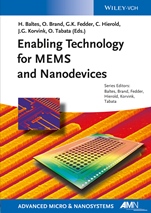
Enabling Technology for MEMS and Nanodevices: Advanced Micro and Nanosystems
ISBN 9783527334988
Autor: Henry Baltes, Oliver Brand, Gary K. Fedder, Christofer Hierold, Jan G. Korvink, Osamu Tabata
Wydawca: Wiley
Dostępność: 3-6 tygodni
Cena: 455,70 zł
Przed złożeniem zamówienia prosimy o kontakt mailowy celem potwierdzenia ceny.
ISBN13: |
9783527334988 |
ISBN10: |
352733498X |
Autor: |
Henry Baltes, Oliver Brand, Gary K. Fedder, Christofer Hierold, Jan G. Korvink, Osamu Tabata |
Oprawa: |
Paperback |
Rok Wydania: |
2013-04-17 |
Ilość stron: |
439 |
Wymiary: |
238x167 |
Tematy: |
TG |
This edition of ′CMOS–MEMS′ was originally published in the successful series ′Advanced Micro & Nanosystems′. A close look at enabling technologies is taken, the first section on MEMS featuring an introduction to the challenges and benefi ts of three–dimensional silicon processing. An insider′s view of industrial MEMS commercialization is followed by chapters on capacitive interfaces for MEMS, packaging issues of micro– and nanosystems, MEMS contributions to high frequency integrated resonators and filters, and the uses of MEMS in mass data storage and electrochemical imaging by means of scanning micro– and nanoprobes. The second section on nanodevices first tackles the emerging topic of nanofluidics with a contribution each on simulation tools and on devices and uses, followed by another two on nanosensors featuring CNT sensors and CMOS–based DNA sensor arrays, respectively.
Preface V Foreword IX List of Contributors XIII 1 Fabrication Technology 1 O. Brand 2 Material Characterization 69 J. O. Paul and P. Ruther 3 Monolithically Integrated Inertial Sensors 137 G. K. Fedder, J. Chae, H. Kulah, K. Najafi, T. Denison, J. Kuang, and S. Lewis 4 CMOS–MEMS Acoustic Devices 193 J. J. Neumann and K. J. Gabriel 5 RF CMOS MEMS 225 T. Mukherjee and G. K. Fedder 6 CMOS–based Pressure Sensors 257 H.–J. Timme 7 CMOS–based Chemical Sensors 335 A. Hierlemann 8 Biometric Capacitive CMOS Fingerprint Sensor Systems 391 C. Hierold, G. Hribernig, and T. Scheiter 9 CMOS–based Biochemical Sensing Systems 447 J. Lichtenberg, H. Baltes 10 CMOS–based Thermal Sensors 479 T. Akin 11 Circuit and System Integration 513 C. Hagleitner and K.–U. Kirstein Subject Index 579
Henry Baltes is Professor Emeritus of ETH Zurich affiliated with Micro and Nanosystems at the Department of Mechanical and Process Engineering. He was Professor of Physical Electronics at ETH Zurich and Director of the Physical Electronics Laboratory (PEL) from 1988 to 2006. In 2004 and 2005 he acted as start–up Chair of the future Department of Biosystems Science and Engineering (D–BSSE) of ETH Zurich located at Basel. Henry Baltes is a Fellow of the IEEE and a Member of the Swiss Academy of Technical Sciences. He served on the Editorial Board of the Proceedings of the IEEE, the Search Committee of the Koerber Foundation, and the Advisory Committee of the Freiburg Institute of Advanced Sudies. He is a co–founder of the spin–off company SENSIRION. Oliver Brand is Professor of Bioengineering and Microelectronics/Microsystems at Georgia Institute of Technology, Atlanta, USA. He received his diploma degree in Physics from Technical University Karlsruhe, Germany, in 1990, and his PhD from ETH Zurich, Switzerland, in 1994. Between 1995 and 2002, he held research and teaching positions at the Georgia Institute of Technology (1995–1997) and ETH Zurich (1997–2002). Oliver Brand?s research interest is in the areas of CMOS–based micro– and nanosystems, MEMS fabrication technologies, and microsystem packaging. Gary K. Fedder is Professor of Electrical and Computer Engineering, Professor of The Robotics Institute and the Director of the Institute for Complex Engineered Systems (ICES) at Carnegie Mellon University, Pittsburgh, USA. He received the BSc and MSc degrees in electrical engineering from MIT in 1982 and 1984, respectively, and his PhD in 1994 from the University of California, Berkeley. His research interests include microelectromechanical systems (MEMS) modeling, simulation and synthesis, integration of MEMS and CMOS, microsensor design, microactuator control systems, and probe–based nanofabrication technologies. Christofer Hierold holds the Chair of Micro– and Nanosystems at the ETH in Zurich, Switzerland, since April 2002. Prior to that, he spent eleven years with Siemens AG and Infineon Technologies AG, responsible for R&D on microsystems, advanced CMOS processes, memories, nanoelectronics and new materials. His current research work focuses on the evaluation of new materials for MEMS, on advanced microsystems and on nanotransducers. He holds numerous patents and has published over 20 research articles in peer reviewed journals and international conference proceedings. He serves on the program committees of several scientific conferences such as the IEEE MEMS series. Jan G. Korvink holds a Chair for Microsystems Engineering at the University of Freiburg, Germany, where he also directs the Freiburg Institute for Advanced Studies – FRIAS. He has co–authored more than 160 papers in scientific journals, as well as numerous conference papers, book chapters and a book on semiconductors for engineers. His research interests cover the modeling, simulation and low cost fabrication of MEMS/NEMS, and applications in magnetic resonance. In 2011 he received a European Research Council (ERC) Advanced Grant, the Red Dot Design Concept Award and the University of Freiburg Teaching Award. Osamu Tabata is Professor in the Department of Microengineering at Kyoto University. He received his MSc and PhD degrees from Nagoya Institute of Technology. From 1981 to 1996, he performed industrial research at Toyota Central Research and Development Laboratories in Aichi, Japan. He joined the Department of Mechanical Engineering of Ritsumeikan University in Shiga, Japan, in 1996, and the Department of Mechanical Engineering at Kyoto University in 2003. Osamu Tabata is engaged in the research of micro/nano processes, MEMS and micro/nano system synthetic engineering. He received numerous awards, including the Science News Award and the Research & Development Top 100 Award in 1993 and 1998.
"Overall, the book gives good insight into very recent technologies, developments, and practical applications in the MEMS field. I would recommend this book as supplementary reading for graduate students, but not as a class text since the book assumes the reader already has fundamental knowledge in this research field. The book is also a very useful source for professionals in related areas of materials science and mechanical and chemical engineering who want to become aware of emerging MEMS technologies." Advanced Materials "... an excellent book that gives a good overview and discussion of sensors and devices commonly found in the field of MEMS as well as more advanced devices..." MRS Bulletin
Koszyk
Książek w koszyku: 0 szt.
Wartość zakupów: 0,00 zł
Informacje


Kontakt
Gambit
Centrum Oprogramowania
i Szkoleń Sp. z o.o.
Al. Pokoju 29b/22-24
31-564 Kraków
Siedziba Księgarni
ul. Kordylewskiego 1
31-542 Kraków
+48 12 410 5991
+48 12 410 5987
+48 12 410 5989
Subskrypcje
Administratorem danych osobowych jest firma Gambit COiS Sp. z o.o. Na podany adres będzie wysyłany wyłącznie biuletyn informacyjny.
Autoryzacja płatności

Informacje na temat autoryzacji płatności poprzez PayU.

© Copyright 2012: GAMBIT COiS Sp. z o.o. Wszelkie prawa zastrzeżone.
Projekt i wykonanie: Alchemia Studio Reklamy