


Wydawcy
Katalog tematyczny
- Archeologia (109)
- Ekonomia, finanse, business (13704)
- Filozofia (1445)
- Historia (3040)
- Języki i językoznawstwo (2356)
- Lifestyle, hobby i rozrywka (475)
- Medycyna (9704)
- Nauki humanistyczne (4)
- Nauki o Ziemi i środowisku (2638)
- Nauki ścisłe (20412)
- Astronomia (294)
- Biologia (5119)
- Chemia (6540)
- Chemia analityczna (361)
- Chemia fizyczna (346)
- Chemia nieorganiczna (137)
- Chemia organiczna (535)
- Krystalografia (27)
- Minerologia (46)
- Fizyka (3309)
- Matematyka (4574)
- Nauki ścisłe, ogólnie (503)
- Nauki społeczne (8486)
- Nauki techniczne (13450)
- Prawo (1696)
- Publikacje informacyjne i interdyscyplinarne (1288)
- Religia i wierzenia (917)
- Technika komputerowa (4067)
- Zdrowie, relacje międzyludzkie i rozwój osobisty (657)





Informacje szczegółowe o książce
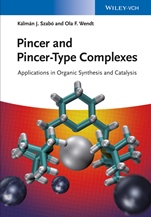
Pincer and Pincer–Type Complexes: Applications in Organic Synthesis and Catalysis
ISBN 9783527334421
Autor: Kálmán J. Szabó, Ola F. Wendt
Wydawca: Wiley
Dostępność: 3-6 tygodni
Cena: 784,35 zł
Przed złożeniem zamówienia prosimy o kontakt mailowy celem potwierdzenia ceny.
ISBN13: |
9783527334421 |
ISBN10: |
3527334424 |
Autor: |
Kálmán J. Szabó, Ola F. Wendt |
Oprawa: |
Hardback |
Rok Wydania: |
2014-07-09 |
Ilość stron: |
320 |
Wymiary: |
250x173 |
Tematy: |
PN |
This new book on this hot topic summarizes the key achievements for the synthesis and catalytic applications of pincer and pincer–type complexes, providing readers with the latest research highlights. The editors have assembled an international team of leaders in the fi eld, and their contributions focus on the application of various pincer complexes in modern organic synthesis and catalysis, such as C–C and C–X bond forming reactions, C–H bond functionalization, and the activation of small molecules, as well as asymmetric catalysis. A must–have for every synthetic chemist in both academia and industry intending to develop new catalysts and improved synthetic protocols.
Preface XI List of Contributors XIII 1 Catalysis by Pincer Complexes: Synthesis of Esters, Amides, and Peptides 1 Chidambaram Gunanathan and David Milstein 1.1 Introduction and Background 1 1.2 Bond Activation by Metal–Ligand Cooperation 3 1.3 Synthesis of Esters 4 1.3.1 Synthesis of Esters from Primary Alcohols 4 1.3.2 Synthesis of Cross–Esters from Primary and Secondary Alcohols 9 1.3.3 Synthesis of Esters by Acylation of Secondary Alcohols Using Esters 9 1.3.4 Synthesis of Polyesters from Diols 11 1.4 Synthesis of Amides 15 1.4.1 Synthesis of Amides from Alcohols and Amines 15 1.4.2 Synthesis of Amides from Esters and Amines 18 1.4.3 Synthesis of Polyamides from Diols and Diamines 20 1.5 Synthesis of Peptides from β–Amino Alcohols 24 1.6 Concluding Remarks 26 Acknowledgments 26 References 27 2 The Role of Redox Processes in Reactions Catalyzed by Nickel and Palladium Complexes with Anionic Pincer Ligands 31 Juan C´ampora and Crist´obal Melero 2.1 Introduction 31 2.2 Pincer Complexes of Ni, Pd, and Pt in Oxidation States Different from II 34 2.2.1 Complexes in the Higher Oxidation States (III, IV) 34 2.2.2 Reduced Complexes of Ni, Pd, and Pt with Pincer Ligands 43 2.3 Catalytic Reactions Involving Redox Processes in the Pincer–Metal Framework 46 2.3.1 Atom–Transfer Radical Addition (ATRA) and Polymerization Reactions (ATRP) 46 2.3.2 The Heck Reaction 48 2.3.3 C–C Cross–Coupling Reactions 54 2.3.4 Carbon–Heteroatom Coupling Reactions 62 2.4 Concluding Remarks 65 Acknowledgment 66 References 66 3 Appended Functionality in Pincer Ligands 71 Cameron M. Moore and Nathaniel K. Szymczak 3.1 Introduction 71 3.1.1 Design Criteria 72 3.1.2 Motivations 72 3.1.2.1 Transition–Metal Catalysis 72 3.1.2.2 Supramolecular Architectures 73 3.2 Appended Functionality Coplanar with the Pincer Chelate 75 3.2.1 Systems that Incorporate 2,2′:6′,2′′–Terpyridine 75 3.2.1.1 Synthetic Strategies 75 3.2.1.2 Appended Lewis Acid/Bases 77 3.2.1.3 Appended Hydrogen–Bond Acceptor/Donors 79 3.2.2 Pyridine–2,6–Dicarboxamide Systems 84 3.3 Appended Functionality Not Coplanar to the Pincer Chelate 86 3.3.1 ENE Pincer Systems 86 3.3.2 PCP Pincer Systems 88 3.3.3 PEP Pincer Systems 88 3.3.4 Pyridine–2,6–Diimine Systems 90 3.4 Future Outlook and Summary 91 References 91 4 C–C, C–O, and C–B Bond Formation by Pincer Complexes Including Asymmetric Catalysis 95 K´alm´an J. Szab´o 4.1 Introduction – Pros and Cons of Using Pincer Complexes in Catalysis 95 4.2 Reaction of Imines and Isocyanoacetates 96 4.2.1 Stereoselective Synthesis of Imidazolines 96 4.2.2 Application of Chiral Pincer Complexes 99 4.2.3 Mechanistic Considerations 101 4.3 C–H Functionalization of Organonitriles 102 4.3.1 Allylation of Imines 102 4.3.2 Benzyl Amine Synthesis 103 4.4 Reactions Involving Hypervalent Iodines 107 4.4.1 Arylation of Alkenes Using Pincer Complex Catalysis 107 4.4.2 Acetoxylation with Hypervalent Iodines 109 4.4.3 C–H Borylation of Alkenes 112 4.5 Summary and Outlook 113 References 115 5 Nickel–Catalyzed Cross–Coupling Reactions 117 Anubendu Adhikary and Hairong Guan 5.1 Introduction 117 5.2 Carbon–Carbon Bond–Forming Reactions 118 5.2.1 Kumada–Corriu–Tamao Coupling 118 5.2.2 Suzuki–Miyaura Coupling 129 5.2.3 Negishi Coupling 132 5.2.4 Sonogashira Coupling 139 5.2.5 Mizoroki–Heck Reaction 140 5.2.6 Other Miscellaneous Cross–Coupling Reactions 141 5.3 Carbon–Heteroatom Bond–Forming Reactions 143 5.4 Summary and Outlook 144 Acknowledgments 144 References 144 6 PSiP Transition–Metal Pincer Complexes: Synthesis, Bond Activation, and Catalysis 149 Laura Turculet 6.1 Introduction 149 6.2 PSiP Ligand Syntheses 151 6.3 Group 8 Metal PSiP Chemistry 153 6.4 Group 9 Metal PSiP Chemistry 161 6.5 Group 10 Metal PSiP Chemistry 169 6.6 Group 11 Metal PSiP Chemistry 179 6.7 Alternative Silyl Pincers 180 6.8 Summary 183 References 183 7 Electronic Structures of Reduced Manganese, Iron, and Cobalt Complexes Bearing Redox–Active Bis(imino)pyridine Pincer Ligands 189 Paul J. Chirik 7.1 Introduction 189 7.2 Reduced Manganese, Iron, and Cobalt Complexes with Redox–Active Bis(imino)pyridines 189 7.2.1 Reduced Bis(imino)pyridine Manganese Chemistry 190 7.2.2 Reduced Bis(imino)pyridine Iron Chemistry 193 7.2.3 Reduced Bis(imino)pyridine Cobalt Chemistry 200 7.3 Conclusions and Outlook 209 References 209 8 Pincer Complexes with Saturated Frameworks: Synthesis and Applications 213 Klara J. Jonasson andOla F. Wendt 8.1 Introduction 213 8.2 Synthesis of the Ligands 213 8.3 Synthesis and Coordination Behavior of Carbometallated PC(sp3)P Complexes 215 8.3.1 Coordination Flexibility in Acyclic PC(sp3)P Complexes 216 8.4 Reactivity and Catalytic Applications of PC(sp3)P Complexes 217 8.4.1 Ammonia Activation 217 8.4.2 Isotopic Labeling 219 8.4.3 Reactions with Coordinated Olefins 219 8.4.4 Carbon–Carbon Coupling Reactions 221 8.4.5 Hydrogenation and Dehydrogenation 223 8.4.6 CO2 Activation 225 References 225 9 Heavier Group 14 Elements–Based Pincer Complexes in Catalytic Synthetic Transformations of Unsaturated Hydrocarbons 229 Jun Takaya and Nobuharu Iwasawa 9.1 Introduction 229 9.2 Synthesis of Palladium Complexes Bearing PXP–Pincer Ligands (X = Si, Ge, Sn) 230 9.2.1 Synthesis 230 9.2.2 Structural Analyses 230 9.3 Hydrocarboxylation 231 9.3.1 Hydrocarboxylation of Allenes 232 9.3.2 Hydrocarboxylation of 1,3–Dienes 234 9.4 Reductive Aldol Type Reaction 235 9.5 Dehydrogenative Borylation 237 9.5.1 Dehydrogenative Borylation of Alkenes and 1,3–Dienes 237 9.5.2 Mechanistic Considerations 239 9.6 Synthesis and Reaction of η2–(Si–H)Pd(0) Complex as an Equivalent to PSiP–Palladium Hydride Complexes 241 9.6.1 Synthesis and Structure of η2–(Si–H)Pd(0) 241 9.6.2 Reaction of η2–(Si–H)Pd(0) Complex with an Allene 242 9.6.3 Reaction of η2–(Si–H)Pd(0) Complex with Diboron 244 9.7 Conclusions 245 References 246 10 Experimental and Theoretical Aspects of Palladium Pincer–Catalyzed C–C Cross–Coupling Reactions 249 Christian M. Frech 10.1 C–C Cross–Coupling Reactions – an Indispensable Tool for the Synthesis of Complex Organic Molecules 249 10.2 Palladium Pincer Complexes as C–C Cross–Coupling Catalysts 250 10.3 The Role of Palladium Pincer Complexes in Heck Reactions 253 10.3.1 PdII/PdIV Cycles and Palladium Nanoparticle Formation 256 10.4 Computational Investigations on the Thermal Feasibility of PdII/PdIV Cycles of Palladium Pincer–Catalyzed Heck Reactions 262 10.4.1 Possible Initial Reaction Steps of PdII/PdIV Mechanisms 263 10.4.2 Investigations on Mechanisms Initiated by Oxidative Addition of Phenyl Bromide on the Palladium(II) Center of [{C6H3–2,6–(NHP(piperidinyl)2)2 }Pd(Cl)] (10) 263 10.4.3 Investigations on Mechanisms Initiated by Styrene Coordination and/or Chloride Dissociation 265 10.4.4 PdII/PdIV Cycle Proposed for Palladium Pincer–Catalyzed Heck Reactions 270 10.4.5 Heck Reactions Catalyzed by Palladium Pincer Complexes: PdII/PdIV Cycles and/or Palladium Nanoparticle Formation 274 10.5 Theoretical Investigations on a Pincer–Catalyzed Negishi Cross–Coupling Reaction 275 10.6 Concluding Remarks 277 References 278 11 Reactions of Square–Planar d8 Pincer Complexes with Oxygen and Hydrogen 281 Wilson D. Bailey, Marie V. Parkes, Richard A. Kemp, and Karen I. Goldberg 11.1 Introduction 281 11.2 Insertion of Molecular Oxygen into Late–Transition Metal Hydride Bonds 284 11.3 Hydrogenolysis of Late–Transition Metal Hydroxide and Alkoxide Complexes 289 11.4 Summary 294 Acknowledgment 294 References 295 Index 299
Kálmán J. Szabó is professor at the Department of Organic Chemistry at the Arrhenius Laboratory, Stockholm University, Sweden since 2003. He obtained his PhD at Lund University, Sweden with Professor Salo Gronowitz in 1993, and did his postdoctoral research with Professor Dieter Cremer at Gothenburg University, Sweden. Szabó?s research interest involves theoretical (DFT) and experimental aspects of organic synthesis, organometallic chemistry and homogenous catalysis. He have developed synthetically useful catalytic transformations, including asymmetric catalysis, based on Pd, Ir, Cu and Ti complexes with a particular attention to C–C, C–B and C–Sn formation reactions. Currently his research interest focuses on C–H functionalization processes and catalytic organofluoride chemistry. He is the author of more than 100 publications and several book chapters. Ola F. Wendt is professor of Inorganic Chemistry since 2010 and Head of the Centre for Analysis and Synthesis at Lund University, Sweden. He received his PhD with Prof. Lars Ivar Elding at Lund University in 1997 and then moved to Caltech in Pasadena (USA) to do postdoctoral work with Prof. John Bercaw for two years. His major research interests revolve around organotransition metal chemistry, homogeneous catalysis and mechanistic studies. He has developed numerous pincer based complexes with palladium, platinum and iridium and studied their applications and mechanisms in cross–coupling reactions and small molecule activation. Since 2010 he is an elected fellow of the Royal Physiographic Society in Lund. He is the author of more than 70 publications and review articles.
Koszyk
Książek w koszyku: 0 szt.
Wartość zakupów: 0,00 zł
Informacje


Kontakt
Gambit
Centrum Oprogramowania
i Szkoleń Sp. z o.o.
Al. Pokoju 29b/22-24
31-564 Kraków
Siedziba Księgarni
ul. Kordylewskiego 1
31-542 Kraków
+48 12 410 5991
+48 12 410 5987
+48 12 410 5989
Subskrypcje
Administratorem danych osobowych jest firma Gambit COiS Sp. z o.o. Na podany adres będzie wysyłany wyłącznie biuletyn informacyjny.
Autoryzacja płatności

Informacje na temat autoryzacji płatności poprzez PayU.

© Copyright 2012: GAMBIT COiS Sp. z o.o. Wszelkie prawa zastrzeżone.
Projekt i wykonanie: Alchemia Studio Reklamy