


Wydawcy
Katalog tematyczny
- Archeologia (109)
- Ekonomia, finanse, business (13704)
- Filozofia (1445)
- Historia (3040)
- Języki i językoznawstwo (2356)
- Lifestyle, hobby i rozrywka (475)
- Medycyna (9704)
- Nauki humanistyczne (4)
- Nauki o Ziemi i środowisku (2638)
- Nauki ścisłe (20412)
- Astronomia (294)
- Biologia (5119)
- Chemia (6540)
- Chemia analityczna (361)
- Chemia fizyczna (346)
- Chemia nieorganiczna (137)
- Chemia organiczna (535)
- Krystalografia (27)
- Minerologia (46)
- Fizyka (3309)
- Matematyka (4574)
- Nauki ścisłe, ogólnie (503)
- Nauki społeczne (8486)
- Nauki techniczne (13450)
- Prawo (1696)
- Publikacje informacyjne i interdyscyplinarne (1288)
- Religia i wierzenia (917)
- Technika komputerowa (4067)
- Zdrowie, relacje międzyludzkie i rozwój osobisty (657)





Informacje szczegółowe o książce
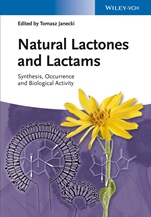
Natural Lactones and Lactams: Synthesis, Occurrence and Biological Activity
ISBN 9783527334148
Autor: Tomasz Janecki
Wydawca: Wiley
Dostępność: 3-6 tygodni
Cena: 801,15 zł
Przed złożeniem zamówienia prosimy o kontakt mailowy celem potwierdzenia ceny.
ISBN13: |
9783527334148 |
ISBN10: |
3527334149 |
Autor: |
Tomasz Janecki |
Oprawa: |
Hardback |
Rok Wydania: |
2013-10-23 |
Ilość stron: |
392 |
Wymiary: |
250x174 |
Tematy: |
PN |
Lactones and lactams, cyclic molecules found in nature, yet so versatile that they can be reused in both the pharmaceutical industry and as chiral building blocks in organic synthesis, are the focus of this book. Although there a numerous tomes on heterocyclic compounds and natural products, this text fills the gap for an up–to–date summary of recently developed and improved synthetic methods for the preparation of the most important classes of lactones and lactams. Each chapter deals with the general and most recent synthetic methods leading to a specific class of lactone or lactam to enable quick accessto the procedure you desire. With brief descriptions of the occurrence and biological or pharmaceutical activity of each compound class, the authors have ensured that this book is comprehensive in its coverage. A valuable resource for organic, bio–, and medicinal chemists in academia and industry wanting to learn about successful synthetic routes to important natural products and use this as inspiration for their own work in the lab.
Preface XIII List of Contributors XV 1 Tetronic Acids 1 Dimitris Georgiadis 1.1 Introduction 1 1.2 Natural Occurrence, Biological Activities, and Biosynthesis 1 1.3 5–Ylidene Tetronic Natural Products 6 1.3.1 Pulvinic Acids and Pulvinones 6 1.3.2 Agglomerins 11 1.3.3 Tetronomycin 13 1.3.4 Stemofoline Alkaloids 13 1.3.5 Variabilin 17 1.3.6 Tetrodecamycin 17 1.4 5–Monosubstituted Tetronic Natural Products 19 1.4.1 Carlic, Carlosic, Carolic, Carolinic, and Viridicatic Acids 19 1.4.2 RK–682 20 1.4.3 Massarilactone B 21 1.4.4 Annularins F, G, and H 21 1.4.5 Palinurin 23 1.4.6 Pesthetoxin 24 1.4.7 Rotundifolides A and B 24 1.5 5–Disubstituted Tetronic Natural Products 25 1.5.1 5–Dialkyl Tetronic Natural Products 25 1.5.1.1 Vertinolide 25 1.5.1.2 Papyracillic Acid B 26 1.5.1.3 Bisorbibutenolide 26 1.5.2 5–Spirotetronic Natural Products 29 1.5.2.1 Spirotetronic Antibiotics 29 1.5.2.2 Ircinianin and Wistarin 35 1.5.2.3 Stemonamine Alkaloids 35 1.5.2.4 Abyssomicins 37 1.6 5–Unsubstituted Tetronic Natural Products 41 1.6.1 Tetronasin 41 1.7 Conclusions 42 References 43 2 Recent Advances in the Field of Naturally Occurring 5,6–Dihydropyran–2–ones 51 Juan Alberto Marco and Miguel Carda 2.1 Introduction 51 2.2 Synthetic Methodologies for 5,6–Dihydropyran–2–ones 52 2.2.1 Lactonization of Substituted δ–Hydroxy Acid Derivatives 52 2.2.2 Oxidation of Substituted Dihydropyran Derivatives 53 2.2.3 Ring–Closing Metathesis 54 2.2.4 Miscellaneous Methods 54 2.3 Formation of Stereogenic Centers inside the Dihydropyrone Ring 55 2.3.1 Use of Chiral Precursors 56 2.3.1.1 Carbohydrate and Related Precursors 56 2.3.1.2 Chiral Hydroxy Acids 58 2.3.1.3 Chiral Epoxides 60 2.3.1.4 Other Chirons 62 2.3.2 Asymmetric (Enantioselective) Reactions 64 2.3.2.1 Asymmetric (Enantioselective) Sharpless Epoxidations or Dihydroxylations 64 2.3.2.2 Asymmetric Aldol–Type Reactions 68 2.3.2.3 Asymmetric Allylations 69 2.3.2.4 Asymmetric Carbonyl Reductions 71 2.3.2.5 Asymmetric Alkylations 72 2.3.2.6 Asymmetric Epoxide Hydrolysis 73 2.3.2.7 Asymmetric Cycloadditions 74 2.3.2.8 Other Asymmetric Methods 75 2.4 Pharmacological Properties of Pyrones 78 2.5 Biosynthetic Formation of Pyrones 79 2.6 Syntheses of Natural 5,6–Dihydropyran–2–ones Reported during the Period from 2006 to the First Half of 2012 91 References 91 3 β–Lactams 101 Girija S. Singh and Siji Sudheesh 3.1 Introduction 101 3.1.1 Biosynthesis of Penicillin and Cephalosporin 102 3.2 Monocyclic β–Lactams 103 3.2.1 Biosynthesis of Nocardicin A 104 3.2.2 Synthetic Approaches to Construct β–Lactam Ring 105 3.2.2.1 Cycloaddition Reactions 106 3.2.2.2 Cyclization Reactions 115 3.2.2.3 Miscellaneous Approaches 118 3.2.3 Biological Activity of Monocyclic 2–Azetidinones 119 3.3 Penams 121 3.3.1 Synthetic Approaches to Penam Skeleton 121 3.3.2 Biological Activity of Penams 122 3.4 Cephalosporins 124 3.4.1 Synthetic Approaches to Cephalosporin Skeleton 125 3.4.2 Biological Activity of Cephalosporins 128 3.5 Clavulanic Acid 130 3.5.1 Synthetic Approaches to Clavam Skeleton 131 3.5.2 Biological Activity of Clavams 132 3.6 Carbapenems 133 3.6.1 Synthetic Approaches to Carbapenem Skeleton 134 3.6.2 Biological Activity of Carbapenems 136 3.7 Spiro–Fused β–Lactams 137 3.7.1 Occurrence and Structure of Chartellines 137 3.7.2 Total Synthesis of Chartelline C 137 3.7.3 Biological Activity of Spiro–Fused β–Lactams 140 3.8 Summary 140 References 141 4 α–Alkylidene–γ– and δ–Lactones and Lactams 147 £ukasz Albrecht, Anna Albrecht, and Tomasz Janecki 4.1 Introduction 147 4.2 Occurrence, Biosynthesis, and Biological Activities of α–Alkylidene γ– and δ–Lactones and Lactams 148 4.2.1 α–Alkylidene–γ–Lactones 148 4.2.2 α–Alkylidene–δ–Lactones 152 4.2.3 α–Alkylidene–γ– and δ–Lactams 153 4.3 Recent Advances in the Synthesis of α–Alkylidene–γ– and δ–Lactones and Lactams 153 4.3.1 Cyclization of 2–Alkylidene–4–(5–)Hydroxyalkanoates and 2–Alkylidene–4–(5–)Aminoalkanoates in the Synthesis of α–Alkylidene–γ– and δ–Lactones and Lactams 154 4.3.1.1 Organometallic Reagents Derived from 2–Bromomethylacrylic Acid and Its Derivatives in the Synthesis of 2–Alkylidene– 4–Hydroxyalkanoates and 2–Alkylidene–4–Aminoalkanoates 155 4.3.1.2 Application of Allylboronates in the Synthesis of 2–Alkylidene–4–Hydroxyalkanoates and 2–Alkylidene–4–Aminoalkanoates 156 4.3.1.3 Baylis–Hillman Alcohol Derivatives in the Synthesis of α–Alkylidene γ– and δ–Lactones and Lactams 161 4.3.1.4 Ring–Opening Reactions in the Synthesis of 2–Alkylidene–4–Hydroxyalkanoates and 4–Aminoalkanoates 167 4.3.2 Construction of α–Alkylidene–γ– and δ–Lactone and Lactam Rings via Intramolecular Morita–Baylis–Hillman Reaction 168 4.3.3 Methods Involving α–Dialkoxyphosphoryl–γ– and δ–Lactones and Lactams as Key Intermediates 172 4.3.3.1 Methods Involving Cyclic α,β–Unsaturated Precursors 172 4.3.3.2 Methods Involving 2–Dialkoxyphosphoryl 4–(5–)Hydroxy or 4–(5–)Aminoalkanoates as Key Intermediates 174 4.3.3.3 α–Diethoxyphosphoryl–δ–Lactones in the Synthesis of 3–Methylene–3,4–Dihydrocoumarins 182 4.3.3.4 Annulation of the Lactone Frameworks via Carbon–Carbon Bond–Forming Reactions 184 4.3.4 β–Elimination Reaction in the Synthesis of α–Alkylidene–γ–Lactones or γ–Lactams 184 4.3.5 Oxidation of 3–Alkylidenetetrahydrofuranones in the Synthesis of α–Alkylidene–γ–Lactones 186 4.3.6 Miscellaneous Methods for the Preparation of α–Alkylidenelactones and Lactams 187 4.4 Conclusions 188 References 188 5 Medium–Sized Lactones 193 Isamu Shiina and Kenya Nakata 5.1 Introduction 193 5.1.1 Natural Eight– and Nine–Membered Lactones 193 5.1.2 Lactonization Methods 194 5.1.2.1 Corey–Nicolaou S–Pyridyl Ester Lactonization Method 195 5.1.2.2 Mukaiyama Onium Salt Method 195 5.1.2.3 Masamune Thioester Activation Method 197 5.1.2.4 Yamaguchi Mixed–Anhydride Method 198 5.1.2.5 Mitsunobu Alcohol Activation Method 199 5.1.2.6 Keck–Steglich DCC/DMAP·HCl Activation Method 199 5.1.2.7 Shiina Benzoic Anhydride Method 200 5.2 Total Synthesis of Eight–Membered Lactones 203 5.2.1 Cephalosporolide D 203 5.2.1.1 Shiina Total Synthesis (1988) 203 5.2.1.2 Buszek Total Synthesis (2001) 204 5.2.1.3 Rao Total Synthesis (2010) 204 5.2.1.4 Sabitha Total Synthesis (2011) 205 5.2.2 Octalactins A and B 205 5.2.2.1 Buszek Total Synthesis (1994) 205 5.2.2.2 Clardy Total Synthesis (1994) 206 5.2.2.3 Holmes Total Synthesis (2004) 207 5.2.2.4 Shiina Total Synthesis (2004) 207 5.2.2.5 Andrus Formal Total Synthesis (1996) 208 5.2.2.6 Hatakeyama Synthesis of the Lactone Moiety (1998) 209 5.2.2.7 Garcia Synthesis of the Lactone Moiety (1998) 210 5.2.2.8 Buszek Alternative Synthesis of Octalactin A (2002) 210 5.2.2.9 Cossy Synthesis of the Lactone Moiety (2005) 211 5.2.2.10 Hulme Partial Synthesis (1997) 211 5.2.3 Solandelactones A–H 212 5.2.3.1 Martin Total Synthesis of Solandelactone E (2007) 212 5.2.3.2 White Total Synthesis of Solandelactones E and F (2007) 213 5.2.3.3 Pietruszka Total Synthesis of Solandelactones A–H (2008) 213 5.2.3.4 Aggarwal Total Synthesis of Solandelactones E (2010) and F (2012) 214 5.2.3.5 Datta Synthesis of the Lactone Moiety (1988) 214 5.2.3.6 Mohapatra Synthesis of the Lactone Moiety (2003) 215 5.3 Total Synthesis of Nine–Membered Lactones 215 5.3.1 Halicolactone 215 5.3.1.1 Wills Total Synthesis (1995) 216 5.3.1.2 Takemoto–Tanaka Total Synthesis (2000) 216 5.3.1.3 Kitahara Total Synthesis (2002) 216 5.3.1.4 Tang Total Synthesis (2009) 217 5.3.1.5 Pietruszka Total Synthesis (2010) 218 5.3.1.6 Datta Formal Synthesis (1998) 218 5.3.2 Griseoviridin 219 5.3.2.1 Meyers Total Synthesis (2000) 219 5.3.3 2–Epibotcinolide 219 5.3.3.1 Shiina Total Synthesis (2006) 220 5.3.3.2 Chakraborty Synthesis of the Lactone Moiety (2006) 222 5.4 Conclusions 222 References 223 6 Macrolactones 229 Gangavaram V. M. Sharma and Venkata Ramana Doddi 6.1 Introduction 229 6.1.1 Classification of Macrolides 231 6.1.1.1 ‘‘Polyoxo’’ Macrolides 232 6.1.1.2 Polyene Macrolides 232 6.1.1.3 Ionophoric Macrolides 233 6.1.1.4 Ansamycin Macrolides 233 6.1.1.5 Other Macrolides 234 6.1.2 Macrolactones as Chemical Signals (Semiochemicals) 235 6.1.3 Macrolactones as Musks 236 6.2 General Methods for the Synthesis of Macrolactones 236 6.3 Synthesis of Macrolides 241 6.3.1 Synthesis of Patulolide C 241 6.3.2 Synthesis of Balticolide 242 6.3.3 Synthesis of Oximidine II 243 6.3.4 Synthesis of Ripostatin B 245 6.3.5 Synthesis of Azamacrolides 247 6.3.6 Synthesis of (+)–Acutiphycin 247 6.3.7 Synthesis of Archazolid A 250 6.3.8 Synthesis of Epothilone B 251 6.3.9 Synthesis of Batatoside L 252 6.4 Synthesis of Macrodiolides 252 6.4.1 Synthesis of Verbalactone 254 6.4.2 Synthesis of Acremodiol 255 6.4.3 Synthesis of Amphidinolide X 257 6.4.4 Synthesis of Marinomycin A 258 6.5 Synthesis of Macrotriolides 260 6.5.1 Synthesis of Macrosphelides A and E 261 6.5.2 Synthesis of Macrosphelides C and F 262 6.5.3 Synthesis of Macrosphelides G and I 263 6.5.4 Synthesis of Macrosphelide M 266 6.6 Conclusions and Perspectives 267 Abbreviations 267 References 269 7 Resorcylic Acid Lactones 273 Carmela Napolitano and Paul V. Murphy 7.1 Introduction – A Historical Perspective 273 7.2 Biosynthesis 277 7.3 Chemical Synthesis 277 7.3.1 Zearalenone 279 7.3.2 Radicicol 285 7.3.3 Pochonins 292 7.3.4 RALs with cis–Enone Groups 295 7.3.5 Aigialomycin D 303 7.3.6 Other RALs 309 7.4 Conclusion and Outlook 315 References 315 8 Cyclic Peptides 321 Srinivasa Rao Adusumalli, Andrei K. Yudin, and Vishal Rai 8.1 Introduction 321 8.2 Synthesis of Natural Lactones and Lactams 332 8.2.1 Cyclocinamide A 332 8.2.2 Biphenomycin B 333 8.2.3 Antillatoxin 336 8.2.4 Halipeptins 338 8.2.5 Largazole 340 8.2.6 Dendroamide A 342 8.2.7 Chondramide C 346 8.2.8 Cyclocitropsides 346 8.2.9 Sanguinamide B 349 8.2.10 Apratoxin A 349 8.2.11 Thiocillin I 351 8.2.12 Lagunamide A 353 8.2.13 Kapakahines 356 8.2.14 Chloptosin 357 8.3 Conclusion 359 References 361 Index 371
Tomasz Janecki was born in Lodz (Poland) and studied chemistry at the Lodz University of Technology. He obtained his doctorate in 1981 under the guidance of Ryszard Bodalski. After postdoctoral appointments at Strathclyde University (Peter Pauson) and the University of Texas at Austin (Josef Michl and Karl Folkers), he began an independent research career and completed his "Habilitation" at the Lodz University of Technology in 1996. Currently, he is a Full Professor of Organic Chemistry at the same university. His main research interest is the application of organophosphorus reagents in stereoselective synthesis of biologically important classes of organic compounds.
Koszyk
Książek w koszyku: 0 szt.
Wartość zakupów: 0,00 zł
Informacje


Kontakt
Gambit
Centrum Oprogramowania
i Szkoleń Sp. z o.o.
Al. Pokoju 29b/22-24
31-564 Kraków
Siedziba Księgarni
ul. Kordylewskiego 1
31-542 Kraków
+48 12 410 5991
+48 12 410 5987
+48 12 410 5989
Subskrypcje
Administratorem danych osobowych jest firma Gambit COiS Sp. z o.o. Na podany adres będzie wysyłany wyłącznie biuletyn informacyjny.
Autoryzacja płatności

Informacje na temat autoryzacji płatności poprzez PayU.

© Copyright 2012: GAMBIT COiS Sp. z o.o. Wszelkie prawa zastrzeżone.
Projekt i wykonanie: Alchemia Studio Reklamy