


Wydawcy
Katalog tematyczny
- Archeologia (109)
- Ekonomia, finanse, business (13704)
- Filozofia (1445)
- Historia (3040)
- Języki i językoznawstwo (2356)
- Lifestyle, hobby i rozrywka (475)
- Medycyna (9704)
- Nauki humanistyczne (4)
- Nauki o Ziemi i środowisku (2638)
- Nauki ścisłe (20412)
- Astronomia (294)
- Biologia (5119)
- Chemia (6540)
- Chemia analityczna (361)
- Chemia fizyczna (346)
- Chemia nieorganiczna (137)
- Chemia organiczna (535)
- Krystalografia (27)
- Minerologia (46)
- Fizyka (3309)
- Matematyka (4574)
- Nauki ścisłe, ogólnie (503)
- Nauki społeczne (8486)
- Nauki techniczne (13450)
- Prawo (1696)
- Publikacje informacyjne i interdyscyplinarne (1288)
- Religia i wierzenia (917)
- Technika komputerowa (4067)
- Zdrowie, relacje międzyludzkie i rozwój osobisty (657)






Informacje szczegółowe o książce
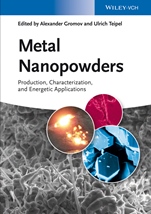
Metal Nanopowders: Production, Characterization, and Energetic Applications
ISBN 9783527333615
Autor: Alexander A. Gromov, Ulrich Teipel
Wydawca: Wiley
Dostępność: 3-6 tygodni
Cena: 830,55 zł
Przed złożeniem zamówienia prosimy o kontakt mailowy celem potwierdzenia ceny.
ISBN13: |
9783527333615 |
ISBN10: |
3527333614 |
Autor: |
Alexander A. Gromov, Ulrich Teipel |
Oprawa: |
Hardback |
Rok Wydania: |
2014-04-09 |
Ilość stron: |
440 |
Wymiary: |
250x173 |
Tematy: |
PN |
Written with both postgraduate students and researchers in academia and industry in mind, this reference covers the chemistry behind metal nanopowders, including production, characterization, oxidation and combustion. The contributions from renowned international scientists working in the field detail applications in technologies, scale–up processes and safety aspects surrounding handling and storage, showing how versatile these materials can be. Contains a Foreword by Prof. Dr.–Ing. George Manelis, Institute of Problems of Chemical Physics, Russian Academy of Science, Chernogolovka, Russia and Prof. Dr.–Ing. Hiltmar Schubert, Fraunhofer Institute of Chemical Technology, Pfinztal, Germany.
Foreword XIII List of Contributors XV Introduction XIX 1 Estimation of Thermodynamic Data of Metallic Nanoparticles Based on Bulk Values 1 Dieter Vollath and Franz Dieter Fischer 1.1 Introduction 1 1.2 Thermodynamic Background 2 1.3 Size–Dependent Materials Data of Nanoparticles 4 1.4 Comparison of Experimental and Calculated Melting Temperatures 8 1.5 Comparison with Data for the Entropy of Melting 16 1.6 Discussion of the Results 17 1.7 Conclusions 19 1.A Appendix: Zeros and Extrema of the Free Enthalpy of Melting Gm–nano 20 References 21 2 Numerical Simulation of Individual Metallic Nanoparticles 25 D.S. Wen and P.X. Song 2.1 Introduction 25 2.2 Molecular Dynamics Simulation 27 2.2.1 Motion of Atoms 27 2.2.2 Temperature and Potential Energy 28 2.2.3 Ensembles 29 2.2.4 Energy Minimization 30 2.2.5 Force Field 30 2.2.6 Potential Truncation and Neighbor List 31 2.2.7 Simulation Program and Platform 32 2.3 Size–Dependent Properties 33 2.3.1 Introduction 33 2.3.2 Simulation Setting 34 2.3.3 Size–Dependent Melting Phenomenon 35 2.4 Sintering Study of Two Nanoparticles 38 2.4.1 Introduction 38 2.4.2 Simulation Setting 40 2.4.3 Sintering Process Characterization 40 2.5 Oxidation of Nanoparticles in the Presence of Oxygen 45 2.5.1 Introduction 45 2.5.2 Simulation Setting 47 2.5.3 Characterization of the Oxidation Process 48 2.6 Heating and Cooling of a Core–Shell Structured Particle 54 2.6.1 Simulation Method 54 2.6.2 Heating Simulation 56 2.6.2.1 Solidification Simulation 59 2.7 Chapter Summary 61 References 63 3 Electroexplosive Nanometals 67 Olga Nazarenko, Alexander Gromov, Alexander Il’in, Julia Pautova, and Dmitry Tikhonov 3.1 Introduction 67 3.2 Electrical Explosion of Wires Technology for Nanometals Production 67 3.2.1 The Physics of the Process of Electrical Explosion of Wires 68 3.2.2 Nonequilibrium State of EEW Products – Nanometals 70 3.2.3 The Equipment Design for nMe Production by Electrical Explosion of Wires Method 71 3.2.4 Comparative Characteristics of the Technology of Electrical Explosion of Wires 73 3.2.5 The Methods for the Regulation of the Properties of Nanometals Produced by Electrical Explosion of Wires 74 3.3 Conclusion 75 Acknowledgments 75 References 76 4 Metal Nanopowders Production 79 M. Lerner, A. Vorozhtsov, Sh. Guseinov, and P. Storozhenko 4.1 Introduction 79 4.2 EEW Method of Nanopowder Production 81 4.2.1 Electrical Explosion of Wires Phenomenon 81 4.2.2 Nanopowder Production Equipment 84 4.3 Recondensation NP–Producing Methods: Plasma–Based Technology 85 4.3.1 Fundamentals of Plasma–Chemical NP Production 89 4.3.2 Vortex–Stabilized Plasma Reactor 90 4.3.3 Starting Material Metering Device (Dispenser) 92 4.3.4 Disperse Material Trapping Devices (Cyclone Collectors and Filters) 93 4.3.5 NP Encapsulation Unit 94 4.4 Characteristics of Al Nanopowders 95 4.5 Nanopowder Chemical Passivation 97 4.6 Microencapsulation of Al Nanoparticles 99 4.7 The Process of Producing Nanopowders of Aluminum by Plasma–Based Technology 102 4.7.1 Production of Aluminum Nanopowder 102 4.7.2 Some Properties of Produced Nanopowders of Aluminum, Boron, Aluminum Boride, and Silicon 103 References 104 5 Characterization of Metallic Nanoparticle Agglomerates 107 Alfred P. Weber 5.1 Introduction 107 5.2 Description of the Structure of Nanoparticle Agglomerates 108 5.3 Experimental Techniques to Characterize the Agglomerate Structure 112 5.3.1 TEM and 3–D TEM Tomography 113 5.3.2 Scattering Techniques 115 5.3.3 Direct Determination of Agglomerate Mass and Size 117 5.4 Mechanical Stability 120 5.5 Thermal Stability 124 5.6 Rate–Limiting Steps: Gas Transport versus Reaction Velocity 126 5.7 Conclusions 127 Acknowledgments 128 References 128 6 Passivation of Metal Nanopowders 133 Alexander Gromov, Alexander Il’in, Ulrich Teipel, and Julia Pautova 6.1 Introduction 133 6.2 Theoretical and Experimental Background 136 6.2.1 Chemical and Physical Processes in Aluminum Nanoparticles during Their Passivation by Slow Oxidation under Atmosphere (Ar + Air) 136 6.2.2 Chemical Mechanism of Aluminum Nanopowder Passivation by Slow Air Oxidation 140 6.3 Characteristics of the Passivated Particles 143 6.3.1 Characteristics of Aluminum Nanopowders, Passivated by Gaseous and Solid Reagents (Samples No 1–6, Table 6.7) 148 6.3.2 Characteristics of Aluminum Nanopowders, Passivated by Gaseous and Solid Reagents (Samples No 7–11, Table 6.7) 149 6.4 Conclusion 150 Acknowledgments 150 References 150 7 Safety Aspects of Metal Nanopowders 153 M. Lerner, A. Vorozhtsov, and N. Eisenreich 7.1 Introduction 153 7.2 Some Basic Phenomena of Oxidation of Nanometal Particles in Air 154 7.3 Determination of Fire Hazards of Nanopowders 155 7.4 Sensitivity against Electrostatic Discharge 158 7.5 Ranking of Nanopowders According to Hazard Classification 159 7.6 Demands for Packing 160 References 161 8 Reaction of Aluminum Powders with Liquid Water and Steam 163 Larichev Mikhail Nikolaevich 8.1 Introduction 163 8.2 Experimental Technique for Studying Reaction Al Powders with Liquid and Gaseous Water 166 8.2.1 Oxidation of Aluminum Powder with Distilled Water 168 8.3 Oxidation of Aluminum Powder in Water Vapor Flow 174 8.4 Nanopowders Passivated with Coatings on the Base of Aluminum Carbide 175 8.5 Study of Al Powder/H2O Slurry Samples Heated Linear in ‘‘Open System’’ by STA 183 8.6 Ultrasound (US) and Chemical Activation of Metal Aluminum Oxidation in Liquid Water 184 8.7 Conclusion 194 Acknowledgments 195 References 195 9 Nanosized Cobalt Catalysts for Hydrogen Storage Systems Based on Ammonia Borane and Sodium Borohydride 199 Valentina I. Simagina, Oksana V. Komova, and Olga V. Netskina 9.1 Introduction 199 9.1.1 Experimental 200 9.1.2 Study of the Activity of Nanosized Cobalt Boride Catalysts Forming in the Reaction Medium of Sodium Borohydride and Ammonia Borane 202 9.2 A Study of Nanosized Cobalt Borides by Physicochemical Methods 204 9.2.1 A Study of the Crystallization of Amorphous Cobalt Borides Forming in the Medium of Sodium Borohydride and Ammonia Borane 208 9.2.2 The Effect of the Reaction Medium on the State of Cobalt Boride Catalysts 214 9.3 Conclusions 223 Acknowledgments 224 References 224 10 Reactive and Metastable Nanomaterials Prepared by Mechanical Milling 227 Edward L. Dreizin and Mirko Schoenitz 10.1 Introduction 227 10.2 Mechanical Milling Equipment 228 10.3 Process Parameters 229 10.4 Material Characterization 232 10.5 Ignition and Combustion Experiments 233 10.6 Starting Materials 235 10.7 Mechanically Alloyed and Metal–Metal Composite Powders 236 10.7.1 Preparation and Characterization 236 10.7.2 Thermal Analysis 242 10.7.3 Heated Filament Ignition 245 10.7.4 Constant Volume Explosion 249 10.7.5 Lifted Laminar Flame (LLF) Experiments 250 10.8 Reactive Nanocomposite Powders 254 10.8.1 Preparation and Characterization 256 10.8.2 Thermally Activated Reactions and their Mechanisms 257 10.8.3 Ignition 263 10.8.4 Particle Combustion Dynamics 267 10.8.5 Constant Volume Explosion 268 10.8.6 Consolidated Samples: Mechanical and Reactive Properties 271 10.9 Conclusions 273 References 274 11 Characterizing Metal Particle Combustion In Situ: Non–equilibrium Diagnostics 279 Michelle Pantoya, Keerti Kappagantula, and Cory Farley 11.1 Introduction 279 11.2 Ignition and Combustion of Solid Materials 281 11.2.1 Ignition 281 11.2.2 Propagation 282 11.2.3 Flame Speeds 286 11.3 Aluminum Reaction Mechanisms 287 11.4 The Flame Tube 289 11.5 Flame Temperature 292 11.5.1 Background 292 11.5.2 Radiometer Setup 294 11.5.3 Infrared Setup 295 11.5.4 Linking Radiometer and IR Data for a Spatial Distribution of Temperature 295 11.6 Conclusions 297 Acknowledgments 297 References 297 12 Characterization and Combustion of Aluminum Nanopowders in Energetic Systems 301 Luigi T. De Luca, Luciano Galfetti, Filippo Maggi, Giovanni Colombo, Christian Paravan, Alice Reina, Stefano Dossi, Marco Fassina, and Andrea Sossi 12.1 Fuels in Energetic Systems: Introduction and Literature Survey 301 12.1.1 An Overall Introduction to Energetic Systems 302 12.1.2 Experimental Investigations on Micro and Nano Energetic Additives 304 12.1.3 Theoretical/Numerical Investigations on Energetic Additives 305 12.1.4 Thermites 308 12.1.4.1 Nanocomposite Thermites 308 12.1.5 Explosives 311 12.1.6 A Short Historical Survey of SPLab Contributions 315 12.1.7 Concluding Remarks on Energetic Additives 319 12.2 Thermochemical Performance of Energetic Additives 319 12.2.1 Ideal Performance Analysis of Metal Fuels 319 12.2.2 Solid Propellant Optimal Formulations 320 12.2.3 Hybrid Rocket Performance Analysis 322 12.2.4 Oxidizing Species in Hybrid Rocket Nozzles 324 12.2.5 Active Aluminum Content and Performance Detriment 325 12.2.6 Two–Phase Losses 326 12.2.7 Concluding Remarks on Theoretical Performance 329 12.3 Nanosized Powder Characterization 330 12.3.1 Introduction 330 12.3.2 Facilities Used for Nanosized Powder Analyses 331 12.3.3 Tested nAl Powders: Production, Coating, and Properties 331 12.3.3.1 Production of nAl Particles 331 12.3.3.2 Coating of nAl Particles 332 12.3.3.3 Morphology and Internal Structure of nAl Particles 333 12.3.3.4 BET Area and Aluminum Content of nAl Particles 333 12.3.4 DSC/TGA Slow Heating Rate Reactivity 337 12.3.4.1 Nonisothermal Oxidation of 50 nm Powder 338 12.3.4.2 Nonisothermal Oxidation of 100 nm Powder 339 12.3.4.3 Passivation/Coating Efficiency 339 12.3.5 High Heating Rate Reactivity 341 12.3.5.1 nAl Powder Ignition Experimental Setup 341 12.3.5.2 nAl Powder Ignition Representative Results 342 12.3.6 CCP Collection by Strand Burner 344 12.3.6.1 Condensed Combustion Product Analysis 344 12.3.7 Concluding Remarks on Powder Characterization 350 12.4 Mechanical and Rheological Behavior with Nanopowders 350 12.4.1 Solid Propellants and Fuels: Mechanical and Rheological Behavior 350 12.4.2 Viscoelastic Behavior 352 12.4.3 Additive Dispersion 354 12.4.4 Rheology of Suspensions 355 12.4.5 Aging Effects 359 12.4.6 Experimental Results: Data Processing and Discussions 360 12.4.7 Tested Formulations 361 12.4.8 Uniaxial Tensile Stress–Strain Tests 362 12.4.9 Dynamic Mechanical Analysis 364 12.4.10 Rheological Tests 365 12.4.11 Concluding Remarks 367 12.5 Combustion of Nanopowders in Solid Propellants and Fuels 367 12.5.1 Solid Rocket Propellants 368 12.5.1.1 Particle Clustering Phenomena 368 12.5.1.2 Propellant Volume Microstructure 369 12.5.1.3 Steady Combustion Mechanisms of AP/HTPB–Based Composite Propellants 370 12.5.1.4 Transient Combustion Mechanisms 374 12.5.1.5 Concluding Remarks 379 12.5.2 Solid Rocket Fuels for Hybrid Propulsion 380 12.5.2.1 Tested Ingredients and Solid Fuel Formulations 380 12.5.2.2 Experimental Setup 381 12.5.2.3 Time–Resolved Regression Rate 383 12.5.2.4 Ballistic Characterization: Analyses of the Results 386 12.5.2.5 Concluding Remarks on Solid Fuel Burning 394 12.5.3 Chapter Summary 395 Nomenclature 396 References 400 Index 411
Alexander Gromov obtained his academic degrees from Bijsk Technologic Institute (1998, Chem.Eng.) and Tomsk Polytechnic University (2000, PhD), before working for Tomsk Polytechnic University (Russia), University of Ulsan (South Korea), Forschungszentrum Karlsruhe and Fraunhofer Institute of Chemical Technology (Germany), Milan Polytechnic University (Italy). He was a visiting professor at the Aerospace Engineering Department at Milan Polytechnic University (Italy), 2011–2013 before obtaining the Humboldt Grant for Experienced Researchers and moving to Nuremberg Technical University George–Simon Ohm (Germany) in 2013. Professor Gromov has authored over 150 scientific publications and several books and has received numerous Russian scientific awards, including the Russian Academy of Science Medal in 2009. He is also a member of the International Award Committee of the "Global Energy Prize". Ulrich Teipel studied Mechanical Engineering at the University of Applied Science of Münster, Germany, 1977 to 1981, followed by Chemical Engineering and Fluid Mechanics at the Technical University (RWTH) of Aachen, Germany, from 1983 to 1990. From 1991 on, he worked as a Research Scientist at the Fraunhofer Institute of Chemical Technology (ICT), becoming Leader of the research group Particle Technology and Deputy Head of the department Energetic Materials in 1996. Since 2004 he has been a Professor of Particle Technology, Mechanical Process Engineering and Fluidmechanics at the Nuremberg Technical University George–Simon Ohm, Germany. His research focuses on R&D on the product design and characterization of particulate materials. Within the field of Particle Technology he is involved in communition, sieve classification, raw materials, mineral processing, rheology of complex fluids and the characterization of particles and disperse systems. Prof. Teipel is a Member of the German Society of Crystallization and Communition and Classification.
Koszyk
Książek w koszyku: 0 szt.
Wartość zakupów: 0,00 zł
Informacje


Kontakt
Gambit
Centrum Oprogramowania
i Szkoleń Sp. z o.o.
Al. Pokoju 29b/22-24
31-564 Kraków
Siedziba Księgarni
ul. Kordylewskiego 1
31-542 Kraków
+48 12 410 5991
+48 12 410 5987
+48 12 410 5989
Subskrypcje
Administratorem danych osobowych jest firma Gambit COiS Sp. z o.o. Na podany adres będzie wysyłany wyłącznie biuletyn informacyjny.
Autoryzacja płatności

Informacje na temat autoryzacji płatności poprzez PayU.

© Copyright 2012: GAMBIT COiS Sp. z o.o. Wszelkie prawa zastrzeżone.
Projekt i wykonanie: Alchemia Studio Reklamy