


Wydawcy
Katalog tematyczny
- Archeologia (109)
- Ekonomia, finanse, business (13704)
- Filozofia (1445)
- Historia (3040)
- Języki i językoznawstwo (2356)
- Lifestyle, hobby i rozrywka (475)
- Medycyna (9704)
- Nauki humanistyczne (4)
- Nauki o Ziemi i środowisku (2638)
- Nauki ścisłe (20412)
- Astronomia (294)
- Biologia (5119)
- Chemia (6540)
- Chemia analityczna (361)
- Chemia fizyczna (346)
- Chemia nieorganiczna (137)
- Chemia organiczna (535)
- Krystalografia (27)
- Minerologia (46)
- Fizyka (3309)
- Matematyka (4574)
- Nauki ścisłe, ogólnie (503)
- Nauki społeczne (8486)
- Nauki techniczne (13450)
- Prawo (1696)
- Publikacje informacyjne i interdyscyplinarne (1288)
- Religia i wierzenia (917)
- Technika komputerowa (4067)
- Zdrowie, relacje międzyludzkie i rozwój osobisty (657)





Informacje szczegółowe o książce
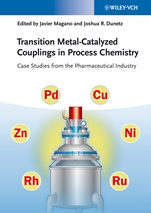
Transition Metal–Catalyzed Couplings in Process Chemistry: Case Studies From the Pharmaceutical Industry
ISBN 9783527332793
Autor: Javier Magano, Joshua R. Dunetz
Wydawca: Wiley
Dostępność: 3-6 tygodni
Cena: 784,35 zł
Przed złożeniem zamówienia prosimy o kontakt mailowy celem potwierdzenia ceny.
ISBN13: |
9783527332793 |
ISBN10: |
3527332790 |
Autor: |
Javier Magano, Joshua R. Dunetz |
Oprawa: |
Hardback |
Rok Wydania: |
2013-09-04 |
Ilość stron: |
401 |
Wymiary: |
246x177 |
Tematy: |
PN |
Transition metal–catalyzed coupling reactions have a rich history that led to the awarding of the 2010 Nobel Prize in Chemistry to Professors Suzuki, Heck, and Negishi for their pioneering contributions to the field. The coming of age of this active area of research is showcased in this book through case studies in which process chemists from the pharmaceutical industry share their experiences developing transition metal–catalyzed couplings for the large–scale manufacture of active pharmaceutical ingredients. Authors from Pfizer, Merck, Boehringer–Ingelheim, Novartis, Amgen, GSK, AstraZeneca, and other companies describe the evolution of robust coupling processes from inception through early and late development, including commercial routes where applicable. The book covers a wide range of coupling transformations while capturing the lessons learned from each process. Every case study details at least one transition metal–catalyzed coupling while elaborating on issues such as design of experiments, scalability and throughput, product purification, process safety, and waste management. The important issue of metal removal and the different technologies available to accomplish this goal are also addressed. Finally, a section covers novel technologies for cross–coupling with high potential for future applications on a large scale, such as microwave and flow chemistry as well as green cross–couplings performed in water.
Case study with Heck/Suzuki chemistry Case study with Buchwald–Hartwig amination Case study with Suzuki coupling Case study with Ullmann–type chemistry use of nanocatalysts in cross–coupling reactions Case study on Negishi and Suzuki couplings Transition metal–catalyzed cross–coupling reactions under microwave and flow chemistry conditions Case study on Sonogashira coupling Case study on Tsuji–Trost allylation Case studies on cyanation, Buchwald–Hartwig amination Case study on Buchwald–Hartwig amination Case study on Kumada coupling
Javier Magano was born in Madrid, Spain. He received a B.S. in organic chemistry from Complutense University in Madrid in 1987 and a M.Sc. degree in chemistry from the University of Michigan in 1990. After working for the oil industry in Spain for several years, he obtained a M.Sc. degree in rubber and polymer science at the Center for Advanced Scientific Research in Madrid. After moving back to the United States, he joined the early process chemistry group at Pfizer in 1998 in Ann Arbor, MI, where he spent nine years developing scalable processes for the preparation of drug candidates. In 2007, he moved to Groton, CT to continue his work as a process chemist and, during this period, he has also worked in the area of biologics for 1.5 years on the preparation of linkers for bioconjugation processes. Javier currently holds a position in the Chemical Technology group at Pfizer, where he is involved in the applications of high–throughput screening to transition metal–catalyzed couplings. His research interests also include the development of catalytic processes that employ non–precious metals in coupling reactions. Joshua R. Dunetz graduated from Haverford College in 2000 with a B.A. in Chemistry after undergraduate research with Professor Karin Åkerfeldt. He received his Ph.D. in Organic Chemistry from MIT in 2005 under the guidance of Professor Rick Danheiser, and then completed postdoctoral studies with Professor William Roush at Scripps Florida. In early 2008, Joshua assumed his current position with Pfizer Chemical R&D in which he develops processes for the GMP manufacture of small molecules on gram to multikilogram scale.
Koszyk
Książek w koszyku: 0 szt.
Wartość zakupów: 0,00 zł
Informacje


Kontakt
Gambit
Centrum Oprogramowania
i Szkoleń Sp. z o.o.
Al. Pokoju 29b/22-24
31-564 Kraków
Siedziba Księgarni
ul. Kordylewskiego 1
31-542 Kraków
+48 12 410 5991
+48 12 410 5987
+48 12 410 5989
Subskrypcje
Administratorem danych osobowych jest firma Gambit COiS Sp. z o.o. Na podany adres będzie wysyłany wyłącznie biuletyn informacyjny.
Autoryzacja płatności

Informacje na temat autoryzacji płatności poprzez PayU.

© Copyright 2012: GAMBIT COiS Sp. z o.o. Wszelkie prawa zastrzeżone.
Projekt i wykonanie: Alchemia Studio Reklamy