


Wydawcy
Katalog tematyczny
- Archeologia (109)
- Ekonomia, finanse, business (13704)
- Filozofia (1445)
- Historia (3040)
- Języki i językoznawstwo (2356)
- Lifestyle, hobby i rozrywka (475)
- Medycyna (9704)
- Nauki humanistyczne (4)
- Nauki o Ziemi i środowisku (2638)
- Nauki ścisłe (20412)
- Astronomia (294)
- Biologia (5119)
- Chemia (6540)
- Chemia analityczna (361)
- Chemia fizyczna (346)
- Chemia nieorganiczna (137)
- Chemia organiczna (535)
- Krystalografia (27)
- Minerologia (46)
- Fizyka (3309)
- Matematyka (4574)
- Nauki ścisłe, ogólnie (503)
- Nauki społeczne (8486)
- Nauki techniczne (13450)
- Prawo (1696)
- Publikacje informacyjne i interdyscyplinarne (1288)
- Religia i wierzenia (917)
- Technika komputerowa (4067)
- Zdrowie, relacje międzyludzkie i rozwój osobisty (657)





Informacje szczegółowe o książce
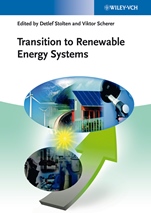
Transition to Renewable Energy Systems
ISBN 9783527332397
Autor: Detlef Stolten, Viktor Scherer
Wydawca: Wiley
Dostępność: 3-6 tygodni
Cena: 1 341,90 zł
Przed złożeniem zamówienia prosimy o kontakt mailowy celem potwierdzenia ceny.
ISBN13: |
9783527332397 |
ISBN10: |
3527332391 |
Autor: |
Detlef Stolten, Viktor Scherer |
Oprawa: |
Hardback |
Rok Wydania: |
2013-06-12 |
Ilość stron: |
1008 |
Wymiary: |
244x176 |
Tematy: |
PN |
In the wake of global climate change and increasing geopolitical instability of oil supply an accelerated Transition to Renewable Energy System gets increasingly important, if not unavoidable. This book encompasses reports of select energy strategies as well as in–depth technical information of the already or potentially involved technologies. On the one hand, it compiles the description of technologies that already proved to be game changers of the energy supply in some countries, i.e. solar, wind, biomass and hydro power, with a strong focus on data, facts and figures that are needed to design a renewable energy system for a region or a country. On the other hand, this book compiles many more technologies that bear the potential to become game changes in some regions or countries, like maritime power technologies or geothermal energy. The focus on the whole energy system involves particular consideration of storage technologies for the fluctuating renewable energy input as well as an overview on energy transportation as electrical or chemical energy. Also the end–use of the renewable energy is considered if the energy system is affected, like in automotive transportation via battery or fuel cell vehicles. Postulating climate change as a major driver for renewable energies, the articles of the book are written assuming the time–line of 2050 for a major CO2 reduction in order to fulfill the UN global warming goal of 2°C. Hence, technologies that have a potential to leave the research stage by 2030 are considered since further ten years are required for industrial development and market penetration each. The book provides specific insights for energy engineers, process engineers, chemists, and physicists, as well as a sufficiently broad scope to be able to understand the challenges, opportunities and implications of a transition to renewable energy systems so, that strategies can be cast.
Foreword V Preface XXIX List of Contributors XXXI Part I Renewable Strategies 1 1 South Korea’s Green Energy Strategies 3 Deokyu Hwang, Suhyeon Han, and Changmo Sung 2 Japan’s Energy Policy After the 3.11 Natural and Nuclear Disasters – from the Viewpoint of the R&D of Renewable Energy and Its Current State 13 Hirohisa Uchida 3 The Impact of Renewable Energy Development on Energy and CO2 Emissions in China 29 Xiliang Zhang, Tianyu Qi and Valerie Karplus 4 The Scottish Government’s Electricity Generation Policy Statement 47 Colin Imrie 5 Transition to Renewables as a Challenge for the Industry – the German Energiewende from an Industry Perspective 67 Carsten Rolle, Dennis Rendschmidt 6 The Decreasing Market Value of Variable Renewables: Integration Options and Deadlocks 75 Lion Hirth and Falko Ueckerdt 7 Transition to a Fully Sustainable Global Energy System 93 Yvonne Y. Deng, Kornelis Blok, Kees van der Leun, and Carsten Petersdorff 8 The Transition to Renewable Energy Systems – On the Way to a Comprehensive Transition Concept 119 Uwe Schneidewind, Karoline Augenstein, and Hanna Scheck 9 Renewable Energy Future for the Developing World 137 Dieter Holm 10 An Innovative Concept for Large–Scale Concentrating Solar Thermal Power Plants 159 Ulrich Hueck 11 Status of Fuel Cell Electric Vehicle Development and Deployment : Hyundai’s Fuel Cell Electric Vehicle Development as a Best Practice Example 183 Tae Won Lim 12 Hydrogen as an Enabler for Renewable Energies 195 Detlef Stolten, Bernd Emonts, Thomas Grube, and Michael Weber 13 Pre–Investigation of Hydrogen Technologies at Large Scales for Electric Grid Load Balancing 217 Fernando Gutiérrez–Martín Part II Power Production 241 14 Onshore Wind Energy 243 Po Wen Cheng 15 Offshore Wind Power 265 David Infield 16 Towards Photovoltaic Technology on the Terawatt Scale: Status and Challenges 283 Bernd Rech, Sebastian S. Schmidt, and Rutger Schlatmann 17 Solar Thermal Power Production 307 Robert Pitz–Paal, Reiner Buck, Peter Heller, Tobias Hirsch, and Wolf–Dieter Steinmann 18 Geothermal Power 339 Christopher J. Bromley and Michael A. Mongillo 19 Catalyzing Growth: an Overview of the United Kingdom’s Burgeoning Marine Energy Industry 351 David Krohn 20 Hydropower 381 Ånund Killingtveit 21 The Future Role of Fossil Power Plants – Design and Implementation 403 Erland Christensen and Franz Bauer Part III Gas Production 423 22 Status on Technologies for Hydrogen Production by Water Electrolysis 425 Jürgen Mergel, Marcelo Carmo, and David Fritz 23 Hydrogen Production by Solar Thermal Methane Reforming 451 Christos Agrafiotis, Henrik von Storch, Martin Roeb, and Christian Sattler Part IV Biomass 483 24 Biomass – Aspects of Global Resources and Political Opportunities 485 Gustav Melin 25 Flexible Power Generation from Biomass – an Opportunity for a Renewable Sources–Based Energy System? 499 Daniela Thrän, Marcus Eichhorn, Alexander Krautz, Subhashree Das, and Nora Szarka 26 Options for Biofuel Production – Status and Perspectives 523 Franziska Müller–Langer, Arne Gröngröft, Stefan Majer, Sinéad O’Keeffe, and Marco Klemm Part V Storage 555 27 Energy Storage Technologies – Characteristics, Comparison, and Synergies 557 Andreas Hauer, Josh Quinnell, and Eberhard Lävemann 28 Advanced Batteries for Electric Vehicles and Energy Storage Systems 579 Seung Mo Oh, Sa Heum Kim, Youngjoon Shin, Dongmin Im, and Jun Ho Song 29 Pumped Storage Hydropower 597 Atle Harby, Julian Sauterleute, Magnus Korpås, Ånund Killingtveit, Eivind Solvang, and Torbjørn Nielsen 30 Chemical Storage of Renewable Electricity via Hydrogen – Principles and Hydrocarbon Fuels as an Example 619 Georg Schaub, Hilko Eilers, and Maria Iglesias González 31 Geological Storage for the Transition from Natural to Hydrogen Gas 629 Jürgen Wackerl, Martin Streibel, Axel Liebscher, and Detlef Stolten 32 Near–Surface Bulk Storage of Hydrogen 659 Vanessa Tietze and Sebastian Luhr 33 Energy Storage Based on Electrochemical Conversion of Ammonia 691 Jürgen Fuhrmann, Marlene Hülsebrock, and Ulrike Krewer Part VI Distribution 707 34 Introduction to Transmission Grid Components 709 Armin Schnettler 35 Introduction to the Transmission Networks 723 Göran Andersson, Thilo Krause, and Wil Kling 36 Smart Grid: Facilitating Cost–Effective Evolution to a Low–Carbon Future 741 Goran Strbac, Marko Aunedi, Danny Pudjianto, and Vladimir Stanojevic 37 Natural Gas Pipeline Systems 773 Gerald Linke 38 Introduction to a Future Hydrogen Infrastructure 795 Joan Ogden 39 Power to Gas 813 Sebastian Schiebahn, Thomas Grube, Martin Robinius, Li Zhao, Alexander Otto, Bhunesh Kumar, Michael Weber, and Detlef Stolten Part VII Applications 849 40 Transition from Petro–Mobility to Electro–Mobility 851 David L. Greene, Changzheng Liu, and Sangsoo Park 41 Nearly Zero, Net Zero, and Plus Energy Buildings – Theory, Terminology, Tools, and Examples 875 Karsten Voss, Eike Musall, Igor Sartori and Roberto Lollini 42 China Road Map for Building Energy Conservation 891 Peng Chen, Yan Da, and Jiang Yi 43 Energy Savings Potentials and Technologies in the Industrial Sector: Europe as an Example 913 Tobias Bossmann, Rainer Elsland, Wolfgang Eichhammer, and Harald Bradke Subject Index 937
Detlef Stolten is the Director of the Institute of Energy Research at the Forschungszentrum Jülich, Germany. Prof. Stolten received his doctorate from the University of Technology at Clausthal, Germany. He served many years as a Research Scientist in the laboratories of Robert Bosch and Daimler Benz/Dornier. In 1998 he accepted the position of Director of the Institute of Materials and Process Technology at the Research Center Jülich. Two years later he became Professor for Fuel Cell Technology at the University of Technology (RWTH) at Aachen. Prof. Stolten’s research focuses on fuel cells, implementing results from research in innovative products, procedures and processes in collaboration with industry, contributing towards bridging the gap between science and technology. His research activities are focused on energy process engineering of SOFC and PEFC systems, i.e. electrochemistry, stack technology, process and systems engineering as well as systems analysis. Prof. Stolten represents Germany in the Executive Committee of the IEA Annex Advanced Fuel Cells and is on the advisory board of the journal Fuel Cells. Viktor Scherer is the Head of the Department of Energy Plant Technology at the University of Bochum, Germany. He received his doctorate from the Karlsruhe Institute of Technolgy (KIT), Germany. Prof. Scherer worked for more than 10 years in the power plant industry for ABB and Alstom. In 2000 he was appointed as a Professor in Energy Plant Technology at the University of Bochum. His research activities are focused on the analysis and description of chemically reacting flow fields in the energy related industry, like power plant, steel and cement industry. Another research aspect is the integration of membranes for carbon capture into Integrated Gasification Combined Cycle (IGCC) power plants. Prof. Scherer is a member of the scientific advisory board of the VGB Power Tech, the European Association of power and heat generation.
Koszyk
Książek w koszyku: 0 szt.
Wartość zakupów: 0,00 zł
Informacje


Kontakt
Gambit
Centrum Oprogramowania
i Szkoleń Sp. z o.o.
Al. Pokoju 29b/22-24
31-564 Kraków
Siedziba Księgarni
ul. Kordylewskiego 1
31-542 Kraków
+48 12 410 5991
+48 12 410 5987
+48 12 410 5989
Subskrypcje
Administratorem danych osobowych jest firma Gambit COiS Sp. z o.o. Na podany adres będzie wysyłany wyłącznie biuletyn informacyjny.
Autoryzacja płatności

Informacje na temat autoryzacji płatności poprzez PayU.

© Copyright 2012: GAMBIT COiS Sp. z o.o. Wszelkie prawa zastrzeżone.
Projekt i wykonanie: Alchemia Studio Reklamy