


Wydawcy
Katalog tematyczny
- Archeologia (109)
- Ekonomia, finanse, business (13704)
- Filozofia (1445)
- Historia (3040)
- Języki i językoznawstwo (2356)
- Lifestyle, hobby i rozrywka (475)
- Medycyna (9704)
- Nauki humanistyczne (4)
- Nauki o Ziemi i środowisku (2638)
- Nauki ścisłe (20412)
- Astronomia (294)
- Biologia (5119)
- Chemia (6540)
- Chemia analityczna (361)
- Chemia fizyczna (346)
- Chemia nieorganiczna (137)
- Chemia organiczna (535)
- Krystalografia (27)
- Minerologia (46)
- Fizyka (3309)
- Matematyka (4574)
- Nauki ścisłe, ogólnie (503)
- Nauki społeczne (8486)
- Nauki techniczne (13450)
- Prawo (1696)
- Publikacje informacyjne i interdyscyplinarne (1288)
- Religia i wierzenia (917)
- Technika komputerowa (4067)
- Zdrowie, relacje międzyludzkie i rozwój osobisty (657)





Informacje szczegółowe o książce
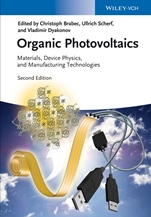
Organic Photovoltaics: Materials, Device Physics, and Manufacturing Technologies
ISBN 9783527332250
Autor: Christoph Brabec, Ullrich Scherf, Vladimir Dyakonov
Wydawca: Wiley
Dostępność: 3-6 tygodni
Cena: 935,55 zł
Przed złożeniem zamówienia prosimy o kontakt mailowy celem potwierdzenia ceny.
ISBN13: |
9783527332250 |
ISBN10: |
3527332251 |
Autor: |
Christoph Brabec, Ullrich Scherf, Vladimir Dyakonov |
Oprawa: |
Hardback |
Rok Wydania: |
2014-04-16 |
Numer Wydania: |
2nd Edition |
Ilość stron: |
642 |
Wymiary: |
249x175 |
Tematy: |
PN |
The versatility of organic photovoltaics is already well known and this completely revised, updated, and enlarged edition of a classic provides an up–to–date overview of this hot topic. The proven structure of the successful first edition, divided into the three key aspects of successful device design: materials, device physics, and manufacturing technologies, has been retained. Important aspects such as printing technologies, substrates, and electrode systems are covered. The result is a balanced, comprehensive text on the fundamentals as well as the latest results in the area that will set R&D trends for years to come. With its combination of both academic and commercial technological views, this is an optimal source of information for scientists, engineers, and graduate students already actively working in this field, and looking for comprehensive summaries on specific topics.
List of Contributors XIII Part One Materials for Thin Film Organic Photovoltaics 1 1 Overview of Polymer and Copolymer Materials for Organic Photovoltaics 3 Solon P. Economopoulos, Grigorios Itskos, Panayiotis A. Koutentis, and Stelios A. Choulis 1.1 Introduction 3 1.2 Early Efforts 4 1.3 Toward Devices with 5% Efficiencies 5 1.4 Novel Thiophene–Containing Polymers 8 1.5 Fluorene–Containing Molecules 11 1.6 Carbazole–Based Copolymers 13 1.7 New Heterocyclic Polymers 15 1.8 Polymers Based on Other Types of Building Blocks 16 1.9 Conclusions 17 References 18 2 Thiophene–Based High–Performance Donor Polymers for Organic Solar Cells 27 Bob C. Schroeder, Raja Shahid Ashraf, and Iain McCulloch 2.1 Introduction 27 2.2 Bandgap Engineering 28 2.3 Charge Generation in Bulk Heterojunction Organic Solar Cells 29 2.4 Polyalkylthiophenes 31 2.4.1 Synthesis 31 2.4.2 Optical and Solid–State Properties 33 2.5 Polyalkylthiophene/PCBM Blends 35 2.6 Polythiophene Copolymers 37 2.7 Side Chain Functionalized P3AT Derivatives 38 2.8 Third–Generation Polythiophenes 39 2.9 Thiophene–Based Push–Pull Copolymers 42 2.10 Benzo[1,2–b:4,5–b0]dithiophene–Based Polymers 44 2.11 Cyclopenta[2,1–b:3,4–b0]dithiophene–Based Polymers 46 2.12 Indacenodithiophene–Based Polymers 50 2.13 Conclusion and Outlook 54 References 55 3 Molecular Design of Conjugated Polymers for High–Efficiency Solar Cells 61 Liqiang Yang, Huaxing Zhou, Andrew C. Stuart, and Wei You 3.1 Introduction 61 3.2 Structural Features of Conjugated Polymers 63 3.3 “D–A” Approach 64 3.3.1 Rational Design of Conjugated Backbones: “Weak Donor–Strong Acceptor” Copolymer 64 3.3.1.1 “Weak Donor” Moieties to Improve VOC 67 3.3.1.2 Balancing VOC and JSC: Interplay of Bandgap and Energy Levels 71 3.3.1.3 From BT to 4DTBT: Why is a “Soluble Acceptor” Better? 72 3.3.1.4 “Strong Acceptor” Moieties to Increase JSC 73 3.3.2 Side Chains Are NOT Trivial 76 3.3.2.1 Chain Positions 76 3.3.2.2 Shape and Size 80 3.3.3 Substituents Do Matter: The Curious Case of Fluorine 83 3.4 Quinoid Approach 88 3.5 Summary and Outlook 91 References 91 4 Solution–Processed Molecular Bulk Heterojunction Solar Cells 95 Jianhua Liu, Bright Walker, and Thuc–Quyen Nguyen 4.1 Introduction 95 4.2 Monochromophoric Molecules 96 4.2.1 Conjugated Macrocycles and Polycycles 96 4.2.2 Acenes and Heteroacenes 98 4.2.3 Oligothiophenes 103 4.3 Multichromophoric Molecules 105 4.3.1 Colorant Chromophore–Containing Derivatives 107 4.3.1.1 Diketopyrrolopyrrole and Isoindigo Derivatives 107 4.3.1.2 Squaraine Derivatives 111 4.3.1.3 Merocyanine and Borondipyrromethene Derivatives 116 4.3.2 Oligothiophene Derivatives 117 4.3.3 Benzothiadiazole Analogue Derivatives 121 4.3.4 Triphenylamine Derivatives 126 4.4 Summary and Future Directions 129 References 133 5 Vacuum–Processed Donor Materials for Organic Photovoltaics 139 Amaresh Mishra and Peter B€auerle 5.1 Introduction 139 5.1.1 Basic Characterization of Organic Solar Cells 140 5.2 Planar and Bulk Heterojunction Solar Cells 142 5.3 Summary and Future Prospects 166 Acknowledgments 167 References 168 6 Polymer–Nanocrystal Hybrid Solar Cells 171 Michael Eck and Michael Krueger 6.1 Introduction 171 6.2 Semiconductor Nanocrystals 172 6.3 Working Principles and Device Structure 177 6.3.1 Donor and Acceptor Materials 181 6.4 Evolution of Polymer–NC Hybrid Solar Cells 184 6.5 Recent Approaches for Overcoming Current Limitations 188 6.5.1 In Situ Synthesis of NCs in the Polymer Film 188 6.5.2 Nanostructured Polymer–Based Assemblies in Solution 189 6.5.3 Lower Bandgap NC Acceptors 191 6.6 Novel Concepts and Perspectives 192 6.6.1 Ternary NC Systems: Energy Level and Bandgap Tuning 192 6.6.2 NC Ligand Design 195 6.6.3 Functionalized Polymers 195 6.6.4 Inorganic Framework for Interdigitated D–A Layers 196 6.6.4.1 Porous Alumina Template–Assisted Approach 197 6.6.4.2 Nanostructured Inorganic Semiconductors as Acceptor Material 198 6.6.5 Nanostructured Polymer 199 6.6.6 Carbon–Based Acceptors and Nanocomposites 199 6.6.7 Less Toxic NC Acceptor Materials 200 6.7 Summary and Outlook 200 Acknowledgments 201 References 201 7 Fullerene–Based Acceptor Materials 209 Alexander B. Sieval and Jan C. Hummelen 7.1 Introduction and Overview 209 7.2 Fullerenes as n–Type Semiconductors 211 7.2.1 Electron–Accepting and Transporting Properties 211 7.2.2 Other Electronic Properties 213 7.3 Fullerene Derivatives 214 7.3.1 [60]PCBM 215 7.3.2 [60]PCBM Analogues 219 7.3.3 Substituents on the Phenyl Moiety of PCBM 221 7.3.3.1 Alkoxy Groups 221 7.3.3.2 Fluorination 222 7.3.3.3 Deuterium Labeling 222 7.3.4 Other C60 Derivatives in OPVs 223 7.4 Derivatives of C70 and C84 226 7.4.1 Derivatives of C70 226 7.4.2 Derivatives of C84 229 7.5 Fullerene Bisadducts 230 7.6 Endohedral Compounds 233 7.7 Commercialization of Fullerene Derivatives 233 References 234 8 Polymeric Acceptor Semiconductors for Organic Solar Cells 239 Antonio Facchetti 8.1 Introduction 239 8.2 Basics Principles and Operation for Organic Solar Cells 241 8.3 Polymeric Acceptor Semiconductors 245 8.3.1 Cyanated Polyphenylenevinylenes 246 8.3.2 Perylene– and Naphthalenediimide–Based Polymers 257 8.3.3 Benzothiadiazole–Based and Other Electron–Poor Polymers 275 8.4 Conclusions and Perspective 293 References 296 9 Water/Alcohol–Soluble Conjugated Polymer–Based Interlayers for Polymer Solar Cells 301 Fei Huang, Chengmei Zhong, Hongbin Wu, and Yong Cao 9.1 Introduction 301 9.2 The Development of Water/Alcohol–Soluble Conjugated Polymers as Interlayer Materials 302 9.3 Interface Engineering for Polymer Solar Cells 305 9.3.1 Interface Modification for Metal Electrodes 306 9.3.2 Interface Modification for Metal Oxide Electrodes 308 9.3.3 Interface Modification for Graphene and Carbon Nanotube Electrodes 311 9.4 Discussion of the Working Mechanism 311 9.5 Summary 315 References 316 10 Metal Oxide Interlayers for Polymer Solar Cells 319 Kevin M. O’Malley, Hin–Lap Yip, and Alex K.–Y. Jen 10.1 Introduction 319 10.2 Conventional Structure 320 10.2.1 Hole–Selective Layer: Replacing PEDOT:PSS 320 10.2.1.1 Nickel Oxide 322 10.2.1.2 Vanadium, Molybdenum, and Tungsten Oxides 324 10.2.2 Electron–Selective Layer 326 10.2.2.1 Titanium and Zinc Oxides 326 10.3 Inverted Structure 329 10.3.1 Electron–Selective Layer: Reducing the Effects of Cathode Oxidation 329 10.3.1.1 Titanium, Zinc, and Cesium Oxides 331 10.3.1.2 Modification via Molecular Self–Assembly 332 10.4 Tandem Structure 333 10.5 Additional Oxides (Cr2O3, CuOx, PbO) 338 10.6 Conclusions 339 References 339 Part Two Device Physics of Thin Film Organic Photovoltaics 343 11 Bimolecular and Trap–Assisted Recombination in Organic Bulk Heterojunction Solar Cells 345 Gert–Jan A.H. Wetzelaer, L. Jan Anton Koster, and Paul W.M. Blom 11.1 Introduction 345 11.2 Recombination at Open Circuit 348 11.3 Trap–Assisted Recombination at Open Circuit 351 11.4 Investigation of the Nature Recombination by Electroluminescence Measurements 353 11.5 Bimolecular Recombination Strength in Organic BHJ Solar Cells 358 11.6 Bimolecular Recombination Losses Under Short–Circuit Conditions 366 11.7 Effect of Bimolecular Recombination on Fill Factor and Efficiency 372 11.8 Conclusions 373 References 373 12 Organic Photovoltaic Morphology 377 Brian A. Collins, Felicia A. Bokel, and Dean M. DeLongchamp 12.1 Introduction 377 12.2 Order in Bulk Heterojunctions 378 12.2.1 Optical Measurements of Order 378 12.2.2 X–Ray Measurement of Crystallinity 381 12.3 Nanoscale Morphology in Bulk Heterojunctions 385 12.3.1 Electron Microscopy 385 12.3.2 Small–Angle Scattering Measurements 388 12.4 Phases in a Bulk Heterojunction 390 12.5 Structure of the Interface between Phases 392 12.5.1 Inferences from Bulk Measurements 395 12.5.2 Surface–Sensitive Measurements 395 12.5.3 Measuring Buried Bilayer Interfaces 396 12.5.4 Measuring Buried Bulk Interfaces 401 12.6 In Situ Measurements of Morphology Development 403 12.6.1 In Situ X–Ray Measurements 403 12.6.2 In Situ Microscopy 407 12.6.3 In Situ Optical and Vibrational Spectroscopies 408 12.6.4 In Operando Measurements 412 12.6.5 The Future of In Situ Measurement 413 References 413 13 Intercalation in Polymer:Fullerene Blends 421 Nichole Cates Miller, Eric T. Hoke, and Michael D. McGehee 13.1 Introduction 421 13.2 Methods for Detecting Molecular Mixing 423 13.2.1 X–Ray Diffraction 423 13.2.2 Photoluminescence Measurements 424 13.2.3 Diffusion Measurements 425 13.2.4 Transmission Electron Microscopy Techniques 427 13.2.5 Small–Angle Scattering Techniques 427 13.3 Factors Affecting Molecular Mixing 428 13.3.1 Fullerene Size 428 13.3.2 Side–Chain Attachment Distance 430 13.3.3 Side–Chain Linearity 430 13.3.4 Thermal Treatments 432 13.4 The Effect of Molecular Mixing on Electronic Properties and Solar Cells 433 13.4.1 Exciton Harvesting 434 13.4.2 Geminate Pair Separation, Charge Extraction, and Optimal Blend Ratio 436 13.4.3 Additional Device Implications 439 13.5 Conclusions 440 References 441 14 Organic Tandem Solar Cells 445 Konstantin Glaser, Andreas P€utz, Jan Mescher, Daniel Bahro, and Alexander Colsmann 14.1 Introduction and Working Principle 445 14.2 Measurement Techniques 448 14.3 Efficient Intermediate Charge Carrier Recombination 450 14.4 Light Management 452 14.5 Choice of Materials 457 14.6 Parallel Tandem Architectures 458 14.7 New Tandem Solar Cell Concepts 459 14.8 Conclusions 460 Acknowledgments 460 References 461 15 Solid–State Dye–Sensitized Solar Cells 465 Jonas Weickert and Lukas Schmidt–Mende 15.1 Introduction 465 15.2 Working Principles of Solid–State Dye–Sensitized Solar Cells 467 15.2.1 Solar Cell Geometries 467 15.2.2 Light Absorption and Charge Separation 471 15.2.3 Charge Transport 475 15.3 Loss Mechanisms in Solid–State Dye–Sensitized Solar Cells 478 15.4 Solid–State Dye–Sensitized Solar Cells with Spiro–OMeTAD as Hole Conductor 483 15.5 Hybrid Solar Cells with Absorbing Hole Conductors 484 15.6 Ordered Nanostructures for Solid–State Dye–Sensitized Solar Cells 486 15.6.1 TiO2 Nanowires 487 15.6.2 TiO2 Nanotubes 488 15.7 Summary and Outlook 489 References 490 Part Three Technology for Thin Film Organic PV 495 16 Reel–to–Reel Processing of Highly Conductive Metal Oxides 497 Matthias Fahland 16.1 Introduction 497 16.2 Materials 499 16.3 Deposition Technology 501 16.4 Equipment 503 16.4.1 Vacuum System 504 16.4.2 Winding System 505 16.4.3 Inline Measurement System 506 16.5 Alternative Approaches 507 References 510 17 Flexible Substrate Requirements for Organic Photovoltaics 513 William A. MacDonald and Julian M. Mace 17.1 Introduction 513 17.2 Polyester Substrates 514 17.3 Properties of Base Substrates 516 17.3.1 Optical Properties 516 17.3.2 Thermal Properties 517 17.3.3 Solvent Resistance 520 17.3.4 Surface Quality 523 17.3.5 Mechanical Properties 524 17.3.6 Hydrolysis Resistance 526 17.3.7 UV Stability 527 17.3.8 Barrier 531 17.3.9 Conductive Coated Film 535 17.3.10 Adhesion 535 17.4 Concluding Remarks 536 Acknowledgments 537 References 537 18 Adhesives for Organic Photovoltaic Packaging 539 Markus Rojahn, Marion Schmidt, and Kilian Kreul 18.1 Introduction 539 18.2 Encapsulation Process for Organic Photovoltaics 540 18.2.1 Basic Process Information 540 18.2.2 Lamination Process Examples 542 18.2.2.1 Radiation–only Curing Process 542 18.2.2.2 Dual Curing Process 544 18.3 Chemistry Aspects of Barrier Adhesives 545 18.3.1 Radically Light Curing Adhesives 545 18.3.2 Cationically Curing Adhesives 549 18.4 Barrier Performance of OPV Adhesives 554 18.4.1 The Intrinsic Barrier Performance of OPV Barrier Adhesives 554 18.4.2 Adhesion of the OPV Barrier Adhesives to the Interfaces 556 18.5 Conclusions 558 References 558 19 Roll–to–Roll Processing of Polymer Solar Cells 561 Dechan Angmo, Markus H€osel, and Frederik C. Krebs 19.1 Introduction 561 19.2 The Roll–to–Roll Process 562 19.3 Structure of Modules 564 19.4 Coating and Printing Techniques for PSC Materials 565 19.4.1 Slot Die Coating 565 19.4.1.1 Novel Slot Die Techniques for Use in PSCs 568 19.4.2 Gravure Printing 568 19.4.3 Knife–Over–Edge 572 19.4.4 Flexographic Printing 573 19.4.5 Screen Printing 574 19.4.6 Inkjet Printing 576 19.4.7 Offset Lithography 578 19.5 Roll–to–Roll Printing of Electrodes 579 19.6 R2R Encapsulation 580 19.7 Roll–to–Roll Characterization 581 19.8 Future and Outlook 582 References 584 20 Current and Future Directions in Organic Photovoltaics 587 Giovanni Nisato and Jens Hauch 20.1 Scientific and Technological Aspects 590 20.2 Commercial Applications 592 20.3 Challenges and Major Hurdles 595 Acknowledgments 597 References 597 Index 599
Christoph J. Brabec is full professor at the University of Erlangen–Nürnberg, Germany. His research is focused on materials for electronics and energy technology. After completing his Ph.D. in 1995, he joined the group of Prof Alan Heeger at the University of Santa Barbara, USA, for a sabbatical in 1996, and continued to work on the opto–electronic properties of organic semiconductors as assistant professor at the University of Linz with Prof. Serdar Sariciftci. In 1998, he became senior scientist of the Christian Doppler Laboratory on organic solar cells, which he left in 2001 to join Siemens Corporate Technology as project leader for organic semiconductor devices. In 2004 he became director of the polymer photovoltaics programme at Konarka Technologies. He finished his habilitation in physical chemistry at the Johannes Kepler University of Linz in 2003, and is author and co–author of more than 140 papers and has filed over 30 patents. He is co–chair of the editorial board of the new journal "Advanced Energy Materials" of Wiley–VCH. Vladimir Dyakonov is full professor of experimental physics at the University of Würzburg, Germany, and scientific director of the Bavarian Centre of Applied Energy Research (ZAE Bayern) in Würzburg. He obtained his diploma degree in physics from the University of Saint Petersburg, his Ph.D. from the A. F. Ioffe–Institute in Russia and his habilitation degree from the University of Oldenburg, Germany in 1986, 1996 and 2001, respectively. From 1996 to 1998, he worked as post–doctoral fellow at the universities of Antwerp, Belgium, and Linz, Austria. Ullrich Scherf is full professor for Macromolecular Chemistry at Bergische Universität Wuppertal, Germany, and director of the interdisciplinary research cluster "Institute for Polymer Technology". He studied chemistry at Friedrich–Schiller–Universität Jena, Germany, obtaining his Ph.D. in 1988 and subsequently spent one postdoctoral year with Heinz Penzlin, Saxonian Academy of Sciences, Jena. He joined the Klaus Müllen group at Max Planck Institute for Polymer Research in Mainz in 1990 and completed his habilitation in 1996 on polyarylene–type ladder polymers. Ullrich Scherf was Professor for Polymer Chemistry at Potsdam University (2000–02) and, since 2002, Professor for Macromolecular Chemistry at Wuppertal University. He has authored or co–authored >500 refereed journal papers.
Koszyk
Książek w koszyku: 0 szt.
Wartość zakupów: 0,00 zł
Informacje


Kontakt
Gambit
Centrum Oprogramowania
i Szkoleń Sp. z o.o.
Al. Pokoju 29b/22-24
31-564 Kraków
Siedziba Księgarni
ul. Kordylewskiego 1
31-542 Kraków
+48 12 410 5991
+48 12 410 5987
+48 12 410 5989
Subskrypcje
Administratorem danych osobowych jest firma Gambit COiS Sp. z o.o. Na podany adres będzie wysyłany wyłącznie biuletyn informacyjny.
Autoryzacja płatności

Informacje na temat autoryzacji płatności poprzez PayU.

© Copyright 2012: GAMBIT COiS Sp. z o.o. Wszelkie prawa zastrzeżone.
Projekt i wykonanie: Alchemia Studio Reklamy