


Wydawcy
Katalog tematyczny
- Archeologia (109)
- Ekonomia, finanse, business (13704)
- Filozofia (1445)
- Historia (3040)
- Języki i językoznawstwo (2356)
- Lifestyle, hobby i rozrywka (475)
- Medycyna (9704)
- Nauki humanistyczne (4)
- Nauki o Ziemi i środowisku (2638)
- Nauki ścisłe (20412)
- Astronomia (294)
- Biologia (5119)
- Chemia (6540)
- Chemia analityczna (361)
- Chemia fizyczna (346)
- Chemia nieorganiczna (137)
- Chemia organiczna (535)
- Krystalografia (27)
- Minerologia (46)
- Fizyka (3309)
- Matematyka (4574)
- Nauki ścisłe, ogólnie (503)
- Nauki społeczne (8486)
- Nauki techniczne (13450)
- Prawo (1696)
- Publikacje informacyjne i interdyscyplinarne (1288)
- Religia i wierzenia (917)
- Technika komputerowa (4067)
- Zdrowie, relacje międzyludzkie i rozwój osobisty (657)





Informacje szczegółowe o książce
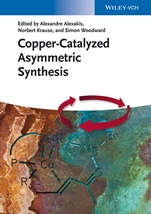
Copper–Catalyzed Asymmetric Synthesis
ISBN 9783527332045
Autor: Alexandre Alexakis, Norbert Krause, Simon Woodward
Wydawca: Wiley
Dostępność: 3-6 tygodni
Cena: 801,15 zł
Przed złożeniem zamówienia prosimy o kontakt mailowy celem potwierdzenia ceny.
ISBN13: |
9783527332045 |
ISBN10: |
3527332049 |
Autor: |
Alexandre Alexakis, Norbert Krause, Simon Woodward |
Oprawa: |
Hardback |
Rok Wydania: |
2014-01-22 |
Ilość stron: |
472 |
Wymiary: |
249x172 |
Tematy: |
PN |
This book reflects the increasing interest among the chemical synthetic community in the area of asymmetric copper–catalyzed reactions, and introduces readers to the latest, most significant developments in the field. The contents are organized according to reaction type and cover mechanistic and spectroscopic aspects as well as applications in the synthesis of natural products. A whole chapter is devoted to understanding how primary organometallics interact with copper to provide selective catalysts for allylic substitution and conjugate addition, both of which are treated in separate chapters. Another is devoted to the variety of substrates and experimental protocols, while an entire chapter covers the use on non–carbon nucleophiles. Other chapters deal with less–known reactions, such as carbometallation or the additions to imines and related systems, while the more established reactions cyclopropanation and aziridination as well as the use of copper (II) Lewis acids are warranted their own special chapters. Two further chapters concern the processes involved, as determined by mechanistic studies. Finally, a whole chapter is devoted to the synthetic applications. This is essential reading for researchers at academic institutions and professionals at pharmaceutical or agrochemical companies.
List of Contributors XIII Introduction 1 Alexandre Alexakis, Norbert Krause, and Simon Woodward 1 The Primary Organometallic in Copper–Catalyzed Reactions 3 Simon Woodward 1.1 Scope and Introduction 3 1.2 Terminal Organometallics Sources Available 4 1.3 Coordination Motifs in Asymmetric Copper Chemistry 5 1.4 Asymmetric Organolithium–Copper Reagents 11 1.5 Asymmetric Grignard–Copper Reagents 13 1.6 Asymmetric Organozinc–Copper Reagents 16 1.7 Asymmetric Organoboron–Copper Reagents 20 1.8 Asymmetric Organoaluminium–Copper Reagents 23 1.9 Asymmetric Silane and Stannane Copper–Promoted Reagents 25 1.10 Conclusions 28 2 Copper–Catalyzed Asymmetric Conjugate Addition 33 Alexandre Alexakis, Norbert Krause, and Simon Woodward 2.1 Introduction 33 2.2 Conjugate Addition 35 2.3 Trapping of Enolates 57 3 Copper–Catalyzed Asymmetric Conjugate Addition and Allylic Substitution of Organometallic Reagents to Extended Multiple–Bond Systems 69 Matthieu Tissot, Hailing Li, and Alexandre Alexakis 3.1 Introduction 69 3.2 Copper–Catalyzed Asymmetric Conjugate Addition (ACA) to Polyconjugated Michael Acceptors 69 3.3 Copper–Catalyzed Asymmetric Allylic Substitution on Extended Multiple–Bond Systems 80 3.4 Conclusion 83 4 Asymmetric Allylic Alkylation 85 Olivier Basle, Audrey Denicourt–Nowicki, Christophe Crevisy, and Marc Mauduit 4.1 Introduction 85 4.2 Nucleophiles in Enantioselective Process Development 87 4.3 Functionalized Substrates 101 4.4 Desymmetrization of meso–Allylic Substrates 112 4.5 Kinetic Resolution Processes 115 4.6 Direct Enantioconvergent Transformation 117 4.7 Conclusion and Perspectives 118 5 Ring Opening of Epoxides and Related Systems 127 Mauro Pineschi 5.1 Introduction 127 5.2 Copper–Catalyzed Asymmetric Ring Opening of Epoxides with Amines 128 5.3 Copper–Catalyzed Asymmetric Ring Opening of Epoxides and Aziridines with Organometallic Reagents 132 5.4 Copper–Catalyzed Asymmetric Ring Opening of Heterobicyclic Systems with Organometallic Reagents 147 5.5 Conclusions 151 6 Carbon–Boron and Carbon–Silicon Bond Formation 157 Masaya Sawamura and Hajime Ito 6.1 Introduction 157 6.2 C–B Bond Formation Reactions 157 6.3 C–Si Bond Formation Reactions 172 6.4 Summary 175 7 CuH in Asymmetric Reductions 179 Bruce H. Lipshutz 7.1 Introduction 179 7.2 Asymmetric Conjugate Reductions 182 7.3 Asymmetric 1,2–Additions 189 7.4 Heterogeneous Catalysis 196 7.5 Conclusions and Perspective 199 8 Asymmetric Cyclopropanation and Aziridination Reactions 203 Andre B. Charette, Helene Lebel, and Marie–Noelle Roy 8.1 Introduction 203 8.2 Asymmetric Cyclopropanation 203 8.3 Asymmetric Aziridination 219 8.4 Conclusion 234 References 234 9 Copper–Catalyzed Asymmetric Addition Reaction of Imines 239 Kiyoshi Tomioka, Ken–ichi Yamada, and Yasutomo Yamamoto 9.1 Introduction 239 9.2 Copper–Catalyzed Asymmetric Addition Reaction of Dialkylzinc to Imines 241 9.3 Copper–Catalyzed Asymmetric Allylation, Arylation, and Alkynylation Reactions of Imines 249 9.4 Copper as a Lewis Acid Catalyst for Asymmetric Reaction of Imines 255 9.5 Conclusions 259 10 Carbometallation Reactions 267 Dorian Didier and Ilan Marek 10.1 Introduction 267 10.2 Carbometallation of Cyclopropenes 269 10.3 Carbometallation of Alkynes 274 10.4 Summary 279 11 Chiral Copper Lewis Acids in Asymmetric Transformations 283 Shinya Adachi, Ramkumar Moorthy, and Mukund P. Sibi 11.1 Introduction 283 11.2 Cycloadditions 283 11.3 Claisen Rearrangements 298 11.4 Ene Reactions 299 11.5 Nucleophilic Addition to C=O and C=N Double Bonds 300 11.6 Conjugate Additions 307 11.7 α–Functionalization of Carbonyl Compounds 315 11.8 Kinetic Resolution 318 11.9 Asymmetric Desymmetrization 319 11.10 Free–Radical Reactions 320 11.11 Conclusions 321 12 Mechanistic Aspects of Copper–Catalyzed Reactions 325 Per–Fredrik Larsson, Per–Ola Norrby, and Simon Woodward 12.1 Introduction 325 12.2 Conjugate Addition 325 12.3 Allylic Alkylation and Substitution 327 12.4 Copper as Lewis Acid 333 12.5 1,2–Addition to Imines and Carbonyls 340 12.6 Copper Hydride 342 12.7 Cyclopropanation, Aziridination, and Allylic Oxidation 343 13 NMR Spectroscopic Aspects 353 Felicitas von Rekowski, Carina Koch, and Ruth M. Gschwind 13.1 Introduction 353 13.2 Copper Complexes with Phosphoramidite Ligands 355 13.3 Copper Complexes with TADDOL–Based Thiolate Ligands 361 13.4 Copper Complexes with Ferrocenyl–Based Ligands 363 13.5 Conclusion 370 14 Applications to the Synthesis of Natural Products 373 Beatriz C. Calvo, Jeffrey Buter, and Adriaan J. Minnaard 14.1 Introduction 373 14.2 Copper–Catalyzed Conjugate Additions in Natural Product Synthesis 373 14.3 Natural Product Synthesis Employing Asymmetric Allylic Alkylation 392 14.4 Asymmetric Copper–Catalyzed Diels–Alder Reactions 402 14.5 Asymmetric Copper–Catalyzed Mukaiyama Aldol Reactions 406 14.6 Other Asymmetric Copper–Catalyzed Aldol–Type Reactions 408 14.7 Asymmetric 1,3–Dipolar Cycloaddition and Claisen Rearrangement 410 14.8 Catalytic Asymmetric Cyclopropanation 416 14.9 Asymmetric Copper–Catalyzed Conjugate Reductions 422 14.10 Copper–Catalyzed Asymmetric 1,2–Type Addition Reactions 426 14.11 Miscellaneous Asymmetric Copper–Catalyzed Reactions 427 14.12 Conclusion 438 References 441 Index 449
Alexandre Alexakis is Professor of Organic Chemistry at the University of Geneva, Switzerland. He received his PhD from Paris VI University in 1975, and following a two–year postdoc at Johns Hopkins University, Baltimore, USA, joined the CNRS at Pierre et Marie Curie University, where he was appointed Head of Research in 1985. In 1996 he became a full professor at Pierre et Marie Curie University, before moving to the University of Geneva in 1998. Professor Alexakis is a recipient of the Silver Medal of the CNRS, as well as the Novartis Lectureship Award, and has authored 300 articles. His research focuses on asymmetric synthesis and methodologies, using both metal catalysts, particularly copper reagents, and non–metallic catalysts. Norbert Krause received his PhD from the Technical University of Braunschweig, Germany, in 1986. After postdoctoral stays at the ETH Zürich and Yale University, he joined TU Darmstadt where he obtained his lecturing qualification in 1993. The following year he moved to the Uni–versity of Bonn as an associate professor, before taking up his present position as a full professor at Dortmund University of Technology in 1998. He has been a fellow of the Japan Society for the Promotion of Science, a guest professor at the Université Catholique de Louvain, Belgium, the University of California, Santa Barbara, USA, and at the École Supérieure de Physique et de Chimie Industrielles de la Ville de Paris, France. Professor Krause has been on the editorial board of the European Journal of Organic Chemistry between 2006 and 2013. His research focuses on the stereoselective synthesis and transfor–mation of functionalized allenes, taking advantage of coinage metal catalysis. Simon Woodward is a professor in synthetic organic chemistry at Nottingham University, UK, and has authored over 120 publications in the areas of organic methodology, organo–metallic chemistry, and selective/ asymmetric catalysis. He has been Director of both The European Ligand Bank and an International Marie Curie PhD School in Catalysis of Organic Reactions incorporating the universities of Nottingham, Geneva, Sassari, and Dortmund. Professor Woodward also chaired the European Cooperation in Science and Technology Action D40 in Innovative Catalysis and is a member of related Action CM0903 in Biomass Utilisation. His research group is greatly enhanced by extensive collaboration with over 20 other groups, involved in the selective catalysis of organic reactions, throughout Europe and beyond.
Koszyk
Książek w koszyku: 0 szt.
Wartość zakupów: 0,00 zł
Informacje


Kontakt
Gambit
Centrum Oprogramowania
i Szkoleń Sp. z o.o.
Al. Pokoju 29b/22-24
31-564 Kraków
Siedziba Księgarni
ul. Kordylewskiego 1
31-542 Kraków
+48 12 410 5991
+48 12 410 5987
+48 12 410 5989
Subskrypcje
Administratorem danych osobowych jest firma Gambit COiS Sp. z o.o. Na podany adres będzie wysyłany wyłącznie biuletyn informacyjny.
Autoryzacja płatności

Informacje na temat autoryzacji płatności poprzez PayU.

© Copyright 2012: GAMBIT COiS Sp. z o.o. Wszelkie prawa zastrzeżone.
Projekt i wykonanie: Alchemia Studio Reklamy