


Wydawcy
Katalog tematyczny
- Archeologia (109)
- Ekonomia, finanse, business (13704)
- Filozofia (1445)
- Historia (3040)
- Języki i językoznawstwo (2356)
- Lifestyle, hobby i rozrywka (475)
- Medycyna (9704)
- Nauki humanistyczne (4)
- Nauki o Ziemi i środowisku (2638)
- Nauki ścisłe (20412)
- Astronomia (294)
- Biologia (5119)
- Chemia (6540)
- Chemia analityczna (361)
- Chemia fizyczna (346)
- Chemia nieorganiczna (137)
- Chemia organiczna (535)
- Krystalografia (27)
- Minerologia (46)
- Fizyka (3309)
- Matematyka (4574)
- Nauki ścisłe, ogólnie (503)
- Nauki społeczne (8486)
- Nauki techniczne (13450)
- Prawo (1696)
- Publikacje informacyjne i interdyscyplinarne (1288)
- Religia i wierzenia (917)
- Technika komputerowa (4067)
- Zdrowie, relacje międzyludzkie i rozwój osobisty (657)





Informacje szczegółowe o książce
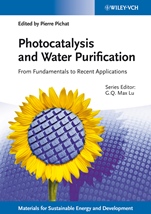
Photocatalysis and Water Purification: From Fundamentals to Recent Applications
ISBN 9783527331871
Autor: Max Lu, Pierre Pichat
Wydawca: Wiley
Dostępność: 3-6 tygodni
Cena: 746,55 zł
Przed złożeniem zamówienia prosimy o kontakt mailowy celem potwierdzenia ceny.
ISBN13: |
9783527331871 |
ISBN10: |
3527331875 |
Autor: |
Max Lu, Pierre Pichat |
Oprawa: |
Hardback |
Rok Wydania: |
2013-03-13 |
Ilość stron: |
438 |
Wymiary: |
253x172 |
Tematy: |
PN |
W ater is one of the essential resources on our planet. Therefore, fresh water and the recycling of waste–water are very important topics in various areas. Energy–saving green technologies are a demand in this area of research. Photocatalysis comprises a class of reactions which use a catalyst activated by light. These reactions include the decomposition of organic compounds into environmental friendly water and carbon dioxide, leading to interesting properties of surfaces covered with a photocatalyst: they protect e.g. against incrustation of fouling matter, they are self–cleaning, antibacterial and viricidal. Therefore, they are attractive candidates for environmental applications such as water purification and waste–water treatment. This book introduces scientists and engineers to the fundamentals of photocatalysis and enlightens the potentials of photocatalysis to increase water quality. Also, strategies to improve the photocatalytic efficacy are pointed out: synthesis of better photocatalysts, combination of photocatalysis with other technologies, and the proper design of photocatalytic reactors. Implementation of applications and a chapter on design approaches for photocatalytic reactors round off the book. “Photocatalysis and Water Purification” is part of the series on Materials for Sustainable Energy and Development edited by Prof. G.Q. Max Lu. The series covers advances in materials science and innovation for renewable energy, clean use of fossil energy, and greenhouse gas mitigation and associated environmental technologies.
Series Editor Preface XVII Preface XIX About the Series Editor XXIII About the Volume Editor XXV List of Contributors XXVII Part I Fundamentals: Active Species, Mechanisms, Reaction Pathways 1 1 Identification and Roles of the Active Species Generated on Various Photocatalysts 3 Yoshio Nosaka and Atsuko Y. Nosaka 1.1 Key Species in Photocatalytic Reactions 3 1.2 Trapped Electron and Hole 6 1.3 Superoxide Radical and Hydrogen Peroxide (O•−2 and H2O2) 7 1.4 Hydroxyl Radical (OH•) 9 1.5 Singlet Molecular Oxygen (1O2) 12 1.6 Reaction Mechanisms for Bare TiO2 15 1.7 Reaction Mechanisms of Visible–Light–Responsive Photocatalysts 17 1.8 Conclusion 20 References 21 2 Photocatalytic Reaction Pathways – Effects of Molecular Structure, Catalyst, and Wavelength 25 William S. Jenks 2.1 Introduction 25 2.2 Methods for Pathway Determination 27 2.3 Prototypical Oxidative Reactivity in Photocatalytic Degradations 29 2.3.1 Oxidation of Arenes and the Importance of Adsorption 30 2.3.1.1 Hydroxylation and the Source of Oxygen 30 2.3.1.2 Ring–Opening Reactions 32 2.3.1.3 Indicators of SET versus Hydroxyl Chemistry in Aromatic Systems 32 2.3.2 Carboxylic Acids 35 2.3.3 Alcohol Fragmentation and Oxidation 36 2.3.4 Oxidation of Alkyl Substituents 37 2.3.5 Apparent Hydrolysis Reactions 38 2.3.6 Sulfur–Bearing Compounds 39 2.4 Prototypical Reductive Reactivity in Photocatalytic Degradations 39 2.5 The Use of Organic Molecules as Test Probes for Next–Generation Photocatalysts 41 2.6 Modified Catalysts: Wavelength–Dependent Chemistry of Organic Probes 42 2.7 Conclusions 44 References 45 3 Photocatalytic Mechanisms and Reaction Pathways Drawn from Kinetic and Probe Molecules 53 Claudio Minero, Valter Maurino, and Davide Vione 3.1 The Photocatalyic Rate 53 3.1.1 Other Kinetic Models 55 3.1.2 Substrate–Mediated Recombination 57 3.2 Surface Speciation 60 3.2.1 Different Commercial Catalysts 60 3.2.2 Surface Manipulation 61 3.2.3 Crystal Faces 62 3.2.4 Surface Traps for Holes 64 3.3 Multisite Kinetic Model 65 3.4 Conclusion 68 References 68 Part II Improving the Photocatalytic Efficacy 73 4 Design and Development of Active Titania and Related Photocatalysts 75 Bunsho Ohtani 4.1 Introduction – a Thermodynamic Aspect of Photocatalysis 75 4.2 Photocatalytic Activity: Reexamination 77 4.3 Design of Active Photocatalysts 78 4.4 A Conventional Kinetics in Photocatalysis: First–Order Kinetics 79 4.5 A Conventional Kinetics in Photocatalysis: Langmuir–Hinshelwood Mechanism 80 4.6 Topics and Problems Related to Particle Size of Photocatalysts 82 4.7 Recombination of a Photoexcited Electron and a Positive Hole 85 4.8 Evaluation of Crystallinity as a Property Affecting Photocatalytic Activity 86 4.9 Electron Traps as a Possible Candidate of a Recombination Center 87 4.10 Donor Levels – a Meaning of n–Type Semiconductor 89 4.11 Dependence of Photocatalytic Activities on Physical and Structural Properties 90 4.11.1 Correlation between Physical Properties and Photocatalytic Activities 90 4.11.2 Statistical Analysis of Correlation between Physical Properties and Photocatalytic Activities – a Trial 92 4.11.3 Common Features of Titania Particles with Higher Photocatalytic Activity 94 4.11.4 Highly Active Mesoscopic Anatase Particles of Polyhedral Shape 95 4.12 Synergetic Effect 96 4.13 Doping 97 4.14 Conclusive Remarks 98 Acknowledgments 99 References 99 5 Modified Photocatalysts 103 Nurit Shaham–Waldmann and Yaron Paz 5.1 Why Modifying? 103 5.2 Forms of Modification 104 5.3 Modified Physicochemical Properties 106 5.3.1 Crystallinity and Phase Stability 106 5.3.2 Surface Morphology, Surface Area, and Adsorption 107 5.3.3 Adsorption of Oxygen 111 5.3.4 Concentration of Surface OH 111 5.3.5 Specificity 112 5.3.5.1 TiO2 Surface Overcoating 115 5.3.5.2 Composites Comprised of TiO2 and Metallic Nanoislands 116 5.3.5.3 Doping with Metal Ions and Oxides 116 5.3.5.4 Utilizing the ‘‘Adsorb and Shuttle’’ Mechanism to Obtain Specificity 117 5.3.5.5 Mesoporous Materials 119 5.3.5.6 Molecular Imprinting 120 5.3.6 Products’ Control 122 5.3.6.1 Surface Modification by Molecular Imprinting 123 5.3.6.2 Composites Comprised of TiO2 and Metallic Nanoislands 124 5.3.6.3 Doping with Metal Ions 124 5.3.6.4 Nonmetallic Composite 125 5.3.6.5 TiO2 Morphology and Crystalline Phase 125 5.3.7 Reducing Deactivation 125 5.3.8 Recombination Rates and Charge Separation 126 5.3.8.1 Structure Modification 127 5.3.8.2 Composites–Metal Islands 127 5.3.8.3 Composites Comprising Carbonaceous Materials 128 5.3.8.4 Composites Composed of TiO2 and Nonoxide Semiconductors 128 5.3.8.5 Composites Composed of TiO2 and Other Oxides 129 5.3.8.6 Doping with Metals 131 5.3.8.7 Doping with Nonmetals 132 5.3.9 Visible Light Activity 132 5.3.10 Charging–Discharging 132 5.3.11 Mass Transfer 133 5.3.12 Facilitating Photocatalysis in Deaerated Suspensions 134 Summary 134 References 134 6 Immobilization of a Semiconductor Photocatalyst on Solid Supports: Methods, Materials, and Applications 145 Didier Robert, Val´erie Keller, and Nicolas Keller 6.1 Introduction 145 6.2 Immobilization Techniques 147 6.3 Supports 152 6.3.1 Packed–Bed Photocatalytic Materials 153 6.3.2 Monolithic Photocatalytic Materials 155 6.3.3 Optical Fibers 164 6.4 Laboratory and Industrial Applications of Supported Photocatalysts 168 6.5 Conclusion 171 References 172 7 Wastewater Treatment Using Highly Functional Immobilized TiO2 Thin–Film Photocatalysts 179 Masaya Matsuoka, Takashi Toyao, Yu Horiuchi, Masato Takeuchi, and Masakazu Anpo 7.1 Introduction 179 7.2 Application of a Cascade Falling–Film Photoreactor (CFFP) for the Remediation of Polluted Water and Air under Solar Light Irradiation 180 7.3 Application of TiO2 Thin–Film–Coated Fibers for the Remediation of Polluted Water 184 7.4 Application of TiO2 Thin Film for Photofuel Cells (PFC) 186 7.5 Preparation of Visible–Light–Responsive TiO2 Thin Films and Their Application to the Remediation of Polluted Water 187 7.5.1 Visible–Light–Responsive TiO2 Thin Films Prepared by Cation or Anion Doping 188 7.5.2 Visible–Light–Responsive TiO2 Thin Films Prepared by the Magnetron Sputtering Deposition Method 190 7.6 Conclusions 195 References 195 8 Sensitization of Titania Semiconductor: A Promising Strategy to Utilize Visible Light 199 Zhaohui Wang, Chuncheng Chen, Wanhong Ma, and Jincai Zhao 8.1 Introduction 199 8.2 Principle of Photosensitization 200 8.3 Dye Sensitization 201 8.3.1 Fundamentals of Dye Sensitization 202 8.3.1.1 Geometry and Electronic Structure of Interface 202 8.3.1.2 Excited–State Redox Properties of Dyes 203 8.3.1.3 Electron Transfer from Dyes to TiO2 205 8.3.2 Application of Dye Sensitization 208 8.3.2.1 Nonregenerative Dye Sensitization 208 8.3.2.2 Regenerative Dye Sensitization 211 8.4 Polymer Sensitization 213 8.4.1 Carbon Nitride Polymer 213 8.4.2 Conducting Polymers 214 8.5 Surface–Complex–Mediated Sensitization 214 8.5.1 Organic Ligand 215 8.5.2 Inorganic Ligand 217 8.6 Solid Semiconductor/Metal Sensitization 218 8.6.1 Small–Band–Gap Semiconductor 219 8.6.1.1 Basic Concepts 219 8.6.1.2 Category in Terms of Charge Transfer Process 219 8.6.2 Plasmonic Metal 222 8.6.2.1 Basic Concepts 222 8.6.2.2 Proposed Mechanisms 224 8.6.2.3 Critical Parameters 225 8.7 Other Strategies to Make Titania Visible Light Active 226 8.7.1 Band Gap Engineering 226 8.7.1.1 Metal Doping 226 8.7.1.2 Nonmetal Doping 227 8.7.1.3 Codoping 227 8.7.2 Structure/Surface Engineering 228 8.8 Conclusions 230 Acknowledgment 231 References 231 9 Photoelectrocatalysis for Water Purification 241 Rossano Amadelli and Luca Samiolo 9.1 Introduction 241 9.2 Photoeffects at Semiconductor Interfaces 242 9.3 Water Depollution at Photoelectrodes 245 9.3.1 Morphology and Microstructure 245 9.3.2 Effect of Applied Potential 247 9.3.3 Effect of pH 247 9.3.4 Effect of Oxygen 248 9.3.5 Electrolyte Composition 249 9.4 Photoelectrode Materials 249 9.4.1 Titanium Dioxide 249 9.4.1.1 Cation Doping 250 9.4.1.2 Nonmetal Doping 250 9.4.2 Other Semiconductor Photoelectrodes 251 9.4.2.1 Zinc Oxide and Iron Oxide 251 9.4.2.2 Tungsten Trioxide 251 9.4.2.3 Bismuth Vanadate 251 9.4.3 Coupled Semiconductors 251 9.4.3.1 n–n Heterojunctions 253 9.4.3.2 p–n Heterojunctions 254 9.5 Electrodes Preparation and Reactors 255 9.6 Conclusions 256 References 257 Part III Effects of Photocatalysis on Natural Organic Matter and Bacteria 271 10 Photocatalysis of Natural Organic Matter in Water: Characterization and Treatment Integration 273 Sanly Liu, May Lim and Rose Amal 10.1 Introduction 273 10.2 Monitoring Techniques 274 10.2.1 Total Organic Carbon 275 10.2.2 UV–vis Spectroscopy 275 10.2.3 Fluorescence Spectroscopy 277 10.2.4 Molecular Size Fractionation 278 10.2.5 Resin Fractionation 280 10.2.6 Infrared Spectroscopy 280 10.3 By–products from the Photocatalytic Oxidation of NOM and its Resultant Disinfection By–Products (DBPs) 281 10.4 Hybrid Photocatalysis Technologies for the Treatment of NOM 284 10.5 Conclusions 287 References 289 11 Waterborne Escherichia coli Inactivation by TiO2 Photoassisted Processes: a Brief Overview 295 Juli´an Andr´es Rengifo–Herrera, Angela Giovana Rinc´on, and Cesar Pulgarin 11.1 Introduction 295 11.2 Physicochemical Aspects Affecting the Photocatalytic E. coli Inactivation 296 11.2.1 Effect of Bulk Physicochemical Parameters 296 11.2.1.1 Effect of TiO2 Concentration and Light Intensity 296 11.2.1.2 Simultaneous Presence of Anions and Organic Matter 297 11.2.1.3 pH Influence 298 11.2.1.4 Oxygen Concentration 298 11.2.2 Physicochemical Characteristics of TiO2 299 11.3 Using of N–Doped TiO2 in Photocatalytic Inactivation of Waterborne Microorganisms 299 11.4 Biological Aspects 302 11.4.1 Initial Bacterial Concentration 302 11.4.2 Physiological State of Bacteria 302 11.5 Proposed Mechanisms Suggested for Bacteria Abatement by Heterogeneous TiO2 Photocatalysis 303 11.5.1 Effect of UV–A Light Alone and TiO2 in the Dark 303 11.5.2 Cell Inactivation by Irradiated TiO2 Nanoparticles 304 11.6 Conclusion 304 References 305 Part IV Modeling. Reactors. Pilot plants 311 12 Photocatalytic Treatment of Water: Irradiance Influences 313 David Ollis 12.1 Introduction 313 12.1.1 Chapter Topics 313 12.1.2 Photon Utilization Efficiency 313 12.2 Reaction Order in Irradiance: Influence of Electron–Hole Recombination and the High Irradiance Penalty 314 12.3 Langmuir–Hinshelwood (LH) Kinetic Form: Equilibrated Adsorption 315 12.4 Pseudo–Steady–State Analysis: Nonequilibrated Adsorption 317 12.5 Mass Transfer and Diffusion Influences at Steady Conditions 321 12.6 Controlled Periodic Illumination: Attempt to Beat Recombination 323 12.7 Solar–Driven Photocatalysis: Nearly Constant nUV Irradiance 324 12.8 Mechanism of Hydroxyl Radical Attack: Same Irradiance Dependence 326 12.9 Simultaneous Homogeneous and Heterogeneous Photochemistry 327 12.10 Dye–Photosensitized Auto–Oxidation 328 12.11 Interplay between Fluid Residence Times and Irradiance Profiles 329 12.11.1 Batch Reactors 329 12.11.2 Flow Reactors 329 12.12 Quantum Yield, Photonic Efficiency, and Electrical Energy per Order 331 12.13 Conclusions 332 References 332 13 A Methodology for Modeling Slurry Photocatalytic Reactors for Degradation of an Organic Pollutant in Water 335 Orlando M. Alfano, Alberto E. Cassano, Rodolfo J. Brandi, and Mar´ýia L. Satuf 13.1 Introduction and Scope 335 13.2 Evaluation of the Optical Properties of Aqueous TiO2 Suspensions 337 13.2.1 Spectrophotometric Measurements of TiO2 Suspensions 338 13.2.2 Radiation Field in the Spectrophotometer Sample Cell 339 13.2.3 Parameter Estimation 341 13.3 Radiation Model 342 13.3.1 Experimental Set Up and Procedure 343 13.3.2 Radiation Field Inside the Photoreactor 344 13.4 Quantum Efficiencies of 4–Chlorophenol Photocatalytic Degradation 346 13.4.1 Calculation of the Quantum Efficiency 346 13.4.2 Experimental Results 347 13.5 Kinetic Modeling of the Pollutant Photocatalytic Degradation 348 13.5.1 Mass Balances 348 13.5.2 Kinetic Model 349 13.5.3 Kinetic Parameters Estimation 350 13.6 Bench–Scale Slurry Photocatalytic Reactor for Degradation of 4–Chlorophenol 352 13.6.1 Experiments 352 13.6.2 Reactor Model 352 13.6.2.1 Radiation Model 352 13.6.2.2 Reaction Rates 354 13.6.2.3 Mass Balances in the Tank and Reactor 354 13.6.3 Results 355 13.7 Conclusions 356 Acknowledgments 357 References 357 14 Design and Optimization of Photocatalytic Water Purification Reactors 361 Tsuyoshi Ochiai and Akira Fujishima 14.1 Introduction 361 14.1.1 Market Transition of Industries Related to Photocatalysis 361 14.1.2 Historical Overview 361 14.2 Catalyst Immobilization Strategy 363 14.2.1 Aqueous Suspension 363 14.2.2 Immobilization of TiO2 Particles onto Solid Supports 365 14.3 Synergistic Effects of Photocatalysis and Other Methods 366 14.3.1 Deposition of Metallic Nanoparticles onto TiO2 Surface for Disinfection 366 14.3.2 Combination with Advanced Oxidation Processes (AOPs) 367 14.4 Effective Design of Photocatalytic Reactor System 369 14.4.1 Two Main Strategies for the Effective Reactors 369 14.4.2 Design of Total System 371 14.5 Future Directions and Concluding Remarks 372 Acknowledgments 373 References 373 15 Solar Photocatalytic Pilot Plants: Commercially Available Reactors 377 Sixto Malato, Pilar Fern´andez–Ib´a˜nez, Maneil Ignacio Maldonado, Isabel Oller, and Maria Inmaculada Polo–L´opez 15.1 Introduction 377 15.2 Compound Parabolic Concentrators 379 15.3 Technical Issues: Reflective Surface and Photoreactor 382 15.4 Suspended or Supported Photocatalyst 386 15.5 Solar Photocatalytic Treatment Plants 388 15.6 Specific Issues Related with Solar Photocatalytic Disinfection 390 15.7 Conclusions 394 Acknowledgments 395 References 395 Index 399
Professor Pierre Pichat is first class Research Director at the French National Center for Scientific Research (CNRS) in Lyon. He has been active in heterogeneous photocatalysis for more than three decades, and founded the laboratory of "Photocatalyse, Catalyse et Environment" at the Ecole Centrale de Lyon. He has published a great number of research papers and several review articles dealing with photocatalytic reactions and materials. At the "9th International Conference on TiO2 photocatalysis: fundamentals and applications", held in 2004 in San Diego, he received an Appreciation Award acknowledging his pioneering contributions; this award has been conferred to only three scientists in 20 years.
Koszyk
Książek w koszyku: 0 szt.
Wartość zakupów: 0,00 zł
Informacje


Kontakt
Gambit
Centrum Oprogramowania
i Szkoleń Sp. z o.o.
Al. Pokoju 29b/22-24
31-564 Kraków
Siedziba Księgarni
ul. Kordylewskiego 1
31-542 Kraków
+48 12 410 5991
+48 12 410 5987
+48 12 410 5989
Subskrypcje
Administratorem danych osobowych jest firma Gambit COiS Sp. z o.o. Na podany adres będzie wysyłany wyłącznie biuletyn informacyjny.
Autoryzacja płatności

Informacje na temat autoryzacji płatności poprzez PayU.

© Copyright 2012: GAMBIT COiS Sp. z o.o. Wszelkie prawa zastrzeżone.
Projekt i wykonanie: Alchemia Studio Reklamy