


Wydawcy
Katalog tematyczny
- Archeologia (109)
- Ekonomia, finanse, business (13704)
- Filozofia (1445)
- Historia (3040)
- Języki i językoznawstwo (2356)
- Lifestyle, hobby i rozrywka (475)
- Medycyna (9704)
- Nauki humanistyczne (4)
- Nauki o Ziemi i środowisku (2638)
- Nauki ścisłe (20412)
- Astronomia (294)
- Biologia (5119)
- Chemia (6540)
- Chemia analityczna (361)
- Chemia fizyczna (346)
- Chemia nieorganiczna (137)
- Chemia organiczna (535)
- Krystalografia (27)
- Minerologia (46)
- Fizyka (3309)
- Matematyka (4574)
- Nauki ścisłe, ogólnie (503)
- Nauki społeczne (8486)
- Nauki techniczne (13450)
- Prawo (1696)
- Publikacje informacyjne i interdyscyplinarne (1288)
- Religia i wierzenia (917)
- Technika komputerowa (4067)
- Zdrowie, relacje międzyludzkie i rozwój osobisty (657)





Informacje szczegółowe o książce
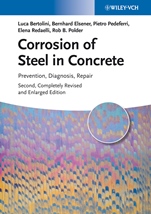
Corrosion of Steel in Concrete: Prevention, Diagnosis, Repair
ISBN 9783527331468
Autor: Luca Bertolini, Bernhard Elsener, Pietro Pedeferri, Elena Redaelli, Rob B. Polder
Wydawca: Wiley
Dostępność: 3-6 tygodni
Cena: 801,15 zł
Przed złożeniem zamówienia prosimy o kontakt mailowy celem potwierdzenia ceny.
ISBN13: |
9783527331468 |
ISBN10: |
3527331468 |
Autor: |
Luca Bertolini, Bernhard Elsener, Pietro Pedeferri, Elena Redaelli, Rob B. Polder |
Oprawa: |
Hardback |
Rok Wydania: |
2013-04-23 |
Numer Wydania: |
2nd Edition |
Ilość stron: |
434 |
Wymiary: |
246x177 |
Tematy: |
PN |
Steel–reinforced concrete is used ubiquitously as a building material due to its unique combination of the high compressive strength of concrete and the high tensile strength of steel. Therefore, reinforced concrete is an ideal composite material that is used for a wide range of applications in structural engineering such as buildings, bridges, tunnels, harbor quays, foundations, tanks and pipes. To ensure durability of these structures, however, measures must be taken to prevent, diagnose and, if necessary, repair damage to the material especially due to corrosion of the steel reinforcement. The book examines the different aspects of corrosion of steel in concrete, starting from basic and essential mechanisms of the phenomenon, moving up to practical consequences for designers, contractors and owners both for new and existing reinforced and prestressed concrete structures. It covers general aspects of corrosion and protection of reinforcement, forms of attack in the presence of carbonation and chlorides, problems of hydrogen embrittlement as well as techniques of diagnosis, monitoring and repair. This second edition updates the contents with recent findings on the different topics considered and bibliographic references, with particular attention to recent European standards. This book is a self–contained treatment for civil and construction engineers, material scientists, advanced students and architects concerned with the design and maintenance of reinforced concrete structures. Readers will benefit from the knowledge, tools, and methods needed to understand corrosion in reinforced concrete and how to prevent it or keep it within acceptable limits.
Preface to the Second Edition XV Preface to the First Edition XVII 1 Cements and Cement Paste 1 1.1 Portland Cement and Hydration Reactions 1 1.2 Porosity and Transport Processes 3 1.3 Blended Cements 8 1.4 Common Cements 13 1.5 Other Types of Cement 15 2 Transport Processes in Concrete 21 2.1 Composition of Pore Solution and Water Content 22 2.2 Diffusion 27 2.3 Capillary Suction 32 2.4 Permeation 33 2.5 Migration 35 2.6 Mechanisms and Significant Parameters 40 3 Degradation of Concrete 49 3.1 Freeze–Thaw Attack 50 3.2 Attack by Acids and Pure Water 54 3.3 Sulfate Attack 59 3.4 Alkali Silica Reaction 61 3.5 Attack by Seawater 66 4 General Aspects 71 4.1 Initiation and Propagation of Corrosion 71 4.2 Corrosion Rate 73 4.3 Consequences 74 4.4 Behavior of Other Metals 75 5 Carbonation–Induced Corrosion 79 5.1 Carbonation of Concrete 79 5.2 Initiation Time 85 5.3 Corrosion Rate 87 6 Chloride–Induced Corrosion 93 6.1 Pitting Corrosion 94 6.2 Corrosion Initiation 96 6.3 Corrosion Rate 108 7 Electrochemical Aspects 113 7.1 Electrochemical Mechanism of Corrosion 113 7.2 Noncarbonated Concrete without Chlorides 116 7.3 Carbonated Concrete 120 7.4 Concrete Containing Chlorides 122 7.5 Structures under Cathodic or Anodic Polarization 126 8 Macrocells 129 8.1 Structures Exposed to the Atmosphere 129 8.2 Buried Structures and Immersed Structures 131 8.3 Electrochemical Aspects 134 8.4 Modeling of Macrocells 137 9 Stray–Current–Induced Corrosion 141 9.1 DC Stray Current 142 9.2 AC Stray Current 149 9.3 High–Strength Steel 150 9.4 Fiber–Reinforced Concrete 151 9.5 Inspection 151 9.6 Protection from Stray Current 152 10 Hydrogen–Induced Stress Corrosion Cracking 155 10.1 Stress Corrosion Cracking (SCC) 156 10.2 Failure under Service of High–Strength Steel 157 10.3.1 Susceptibility of Steel to HI–SCC 164 10.4 Environmental Conditions 165 10.5 Hydrogen Generated during Operation 166 10.6 Hydrogen Generated before Ducts Are Filled 169 10.7 Protection of Prestressing Steel 169 11 Design for Durability 171 11.1 Factors Affecting Durability 172 11.2 Approaches to Service–Life Modeling 177 11.3 The Approach of the European Standards 183 11.4 The fib Model Code for Service–Life Design for Chloride–Induced Corrosion 189 11.5 Other Methods 194 11.6 Additional Protection Measures 197 11.7 Costs 198 12 Concrete Technology for Corrosion Prevention 203 12.1 Constituents of Concrete 203 12.2 Properties of Fresh and Hardened Concrete 206 12.3 Requirements for Concrete and Mix Design 212 12.4 Concrete Production 215 12.5 Design Details 219 12.6 Concrete with Special Properties 219 13 Corrosion Inhibitors 227 13.1 Mechanism of Corrosion Inhibitors 228 13.2 Mode of Action of Corrosion Inhibitors 228 13.3 Corrosion Inhibitors to Prevent or Delay Corrosion Initiation 229 13.4 Corrosion Inhibitors to Reduce the Propagation Rate of Corrosion 234 13.5 Transport of the Inhibitor into Mortar or Concrete 236 13.6 Field Tests and Experience with Corrosion Inhibitors 238 13.7 Critical Evaluation of Corrosion Inhibitors 238 13.8 Effectiveness of Corrosion Inhibitors 240 14 Surface Protection Systems 243 14.1 General Remarks 243 14.2 Organic Coatings 245 14.3 Hydrophobic Treatment 251 14.4 Treatments That Block Pores 257 14.5 Cementitious Coatings and Layers 258 14.6 Concluding Remarks on Effectiveness and Durability of Surface 15 Corrosion–Resistant Reinforcement 263 15.1 Steel for Reinforced and Prestressed Concrete 263 15.2 Stainless Steel Rebars 266 15.3 Galvanized Steel Rebars 276 15.4 Epoxy–Coated Rebars 280 16 Inspection and Condition Assessment 287 16.1 Visual Inspection and Cover Depth 288 16.2 Electrochemical Inspection Techniques 291 16.3 Analysis of Concrete 307 17 Monitoring 315 17.1 Introduction 315 17.2 Monitoring with Nonelectrochemical Sensors 316 17.3 Monitoring with Electrochemical Sensors 322 17.4 Critical Factors 324 17.5 On the Way to "Smart Structures" 325 17.6 Structural Health Monitoring 327 18 Principles and Methods for Repair 333 18.1 Approach to Repair 334 18.2 Overview of Repair Methods for Carbonated Structures 339 18.3 Overview of Repair Methods for Chloride–Contaminated Structures 342 18.4 Design, Requirements, Execution and Control of Repair Works 346 19 Conventional Repair 349 19.1 Assessment of the Condition of the Structure 349 19.2 Removal of Concrete 350 19.3 Preparation of Reinforcement 356 19.4 Application of Repair Material 357 19.5 Additional Protection 360 19.6 Strengthening 361 20 Electrochemical Techniques 365 20.1 Development of the Techniques 366 20.2 Effects of the Circulation of Current 369 20.3 Cathodic Protection and Cathodic Prevention 373 20.4 Electrochemical Chloride Extraction and Realkalization 386 References 400 Index 407
Luca Bertolini is Full Professor in the field of materials science and technology at the Polytechnic University of Milan, Italy, where he teaches Construction Materials and Durability of Materials to students of Civil Engineering and Building Engineering Faculties. The scientific activity of Luca Bertolini is focused on the durability of building materials, especially reinforced concrete. Bernhard Elsener is Professor for materials science at the Faculty of Engineering at the University of Cagliari, Italy, and a lecturer at ETH Zurich, Switzerland. He is an internationally well–known expert on the durability of reinforced and prestressed concrete structures. His extensive research work and numerous publications focus on non–destructive methods to detect and quantify corrosion, the use of new electrically isolated post–tensioning tendons and electrochemical restoration techniques. Pietro Pedeferri (1938–2008) , a graduate in chemical engineering and former Professor of Electrochemistry at the University of Bari, has been Professor of Corrosion and Protection of Materials at the Technical University of Milan since 1983. His work has been mainly concerned with the corrosion of steel in concrete, and he has published more than 300 papers and a dozen books in the field of corrosion and materials technology. Elena Redaelli is Assistant Professor in the field of materials science and technology at the Polytechnic University of Milan where she teaches Construction Materials to Building Engineering students. Her main scientific interests are connected with the corrosion of steel in concrete, its characterization and methods to prevent and control it. In particular, her research activity has focused on electrochemical techniques in concrete and methods for durability design of concrete structures. Rob B. Polder is a senior materials scientist at the Netherlands Organization for Applied Scientific Research, and a full professor of materials and durability at Delft University of Technology in the Faculty of Civil Engineering and Geosciences. The main focus of his work is on corrosion of steel in concrete, from modeling and prediction to prevention and remediation, including electrochemical methods.
Koszyk
Książek w koszyku: 0 szt.
Wartość zakupów: 0,00 zł
Informacje


Kontakt
Gambit
Centrum Oprogramowania
i Szkoleń Sp. z o.o.
Al. Pokoju 29b/22-24
31-564 Kraków
Siedziba Księgarni
ul. Kordylewskiego 1
31-542 Kraków
+48 12 410 5991
+48 12 410 5987
+48 12 410 5989
Subskrypcje
Administratorem danych osobowych jest firma Gambit COiS Sp. z o.o. Na podany adres będzie wysyłany wyłącznie biuletyn informacyjny.
Autoryzacja płatności

Informacje na temat autoryzacji płatności poprzez PayU.

© Copyright 2012: GAMBIT COiS Sp. z o.o. Wszelkie prawa zastrzeżone.
Projekt i wykonanie: Alchemia Studio Reklamy